
Executive boards, law firms, private wealth offices, and luxury hospitality brands in Singapore commission custom blind embossing and debossing, letterheads, foil-blocked invitations, and stickers and labels to add three-dimensional tactile relief to their corporate identity. Understanding how male and female metal dies deform paper fibres helps you choose the right stock thickness, relief depth, and card construction.
How does blind embossing differ from debossing and foil-embossing on name cards, stickers, and letterheads?
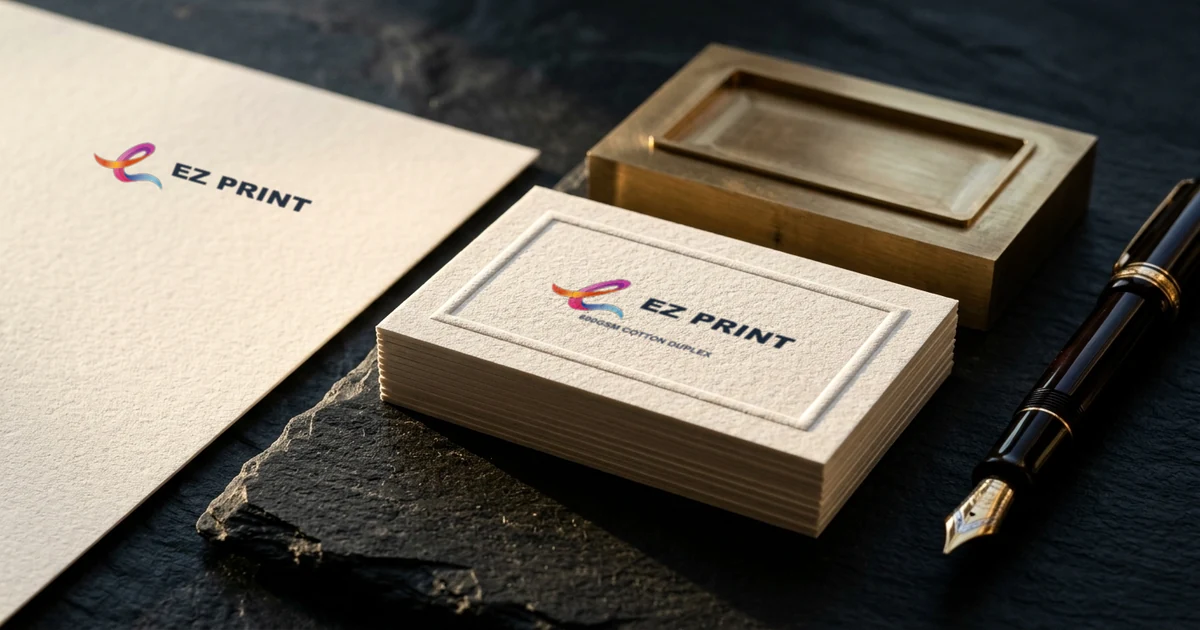
Embossing presses paper or foil label stock between a matched pair of machined brass or magnesium male and female counter-dies to raise the design above the sheet surface, whereas debossing presses a single metal relief plate down into heavy uncoated cotton board to create a sunken indentation.
Because mechanical embossing reshapes the physical paper fibres under high tonnage, every raised elevation on the front of a sheet produces a corresponding recessed mirror cavity on the reverse unless two boards are duplex-laminated back-to-back after stamping. Standard production turnaround is generally 7–14 working days.
| Relief Finishing Method | Die Tooling & Mechanics | Reverse-Side Sheet Appearance | Best Paper & Label Stock Pairing |
|---|---|---|---|
| Blind Embossing (Raised Uninked Relief) | Matched male back counter-die and engraved female front brass or magnesium die | Mirror-image sunken cavity on the back (or smooth back if duplex-mounted after embossing) | 350gsm–400gsm uncoated cotton/fine card, 120gsm cotton letterhead, or 600gsm duplex card |
| Blind Or Inked Debossing (Sunken Relief) | Single-sided raised metal relief die pressed downward into thick compressible stock | Flat unblemished reverse face when pressed into 450gsm to 600gsm cotton cushion board |
450gsm–600gsm 100% cotton letterpress card (such as Gmund Cotton or Crane Lettra) |
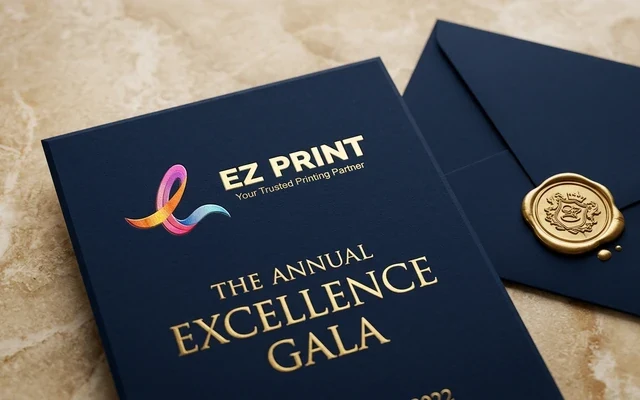
| Combination Foil-Embossing (Registered or Single-Pass) | Sculpted brass combination die applies metallic hot foil and raises the emblem simultaneously | Recessed reverse cavity behind the raised metallic gold, silver, or copper seal | 350gsm matt-laminated or dyed-through navy/black card, and metallic foil certificate seal stickers |
| Embossed Foil Seal & Packaging Sticker | Rotary or flatbed brass embossing die stamps soft dead-soft metallic foil paper or wine-grade label stock | Flat pressure-sensitive adhesive liner ready to peel and apply onto certificates or boxes | Gold/silver metallic foil seal labels, textured laid wine/spirits labels, and award wafers |
Which paper weights and fibre structures hold the crispest embossed relief without cracking?
Long-fibre uncoated cotton and textured fine papers (300gsm to 600gsm for name cards, and 110gsm to 120gsm for corporate letterheads) hold the sharpest, deepest embossed and debossed bevel edges because their supple cellulose and cotton fibres stretch cleanly into the metal die without surface cracking.
Coated art cards that have been sealed in rigid gloss film lamination resist deep stretching; if an embossing die has sharp 90-degree corners or excessive depth, the plastic laminate layer can craze or fracture along the rim. Follow three substrate rules for clean relief work:
- Name Cards (
350gsmSingle Board vs600gsmDuplex Board): On a single350gsmcard, place your embossed crest in a dedicated clear zone so the recessed indentation on the back never collides with reverse-side telephone numbers or addresses. If you want a raised embossed logo on the front and a completely flat reverse side, specify a600gsmduplex card where the front300gsmsheet is embossed first and then laminated back-to-back onto a second300gsmsheet. - Embossed Corporate Letterheads (
100gsm–120gsmCotton or Laid Bond): Position the blind-embossed or foil-embossed corporate crest in the top-left, top-centre, or top-right header margin at least15 mmaway from where office laser printers feed and fuse body text, ensuring the raised relief never causes toner skips. - Embossed Foil Seal Stickers & Labels (
40 mm–55 mmRound or Serrated Wafer): Use malleable metallic gold, silver, or bronze foil paper or uncoated textured wine stock (90gsm–110gsmface stock on permanent adhesive) so the fine heraldic ring and lettering stay permanently raised after peeling and sticking onto a certificate or rigid gift box.
What minimum line weights and letter spacing are required for a brass embossing die?
To allow paper or label stock to flow into the engraved die cavity without puncturing the sheet, keep all embossed strokes at least 0.4 mm (1.1 pt) wide, maintain at least 0.6 mm of open space between adjacent raised letters, and avoid embossing body copy smaller than 10 pt.
Because a brass embossing die requires angled bevel sidewalls (typically 35 to 45 degrees) around every letter and emblem contour to lift the paper smoothly, ultra-fine hairlines or tightly tracked serif script fonts cannot develop enough vertical height to catch side lighting. Bold geometric emblems, monograms, heraldic crests, and tracked-out uppercase wordmarks cast the strongest sculptural shadow across an uninked blind emboss.
How do you supply the 100% K vector die mask in your print-ready PDF?
Supply your embossing or debossing artwork as a 100% solid vector spot-colour layer named Emboss or Deboss set to overprint in exact registration above your CMYK print layer, using crisp closed vector paths with zero raster gradients, feathered edges, drop shadows, or half-tone screen tints.
If your design combines metallic hot-foil stamping with raised embossing (foil-embossing), verify that the vector path for the foil layer and the emboss layer match identically (or include a 0.15 mm foil spread around the bevel rim if recommended by prepress) so the metallic reflection wraps seamlessly over the raised shoulder of the paper. Standard production turnaround is generally 7–14 working days. Upload your vector PDF and stock preferences on our request a quote page for a tooling and production quote.
Frequently asked questions
Will an embossed logo on the front of a 350gsm name card show in reverse on the back?
Yes. Because mechanical embossing presses the paper upward between male and female metal dies, a single-layer 350gsm card will show the recessed mirror impression on the reverse face. To keep the back completely flat, either switch to debossing into a thick 600gsm cotton board or order a 600gsm duplex-mounted card where the front sheet is embossed before the two sheets are bonded together.
Can we run embossed corporate letterheads through a standard office laser printer?
Yes, provided the embossed crest is kept inside the top header zone (top 25 mm to 35 mm of the A4 sheet) and pressed to a moderate relief height on 100gsm to 120gsm laser-compatible uncoated bond or cotton paper. Avoid placing heavy embossing across the middle of the sheet where the laser fuser roller bonds toner.
What is the difference between a single-level brass die and a sculpted multi-level embossing die?
A single-level die raises all vector shapes to one uniform flat plateau height with a clean bevel edge, which is ideal for typography and geometric logos. A CNC-sculpted multi-level brass die carves varying three-dimensional depths and rounded contours into the brass block, making crests, wreaths, and wax-style seal stickers look hand-carved.
Why are embossed stickers printed on metallic foil paper or textured uncoated stock rather than thin vinyl?
Elastic plastic vinyl films have “plastic memory” and tend to flatten back out after being stamped by an embossing die. Dead-soft metallic gold or silver foil paper and heavy cotton/uncoated paper label stocks have zero elastic memory—once the metal counter-die creases the fibre, the raised three-dimensional relief locks in permanently.
Same-day and urgent printing available. Subject to artwork approval, payment, print type and production availability. Timing confirmed per job.