Stickers, and the three layers under the one you see
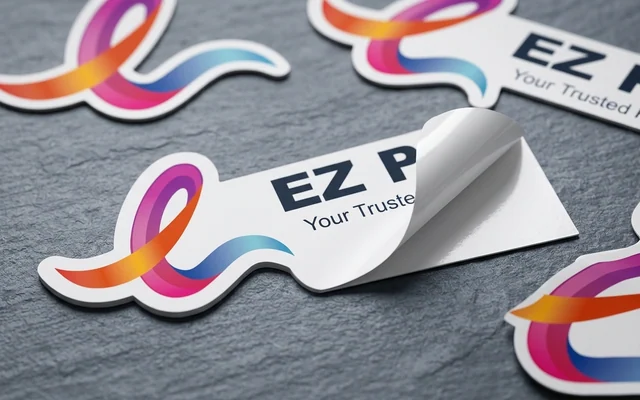
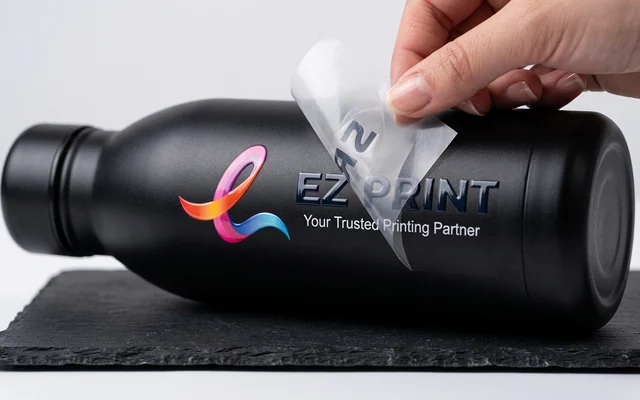
A sticker is a face, an adhesive and a liner. Almost every sticker problem — it lifted, it tore, it left a mark, it will not come off — is a decision made in one of the two layers nobody looks at.
Sticker and label printing in Singapore, in one paragraph
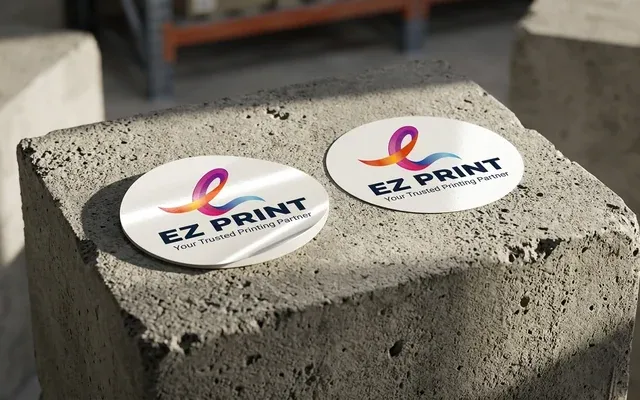
EZ Print prints stickers and product labels in Singapore, and has done since 2017. Faces are paper for indoor and short-life use, and vinyl or synthetic film where the label must survive moisture, refrigeration or handling. Labels are supplied on sheets or on rolls, kiss-cut so the face peels while the liner stays whole, or die-cut through to a free shape. Adhesives are chosen for the surface and the intended life: removable for a promotion, permanent for a product, and low-tack where a surface must be left unmarked. Matt, gloss and soft-touch lamination protect the printed face; a matt laminate is also what makes a label writable. A cutting die or contour path is made once and kept on file, so a reorder does not pay for it again. EZ Print quotes from the specification and does not publish prices.
Products quoted on this page
Specifications, formats and enquiry details for each product quoted on this service.
Face material, adhesive, finished shape, and sheet or roll. Then the one question that decides all four: what surface is it going onto, and for how long. The label below is drawn at true physical size.
Product label · 60 × 40 mm
Bleed line (+2 mm)Actual trim size (60 × 40 mm)Safe zone (3 mm inside trim)
Bleed line (+2 mm)Actual trim size · 60 × 40 mmSafe zone (3 mm)
Batch 04
Keep refrigerated
ezprint.com.sg
Drawn at true size — trim 60 × 40 mm, 2 mm bleed dashed outside the trim, 3 mm safety margin dashed inside it.
3layers
Face, adhesive, liner. The face is the design; the other two are the reason it stays on, or does not, or leaves a mark when it comes off.
Faces
Coated paper, uncoated paper, white vinyl, clear vinyl, and synthetic stock for wet and cold use.
Adhesives
Permanent, removable and low-tack. Chosen for the surface and the intended life.
Cutting
Kiss-cut on the liner, die-cut through, or contour-cut to any closed vector path.
Supply
On A4 or A3 sheets, or on rolls with a stated core and unwind direction.
Sizes
From about 15 × 15 mm to a full A3 sheet. Larger shapes run as vinyl graphics.
Bleed and safe area
2 mm bleed outside the cut line, 3 mm safe margin inside it.
Finishing
Matt, gloss and soft-touch lamination. A matt laminate takes a marker pen.
Turnaround
Standard is 7–14 working days, on a die held or a die cut for the first time. Express is quoted per job.
What to ask for
2,000 product labels, 60 × 40 mm
White vinyl face, permanent adhesive
4C, matt lamination
Kiss-cut on a roll, 76 mm core, unwind outside edge first
Rounded corners, 3 mm radius
Print-ready PDF with the cut path on its own layer
Needed by — your date
The material
Faces, adhesives and liners
The face is what is printed and what is seen; the adhesive decides how long it stays and what it leaves behind; the liner decides whether the label can be applied by hand or by machine. All three are specified, and only the first is visible.
0.13 mmCoating at 8×
Gloss art paper0.13 mm · 157 gsm
Also sold as gloss sticker paper, gloss art label paper or coated label stock. Held at 128 and 157 gsm. This is the estate’s coated art sheet with an adhesive back — not mirrorkote, which is a different sheet and is described below.
A coated paper face. The cheapest option and the right one for anything indoors with a short life.
Anything refrigerated, wet or handled constantly. Paper wicks water at the cut edge.
On the schedule
Held. Printed, laminated, then cut — in that order, always.
0.20 mmCoating at 8×
Synthetic stock0.20 mm · 200 micron
Also sold as synthetic gloss white sticker, sticker gloss, synthetic paper, PP face, OPP sticker or tear-resistant film. The white gloss synthetic is the face most round product labels are cut from.
A plastic face rather than a paper one. It does not absorb water at the cut edge, which is what makes it survive a fridge or a bathroom.
Under ink
Ink sits on the surface, so it wants a laminate over it if the label will be rubbed.
Best for
Food and beverage labels, cosmetics, anything refrigerated or handled wet.
Avoid for
Being recycled with paper packaging.
On the schedule
Held. Ink sits on the surface, so it wants a laminate over it.
White vinyl face
Also sold as white sticker, label sticker, self-adhesive vinyl, PVC label film, and as monomeric or polymeric vinyl by film grade.
A flexible printable film that conforms to a slightly curved surface. The general-purpose sticker material, and the one most die-cut shapes are cut from.
Under ink
Prints densely and takes a laminate well. Unlaminated vinyl scuffs under a fingernail.
Best for
Die-cut logo stickers, equipment labels, bottles and jars.
Avoid for
Deeply textured surfaces — the film bridges the texture and lifts at the edges.
On the schedule
Held. The film most die-cut shapes are cut from.
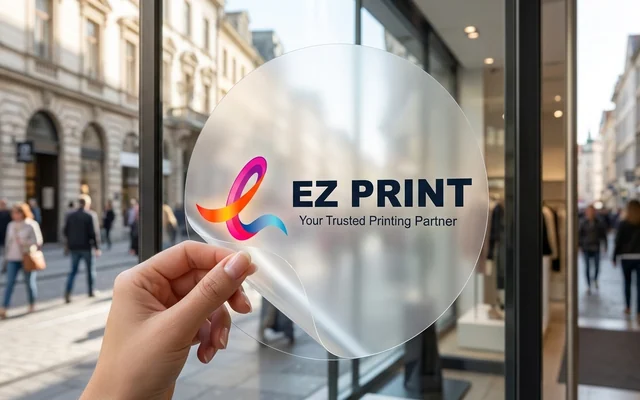
Clear vinyl face
Also sold as transparent sticker, clear label film or no-label-look film. Transparent sticker is the term it is ordered under locally, and it is the same face.
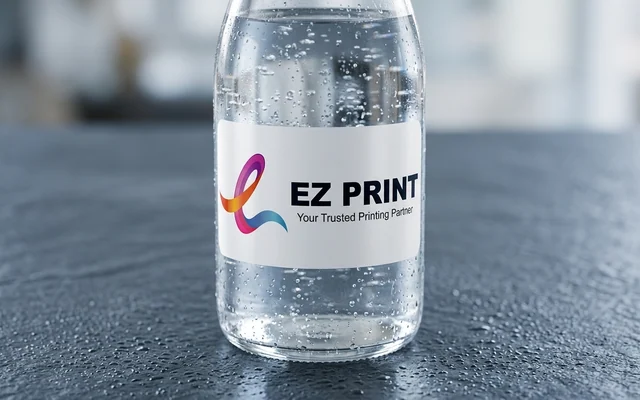
The same film without the white pigment, so whatever is behind it shows through. It is what makes a label on a glass bottle disappear into the product.
Under ink
Needs a white underbase printed behind any colour that must stay opaque, or the colour goes transparent.
Best for
Glass and clear plastic containers, window seals, anything meant to look unlabelled.
Avoid for
Dark surfaces, unless a white underbase is specified.
On the schedule
Held. Needs a white underbase pass behind any opaque colour.
Removable adhesive
Also sold as low-tack, repositionable or peelable adhesive.
An adhesive designed to release cleanly within a stated period. It holds firmly enough for a promotion and comes away without a residue afterwards.
Under ink
No effect on printing. It is a decision about the back of the label, not the front.
Best for
Seasonal promotions, price flashes, anything on rented or finished surfaces.
Avoid for
Anything outdoors or long-term. It will lift at a corner and collect dirt.
On the schedule
No extra pass — it is a material choice, not an operation.
Mirrorkote face
Also sold as mirrorkote sticker, mirror coat, cast-coated label paper, C1S sticker paper.
The face this market orders by name. It is cast-coated — the wet coating is dried against a polished drum rather than blade-levelled — which gives a harder, higher gloss than art paper reaches, and it is coated on ONE side only because the other side is where the adhesive goes. That single-sided construction is why it is a different sheet from the estate’s two-side coated art paper and not a trade name for it.
Under ink
Very high chroma on a very smooth face, and it is the reason a mirrorkote label looks wet next to the same artwork on ordinary coated paper. It scuffs unlaminated.
Best for
Product and promotional labels, packaging seals, anything indoors that has to look glossy off the shelf.
Avoid for
Wet, refrigerated or frequently handled surfaces — the base is still paper and it wicks at the cut edge.
On the schedule
Ordered in by sheet size for the job rather than held, so name the finished label size with the enquiry.
Uncoated paper face
Also sold as simili sticker, simili paper sticker, matt paper label, woodfree label stock.
A plain uncoated white paper face with no coating over it. The cheapest sticker there is, and the one that takes a pen, a rubber stamp or a thermal printer without any laminate over it first.
Under ink
Absorbent, so colour lands softer and flatter than on a coated face. What it loses in chroma it gains in being writable.
Best for
Batch and date labels, internal asset tags, address labels, anything written on after it is applied.
Avoid for
Anything wet, refrigerated or handled often. Uncoated paper marks, scuffs and wicks at the cut edge.
On the schedule
No laminate — a laminate over it would remove the one property it is chosen for.
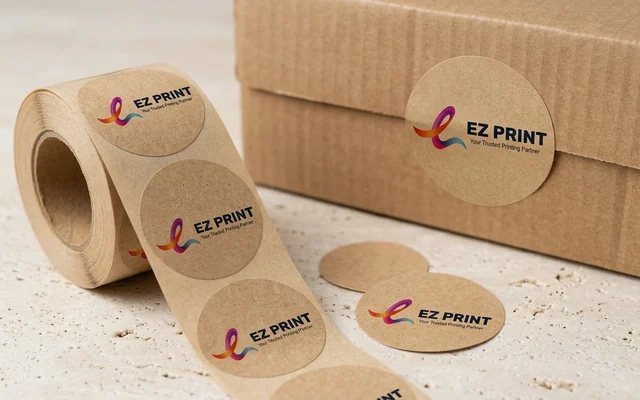
Kraft sticker face
Also sold as kraft label, brown kraft sticker, natural kraft face.
An unbleached brown face with the fibre visible in it. It is the one sticker material whose colour is part of the design rather than something printed over.
Under ink
Every colour prints over brown, not over white, so it goes muted and warm. White does not print at all unless a white underbase is specified.
Best for
Food and craft packaging seals, refill labels, anything whose packaging is already unbleached board.
Avoid for
Photographic artwork, and any brand colour that has to match a reference. It will not.
On the schedule
Held. A white underbase, where the design needs one, is an extra pass.
Metallic foil sticker face
Also sold as foil sticker, silver sticker, gold sticker, metallised label film.
A mirror-finish metallised face. The metal is the material, not an effect added afterwards, so the shine appears wherever no ink covers it.
Under ink
Ink is translucent over metal, which is the point — a yellow over silver reads as gold. Anything that must stay flat and opaque needs a white underbase first.
Best for
Seals, authenticity marks, premium product labels, anything that has to catch a light.
Avoid for
Small text in a light colour. Metal behind type destroys its contrast at reading size.
On the schedule
Held. Plan the underbase at artwork stage, not after proofing.
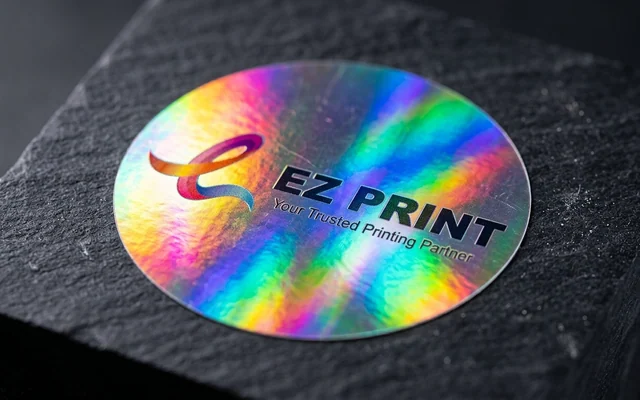
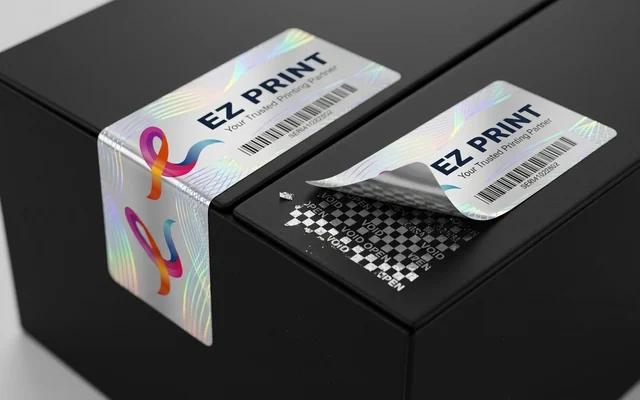
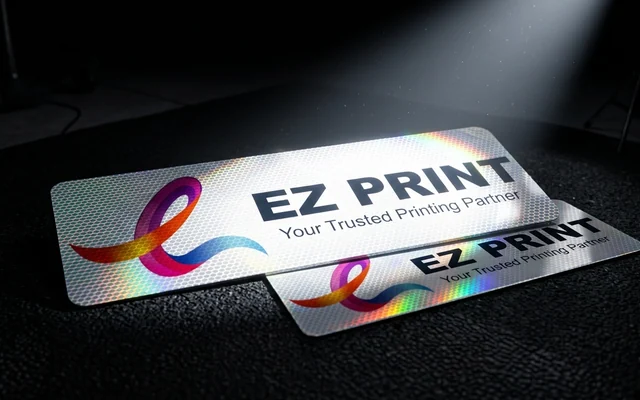
Hologram sticker face
Also sold as holographic sticker, security sticker, tamper-evident label.
A diffraction-patterned metallised face. Ordered for two different reasons that want two different constructions: decoration, or security. A tamper-evident version destroys itself on removal and cannot be reused.
Under ink
The pattern shows through everything printed on it. Treat it as a background with a texture, never as a white sheet.
Best for
Warranty and authenticity seals, ticketing, packaging that must show it was opened.
Avoid for
Anything needing accurate colour. The face shifts hue with the viewing angle, by design.
On the schedule
Specify decoration or tamper-evident with the enquiry — they are different materials.
Name the surface with the enquiry — glass, painted metal, powder-coated steel, corrugated card, a matt-laminated carton — and the adhesive is chosen against it. That single sentence prevents most label failures.The materials library →
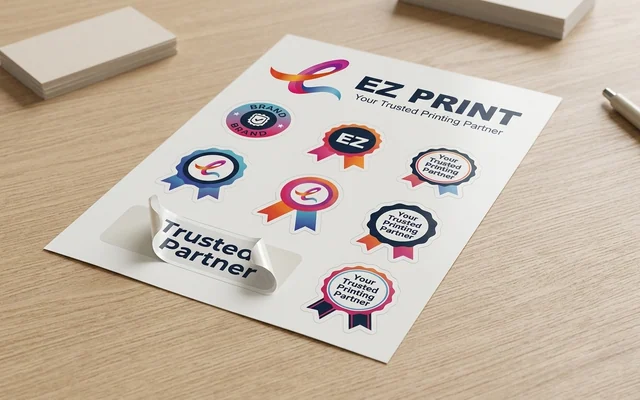
Kiss-cut means the blade goes through the face and the adhesive but not the liner, so the label peels off a sheet that stays in one piece. Die-cut goes all the way through. The sticker die itself is the tooling: cut once, held with the approved artwork, and used again on the reorder.
Cutting, laminating and the die that is kept
A label is printed, laminated and then cut, in that order, because the cutter has to go through the laminate rather than under it. The cut is where the tooling lives: a standard rectangle or circle uses a die already held, and anything else is a new one.
Label finishing: what each operation needs, and whether its die is kept for the reorder
Finish
Tooling
What the reorder pays for
Round-corneringStandard radii, on a die held as stock tooling
None
Nothing to make, so nothing to remake.
Matt or gloss laminationSingle pass, both sides
None
Nothing to make, so nothing to remake.
Hole-punchingStandard bits. A shaped or slotted opening is die-cutting, not punching
None
Nothing to make, so nothing to remake.
Soft-touch laminationThe film settles before the sheet is guillotined
None
Nothing to make, so nothing to remake.
Spot UVNeeds a screen; reads best over matt film
Made once
Kept on file with your approved artwork. The reorder runs from it.
Die-cuttingA forme is cut once, then kept for the reorder
Made once
Kept on file with your approved artwork. The reorder runs from it.
Kiss-cuttingThrough the face and adhesive but not the liner, so the sheet stays whole
Made once
Kept on file with your approved artwork. The reorder runs from it.
Contour cuttingCut to any closed vector path rather than to a die shape
Made once
Kept on file with your approved artwork. The reorder runs from it.
Roll finishingWound onto a stated core with a stated unwind direction, for applicator use
None
Nothing to make, so nothing to remake.
White underbasePrinted behind colour on clear film so it stays opaque
None
Nothing to make, so nothing to remake.
Scroll the table sideways to see every column.
Every operation here is quoted inside the standard window. What changes between a first order and a second is the tooling: a die, a block or a screen is made once and then kept on file with your approved artwork, which is why the reorder of a job carrying one is a different job from the first.
Nobody specifies an adhesive and then everybody is surprised by the adhesive. It is the layer that decides whether a label is a success or a complaint.
Pairings that work
+White vinyl, permanent adhesive, matt laminate, kiss-cut on a roll. The default product label, and it survives a supply chain.
+Clear vinyl with a white underbase on a glass bottle. The label disappears and the print stays opaque.
+Removable adhesive on a seasonal price flash. It comes off a shelf edge in one piece and leaves nothing behind.
+Matt laminate on anything written on. A marker or a ballpoint takes on matt film and slides off gloss.
Combinations that fail
×Paper labels in a fridge or a bathroom. Paper wicks water at the cut edge, the print lifts and the corners curl within days.
×Colour printed on clear film with no white underbase. Everything behind the label shows through the ink and the colour looks washed out.
×A permanent adhesive on a temporary promotion. It removes the paint or leaves a residue outline that is worse than the sticker.
×A die-cut shape with a sharp internal corner under about 2 mm radius. The blade cannot turn that tightly and the corner tears when the label is peeled.
Shapes, cuts and supply formats
How a label is cut and how it is supplied are two separate decisions, and both depend on how it will be applied — by hand from a sheet, or by machine from a roll.
Rectangle and rounded rectangle
Cut on a die already held at common sizes. No tooling wait.
Circle and oval
Also standard dies. A circle hides a slight misapplication better than a rectangle does.
Custom die-cut shape
Any closed outline. A new die is cut once and kept on file.
Kiss-cut on a sheet
Multiple labels on an A4 or A3 backing sheet, peeled by hand.
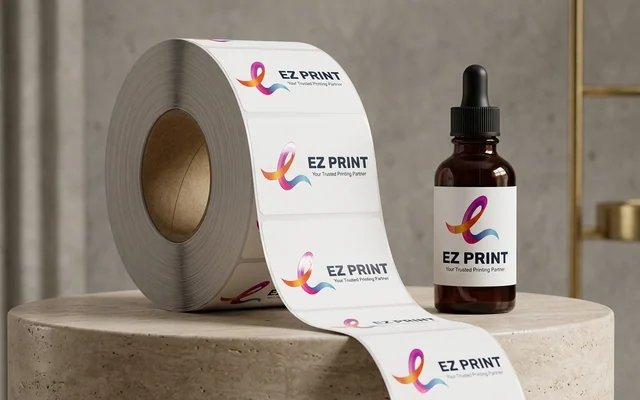
On a roll
Wound onto a 40 mm or 76 mm core with a stated unwind direction for applicator use.
Sizes
About 15 × 15 mm at the small end up to a full A3 sheet. Beyond that it becomes a vinyl graphic.
The cut path is a drawing, not a suggestion
A label file has two artworks in it: what is printed, and where it is cut. The cut path drives a blade, so it has to be a closed vector on its own layer — not a drawn outline, not a rasterised edge, and not implied by the shape of the design.
The file
Format
PDF/X-4 or Illustrator, with the cut path intact as a vector.
CUT layer
A single closed path on a layer named CUT, in a spot colour, never printed.
Bleed
2 mm of artwork outside the cut path on every edge.
Safe margin
3 mm inside the cut path. Cutting tolerance on a small label is around half a millimetre.
Internal corners
2 mm minimum radius. A blade cannot turn a sharper corner without tearing the face.
Repeat labels
One label per artboard, not a sheet of them. The step-and-repeat is worked out against the die.
The colour, and the detail
Colour mode
CMYK. A brand colour repeated across every batch is worth a Pantone reference.
White underbase
On clear film, supplied as a 100% K vector on a layer named WHITE, under any colour that must stay opaque.
Small text
K100, 5 pt minimum. Ingredient and warning text is often the smallest type printed here.
Barcodes
Vector, at 100% or larger, with the quiet zones intact. Never scaled from a low-resolution image.
Rich black
C60 M40 Y40 K100 for solids, total ink 240%.
Varnish-free zones
Where a label is written on, mask the laminate or specify matt film.
Say the surface, the environment and the expected life with the enquiry — a bottle that goes in a fridge, a carton in a warehouse, a painted wall for one month — and the face, the adhesive and the laminate are specified against it.
Turnaround
The cut is where the tooling lives
Standard
Standard turnaround is 7–14 working days.
Standard orders. The schedule for specialist finishing is confirmed in your quotation.
Express
Same-day printing available.
Subject to artwork, stock and production capacity confirmation. Timing is agreed for each job.
What sets the date
The order the material insists on: a label is printed, then laminated, then cut, because the blade has to go through the laminate rather than under it. A custom shape adds a die, and clear film adds a white underbase pass. All of it is quoted inside the standard window.
What a reorder skips
The die, or the stored contour path, kept on file with the approved artwork. A repeat order of the same label does not wait for tooling again, which on a shaped label is the largest part of the first run.
If the date is tight
Say the surface, the environment and the expected life, with the size and the supply format, and ask for an express quotation. We confirm the specification, production schedule and next steps in the quotation.
The die or the cut path is kept on file with the approved artwork, so a repeat order of the same label skips the tooling entirely — which on a shaped label is the largest single piece of work in the first run.
Every answer here is in the page source at full opacity, open or closed. An answer engine has to be able to read it without executing anything.
Questions asked about stickers and labels
What is the difference between kiss-cut and die-cut?
Kiss-cut goes through the face and the adhesive but not the liner, so the labels peel off a backing sheet that stays whole. Die-cut goes all the way through, giving individual stickers with no surrounding sheet. Kiss-cut is easier to handle in quantity; die-cut looks better as a single giveaway.
Are your stickers waterproof?
A vinyl or synthetic face with a laminate over it survives water, refrigeration and handling, because the material does not absorb moisture at the cut edge. A paper label does, which is why paper stickers curl and lift in a fridge or a bathroom within days.
What adhesive should I choose?
It depends on the surface and how long the label has to stay. Permanent for products and equipment; removable for promotions and anything on a rented or painted surface; low-tack where the surface must be left unmarked. Name the surface with the enquiry and the adhesive is chosen against it.
Can you print labels on a roll?
Yes. Rolls are wound onto a 40 mm or 76 mm core with a stated unwind direction, which matters if the labels go through an applicator. Say the machine or the core size with the specification, because a roll wound the wrong way round has to be rewound.
Can I have a clear label on a bottle?
Yes, on clear vinyl. Specify a white underbase behind any colour that must stay opaque — without it, whatever is behind the label shows through the ink and the colour looks washed out. The underbase is supplied as its own vector layer.
What is the smallest sticker you can cut?
About 15 × 15 mm as a die-cut shape. Below that the label is difficult to peel and the cutting tolerance becomes a significant proportion of the label. Internal corners need a 2 mm radius at any size, because a blade cannot turn a sharper corner without tearing.
Do you keep the cutting die for reorders?
Yes. A die or a stored contour path is kept on file with the approved artwork, so a repeat order does not wait for tooling again. On a shaped label that is the largest single piece of work in the first run, and it is only ever paid for once.
Trading since 2017 — EZ PRINT PRIVATE LIMITED, UEN 201706183R.
Standard turnaround is 7–14 working days. For urgent orders or express schedules, please check with EZ Print.
Artwork is checked before production.
Island-wide courier delivery within Singapore.
Collection can be arranged on request.
Ask for a quote on these labels
Every job is quoted from its specification — stock, quantity, sides, finish, size and deadline.
Quantity
Stock — or the feel you want, if you do not know the stock