
- What it is
- A thin self-adhesive vinyl overlay trimmed to the footprint of a standard wallet transit or access card, with radiused corners and an optional rectangular window where an exposed contact chip sits. It is supplied either kiss-cut on a backing carrier for easy peeling or individually die-cut through the liner as single handouts. Because it is a surface film rather than a rigid PVC card, it re-skins an existing stored-value or access card without replacing the underlying credential.
- What it is printed on
Cast or polymeric self-adhesive vinyl paired with a thin matt, satin or gloss overlaminate, mounted on a siliconised release liner. A removable low-tack acrylic adhesive is specified so the skin peels off cleanly when a campaign ends without leaving gummy residue on the plastic card body. It is a multi-layer film rather than a paper sheet, so the caliper table holds no entry for it; the critical specification is a thin total stack that still slides smoothly into a tight card sleeve or reader slot.
- How it feels
- Smooth, supple and barely thicker than the card it covers. A matt overlaminate gives a dry, glare-free face that hides thumbprints and reads clearly under indoor station lighting, while a gloss overlaminate feels slick and intensifies dark brand colours. Run a thumb around the perimeter and the kiss-cut edge sits fractionally inside the plastic card bevel so a fingernail or wallet pocket does not catch and lift the corner.
- What it suits
- Commuter transit card giveaways, commemorative event and anniversary editions, campus and office access pass branding, and retail loyalty promotions where recipients apply the graphic to a card they already carry daily. It does not suit cards that must feed through mechanical motorized rollers with tight thickness tolerances, and it does not suit embossed cards with raised numbering unless a window is left clear over the raised digits.
- Lead time
- Standard turnaround is generally 7–14 working days. A cutting forme, a foil block, an embossing die or a screen made for the first time is made before anything can run; a tool already held is not.
- The common mistake
- Sizing the cut line to the exact outside edge of the plastic card with zero inset tolerance. Nobody aligns a sticker by hand to zero error: a skin cut to the full outer dimension inevitably overhangs one edge by half a millimetre, catches on a wallet pocket, and starts peeling from that corner. Inset the cut line slightly inside the card perimeter, supply a full 3 mm bleed outside the cut contour, and keep small type at least 3 mm inside the radiused corners.
Print idea
CR80 card skin sticker
Custom-printed removable vinyl skin cut to standard bank and transit card dimensions with rounded corners and optional smart-chip clearance.
Standard turnaround is generally 7–14 working days.
What cr80 card skin sticker is
A thin self-adhesive vinyl overlay trimmed to the footprint of a standard wallet transit or access card, with radiused corners and an optional rectangular window where an exposed contact chip sits. It is supplied either kiss-cut on a backing carrier for easy peeling or individually die-cut through the liner as single handouts. Because it is a surface film rather than a rigid PVC card, it re-skins an existing stored-value or access card without replacing the underlying credential.
Cast or polymeric self-adhesive vinyl paired with a thin matt, satin or gloss overlaminate, mounted on a siliconised release liner. A removable low-tack acrylic adhesive is specified so the skin peels off cleanly when a campaign ends without leaving gummy residue on the plastic card body. It is a multi-layer film rather than a paper sheet, so the caliper table holds no entry for it; the critical specification is a thin total stack that still slides smoothly into a tight card sleeve or reader slot.
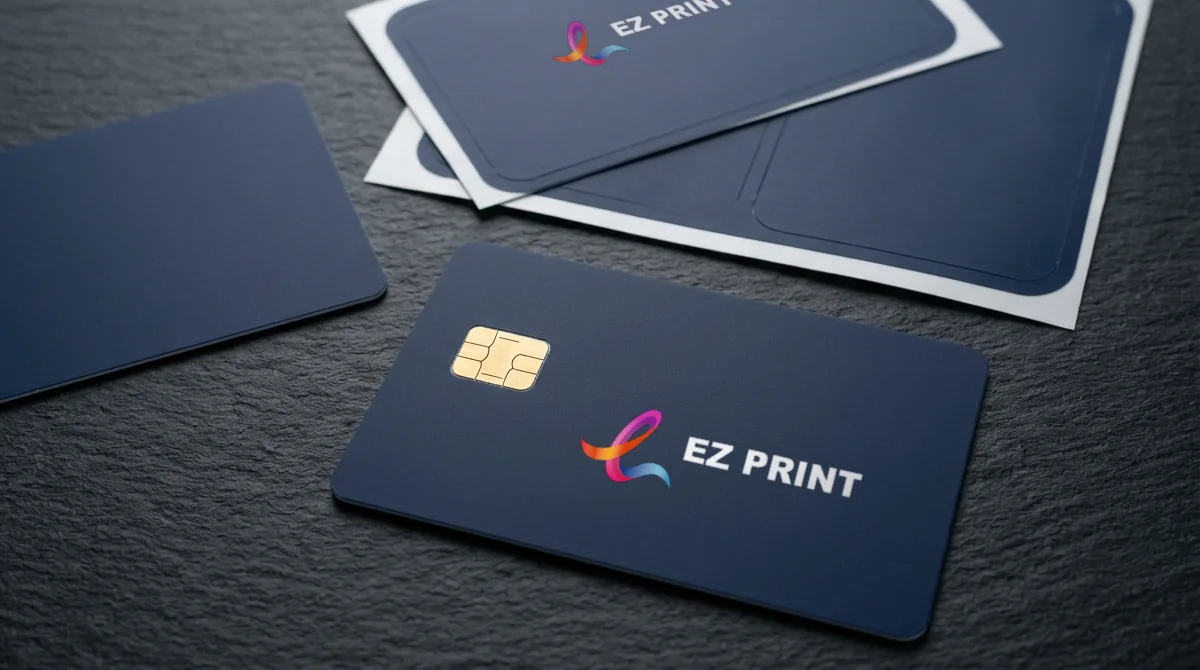
No plateThe distinguishing geometry of a card skin — the inset perimeter margin, the corner radius and the contact-chip window position — is a flat plan dieline rather than a film cross-section, so the cover carries a studio photograph of the finished skin beside a card.
The specification
Six fields, and the last one is the useful one.
The same six questions are answered for every entry in this section, in the same order, so two objects can be compared without reading two pages of prose. The mistake is stated last and stated plainly, because it is the one that costs a reprint and it is the reason this page is worth sending to a colleague.
Where this sits.
Every entry is indexed three ways, because a buyer arrives knowing the occasion, the object or the material and almost never all three.
- Application
- Format
- Material and effect
Also worth looking at
- Die-cut shapesStandard turnaround is generally 7–14 working days.
- Holographic and metallised substratesStandard turnaround is generally 7–14 working days.
- Window and floor graphicsStandard turnaround is generally 7–14 working days.
- Every service, groupedSpecifications, stocks and finishing
- Every print idea, indexed three waysThe section index
- The materials libraryCaliper, weight and what each finish costs
Send the specification for this, and it comes back quoted.
Every job is quoted from its specification — stock, quantity, sides, finish, size and deadline.
- Quantity
- Stock — or the feel you want, if you do not know the stock
- Sides printed
- Finish
- Flat and finished size
- The deadline
Artwork is welcome but not required to start. Email sales@ezprint.com.sg if you would rather attach files.