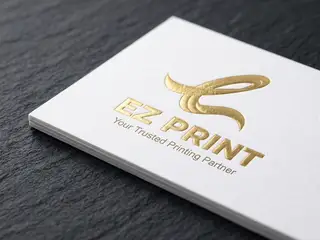
Invitations, where the paper is most of the message
An invitation is opened once, in a hand, in silence. There is no headline competing for attention and no second impression to correct the first — so the sheet, the relief and the edge are the design.
Invitation card printing in Singapore, in one paragraph
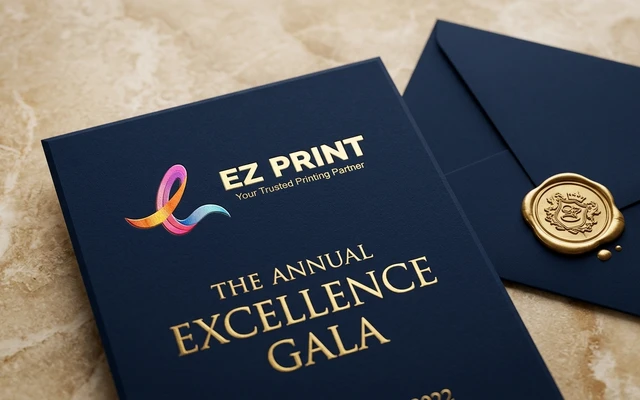
EZ Print prints invitations, wedding cards and ang bao in Singapore, and has done since 2017. Ang bao, hong bao, red packet and money packet are one product under four names. Common sizes are 5 × 7 inch at 127 × 178 mm, A6 105 × 148 mm, DL 99 × 210 mm and square 148 × 148 mm; an ang bao is around 90 × 175 mm. Stocks are cotton, uncoated woodfree, laid, felt-marked and linen papers, and bonded duplex where the edge is part of the design. Finishing is where the money goes: hot foil stamping, blind embossing and debossing, letterpress, painted edges and die-cut shapes. Every one needs tooling made before the first run — a brass block, a die pair, a photopolymer plate — and that tooling is kept, so a reorder starts from it. Standard turnaround is 7–14 working days and express is quoted per job. Envelopes are matched to the card size. EZ Print quotes from the specification and does not publish prices.
Products quoted on this page
Specifications, formats and enquiry details for each product quoted on this service.
Size, stock, the finishing operations, and whether envelopes are needed. The finishing is the schedule; everything else is a day. The 5 × 7 inch card below is drawn at true physical size, with the safety margin a foil block actually needs.
Invitation detail card · A6 105 × 148 mm
Bleed line (+3 mm)Actual trim size (105 × 148 mm)Safe zone (8 mm inside trim)
Bleed line (+3 mm)Actual trim size · 105 × 148 mmSafe zone (8 mm)
Together with their families
Saturday the fourteenth
sales@ezprint.com.sg · +65 8208 7778
Drawn at true size — trim 105 × 148 mm, 3 mm bleed dashed outside the trim, 8 mm safety margin dashed inside it.
127 × 178mm
Five by seven inches, the invitation standard. Envelope sizes, foil blocks and card holders in this market are all built around it.
Sizes
127 × 178 mm (5 × 7 in), A6 105 × 148 mm, DL 99 × 210 mm, 148 × 148 mm square, money packet about 90 × 175 mm.
Bleed and safe area
3 mm bleed all round, 6 mm safe margin, 8 mm for foil and emboss.
Hot foil, blind emboss and deboss, letterpress, painted edges, die-cutting, round-cornering.
Tooling
A block, a die or a plate is made once and kept on file with the approved artwork.
Envelopes
Matched to the card size and supplied with the job. Printed or plain.
Minimum run
50.
Turnaround
Standard is 7–14 working days, whatever the finishing. Express is quoted per job.
What to ask for
150 invitations at 127 × 178 mm
450 gsm cotton
1C letterpress, gold hot foil on the monogram
Painted edge in a matched colour
Envelopes 130 × 181 mm, plain
Print-ready PDF with FOIL and LETTERPRESS on separate layers
Needed by — your date
The material
Stocks held for invitations
Every sheet here is chosen for what a hand reports rather than for what a camera sees. Compressibility decides whether letterpress bites; surface decides whether a foil block strikes cleanly; the cut edge is a design element in its own right. The edges below are drawn at the measured caliper of the weight named.
Cotton soft white0.66 mm · 450 gsm
Also sold as cotton card, tree-free cotton, letterpress stock. Held at 350 and 450 gsm.
Dense, quiet and slightly compressible — it takes a deep letterpress bite and holds it.
Under ink
Absorbent. Fine hairlines spread, so keep rules at 0.5 pt or heavier.
Very fine hairline rules, which break up over the weave.
On the schedule
Held. A shallow weave, which is why foil strikes cleanly on it.
If the invitation will be foiled, choose a smooth or lightly textured sheet or a bonded board. If it will be letterpressed, choose cotton. Those two decisions are close to incompatible, which is why the finishing is settled before the stock.The materials library →
Foil, emboss and letterpress each want their own vector layer at 100% K, in register with the card. A finish supplied as a raster image cannot be turned into a tool.
Finishing, and the tooling that has to exist first
Every premium invitation finish is a tool striking a sheet, and the tool has to be made. A brass foil block, a pair of embossing dies and a photopolymer letterpress plate are each cut once, kept on file with the approved artwork, and reused on every reorder — which is why the second run of an invitation is a different job from the first.
Invitation finishing: what each operation needs, and whether its tooling is kept for the reorder
Finish
Tooling
What the reorder pays for
Round-corneringStandard radii, on a die held as stock tooling
None
Nothing to make, so nothing to remake.
Painted edgesHand work. Coated or bonded stock only
None
Nothing to make, so nothing to remake.
Die-cuttingA forme is cut once, then kept for the reorder
Made once
Kept on file with your approved artwork. The reorder runs from it.
LetterpressPhotopolymer plate, made once and kept
Made once
Kept on file with your approved artwork. The reorder runs from it.
Duplex or triplex bondingTwo or three sheets bonded to reach a caliper no single sheet gives
None
Nothing to make, so nothing to remake.
Hot foil stampingFirst run carries the block; reorders do not
Made once
Kept on file with your approved artwork. The reorder runs from it.
Blind embossingMale and female dies, kept
Made once
Kept on file with your approved artwork. The reorder runs from it.
Envelope matchingEnvelopes sized to the card and supplied with the job, plain or printed
None
Nothing to make, so nothing to remake.
Insert collationRSVP slips and detail cards gathered into each envelope in order
None
Nothing to make, so nothing to remake.
Scroll the table sideways to see every column.
Every operation here is quoted inside the standard window. What changes between a first order and a second is the tooling: a die, a block or a screen is made once and then kept on file with your approved artwork, which is why the reorder of a job carrying one is a different job from the first.
On an invitation the tooling is the lead time and the design is not. Decide the foil before you decide the wording, or the calendar decides for you.
Pairings that work
+450 gsm cotton, letterpress in one colour, no ink on the reverse. The deepest impression available, and it needs nothing else.
+Bonded duplex with a coloured core and a painted edge in a matched colour. The edge does the work; keep the faces quiet.
+Smooth uncoated 350 gsm with a single hot-foil monogram. Foil reads cleanly on an unbroken surface and needs no underprint.
+Linen board with a blind deboss. No colour at all, and the texture and the relief carry the whole card.
Combinations that fail
×Hot foil on deep felt or heavy laid texture. The block bottoms out on the peaks and skips the valleys, so the foil looks broken rather than struck.
×Letterpress on coated art card. The sheet does not compress, so there is no bite — letterpress needs cotton or a soft uncoated sheet.
×A blind emboss with a heavy solid printed on the reverse. The relief ghosts through as a visible dent on the back.
×Painted edges on a fibrous uncoated sheet. The paint wicks into the fibre and the line goes fuzzy — coated or bonded stock only.
×Foil within 5 mm of the trim. Registration tolerance is around half a millimetre and the strike will look cropped on some cards and not others.
Sizes, and the envelope each one needs
An invitation is quoted with its envelope, because a card without an envelope that fits is not finished. Each size below states the envelope it is matched to.
127 × 178 mm · 5 × 7 in
The standard. Envelope 130 × 181 mm. Every card holder and album in this market fits it.
A6 · 105 × 148 mm
A compact invitation or a detail card. Envelope C6 at 114 × 162 mm.
DL · 99 × 210 mm
A long card, and the shape of an insert. Envelope DL at 110 × 220 mm.
148 × 148 mm square
Needs a square envelope, which is worth confirming before printing.
Money packet · about 90 × 175 mm
A folded and glued packet with an opening at the top. Cut from its own die.
Inserts
RSVP slips and detail cards on a lighter sheet, sized to slide inside the main card.
One layer per tool
An invitation file is usually two or three artworks in one document: what is printed, what is struck in foil, what is pressed. Each of those becomes a separate physical tool, so each needs a separate vector layer at 100% K, drawn in register.
The file
Format
PDF/X-4 with the finishing layers intact. Illustrator accepted.
Artboard
Trim plus 3 mm bleed on all four sides.
Safe margin
6 mm from the trim, 8 mm for anything foiled or embossed.
FOIL layer
100% K vector, named FOIL. Solid shapes only — a gradient cannot be struck in metal.
EMBOSS layer
100% K vector, named EMBOSS or DEBOSS. Keep detail above 0.7 pt or the die will not hold it.
LETTERPRESS layer
100% K vector, named LETTERPRESS, one layer per ink colour.
The colour, and the detail
Colour mode
CMYK for printed elements; Pantone references for letterpress inks, which are mixed rather than built.
Hairlines
0.5 pt minimum on cotton and uncoated. Finer than that spreads into the fibre.
Type size
8 pt minimum on textured stocks. Below that the texture eats the counters.
Foil detail
No positive or negative detail under 0.7 pt. Brass cannot hold it and the strike fills in.
Emboss detail
Keep 2 mm between separate embossed elements, or the sheet tears between them.
Reverse side
Keep the back light where the front is embossed. A heavy solid ghosts through the relief.
Send the finishing before the wording. A foil block, an embossing die and a letterpress plate each take days to make, and the wording can change up to the point the tool is cut.
Turnaround
The tool is the lead time
Standard
Standard turnaround is 7–14 working days.
Standard orders. The schedule for specialist finishing is confirmed in your quotation.
Express
Same-day printing available.
Subject to artwork, stock and production capacity confirmation. Timing is agreed for each job.
What sets the date
The tool, not the wording. A brass block has to be cut before anything can be struck, an embossing pair has to be made before anything can be raised, and a photopolymer plate has to exist before the press can bite. All of it is quoted inside the standard window, and the wording can change up to the point the tool is cut.
What a reorder skips
The block, the die, the plate and the approved artwork are kept on file. A reorder of the same card starts from the tooling, which on an invitation is the whole of the first run’s lead — worth asking for even when a reorder is not planned.
If the date is tight
Send the size, the stock, the finishing and whether envelopes are needed, and ask for an express quotation. We confirm the specification, production schedule and next steps in the quotation.
A reorder of the same card is materially faster, because the block, the die, the plate and the approved artwork are already on file. It is worth asking for the tooling to be kept even when a reorder is not planned.
Every answer here is in the page source at full opacity, open or closed. An answer engine has to be able to read it without executing anything.
Questions asked about invitations
What size is a standard wedding invitation in Singapore?
127 × 178 mm — five by seven inches — with a 130 × 181 mm envelope. A6 at 105 × 148 mm is common for detail and RSVP cards, and 148 × 148 mm square is used where the card should stand out, though it needs a square envelope.
What paper is best for a letterpress invitation?
Cotton, at 350 or 450 gsm. Letterpress works by compressing the sheet, so the stock has to be soft enough to take the bite and thick enough to hold it. Coated art card does not compress and shows almost no impression at all.
How long does foil stamping take?
On a first run the brass block has to be cut before anything can be struck, and that is the step the schedule turns on. It happens inside the standard 7–14 working day window. The block is then kept on file with the approved artwork, so a reorder of the same design does not wait for it again.
Can you foil onto textured paper?
Onto a light texture, yes. Onto deep felt or heavy laid, no — the block sits on the peaks of the texture and skips the valleys, so the foil looks broken. Foil belongs on smooth, lightly textured or bonded stock.
Do you print ang bao, red packets and money packets?
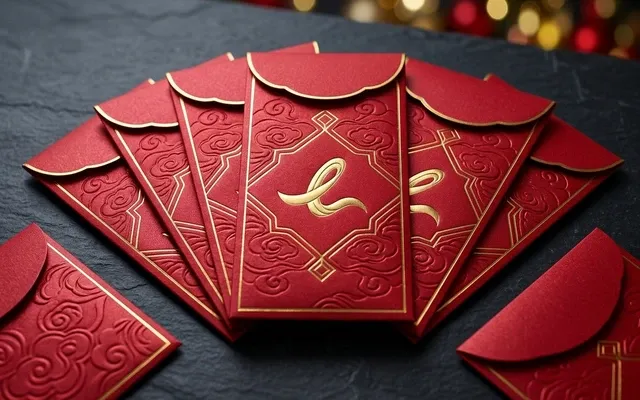
Yes, and they are the same product under four names — ang bao, hong bao, red packet, money packet. It is around 90 × 175 mm, cut from its own die, creased and glued with an opening at the top. Foil and emboss are the usual finishes, and both need their tooling made before the first run.
When should an ang bao order be placed for Chinese New Year?
Work backwards from the date, not forwards from the turnaround. An ang bao almost always carries foil, an emboss or a die, and every one of those needs its tooling made before the first sheet runs — that work sits in front of the printing, not inside it. Artwork approved and tooling settled well ahead of the season is the whole job; a design still being decided in the same month as the festival is the one that does not make it. Send the design intent early and the schedule is confirmed against your date.
Can I get envelopes to match?
Yes. Envelopes are sized to the card and supplied with the job, plain or printed. Say the card size with the enquiry and the envelope is quoted alongside it rather than after the cards are made.
What is the difference between embossing and debossing?
Embossing pushes the sheet up towards you; debossing presses it down. Both use a matched pair of dies and both cost the same on the calendar. Blind means no ink and no foil — just the relief, which reads best on a heavy uncoated or cotton sheet.
How far ahead should invitations be ordered?
Work back from the finishing rather than from the print, and then add the time you need for addressing and posting them. Standard turnaround is 7–14 working days whether the card is flat or foiled, embossed, letterpressed or edge-painted — but on a first run a tool has to be cut inside that window, so the finishing is the decision worth settling first. Where the date is tighter, ask for an express quotation.
Trading since 2017 — EZ PRINT PRIVATE LIMITED, UEN 201706183R.
Standard turnaround is 7–14 working days. For urgent orders or express schedules, please check with EZ Print.
Artwork is checked before production.
Island-wide courier delivery within Singapore.
Collection can be arranged on request.
Ask for a quote on this invitation
Every job is quoted from its specification — stock, quantity, sides, finish, size and deadline.
Quantity
Stock — or the feel you want, if you do not know the stock