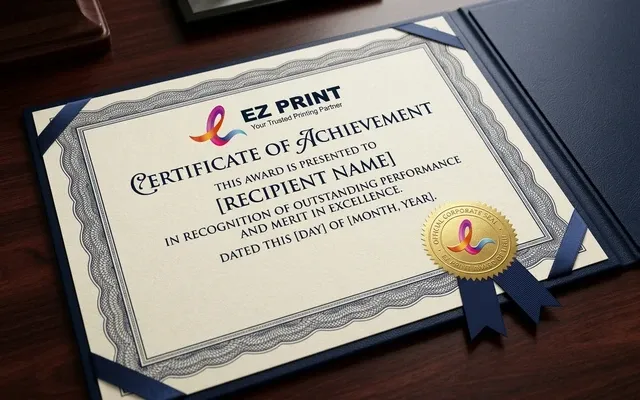
Certificates, and the two things that make one look official
A relief mark and a sheet with a visible surface. Neither is expensive and both are what the eye reads as authority — far more than a border, a gradient or a script typeface ever will.
Certificate printing in Singapore, in one paragraph
EZ Print prints certificates, awards and completion documents in Singapore, and has done since 2017. A4 210 × 297 mm is the standard, portrait or landscape, with A5 148 × 210 mm used for course and attendance certificates. Stocks are linen board, laid text, felt-marked and uncoated woodfree — sheets with a visible surface, because a certificate on gloss art paper reads as a flyer. Finishing includes hot foil seals, blind embossing, sequential numbering and round-cornering. Names, dates and reference numbers can be printed variably from a supplied spreadsheet, so each certificate is different without the run being reprinted. A foil seal needs a brass block made before the first run, and the block is then kept for every year after it. Standard turnaround is 7–14 working days and express is quoted per job. EZ Print quotes from the specification and does not publish prices.
Products quoted on this page
Specifications, formats and enquiry details for each product quoted on this service.
Size, stock, whether there is a relief mark, and whether the names are printed or written. That last one changes the job entirely: variable data is a different setup from a static run. The A5 certificate below is drawn at true physical size.
No certificate is drawn here at true size. A5 is the smaller of the two sizes on this page and it is 148 mm across, which is wider than this column — and a certificate reduced to fit would misstate the margin that actually decides the layout, the 10 mm a frame rebate covers on every edge. That figure is stated below, with the foil-seal diameter and the smallest detail a brass block can hold, which are the other two numbers this page exists to publish.
A4210 × 297 mm
Portrait or landscape. The size every frame, folder and filing sleeve in this market is built for, which is why it is worth a reason to leave it.
Sizes
A4 210 × 297 mm portrait or landscape, A5 148 × 210 mm. Custom sizes cut from the same sheets.
Bleed and safe area
3 mm bleed all round, 10 mm safe margin — a certificate is usually framed or mounted.
Stocks
Linen board 300–350 gsm, laid text 100–120 gsm, felt-marked 270–300 gsm, uncoated woodfree 300–400 gsm.
Colour
4C or 1C. A single dark ink on a textured sheet reads more formally than four colours.
Relief
Hot foil seal, blind emboss, or both. Tooling is made once and kept.
Variable data
Names, dates and reference numbers printed from a supplied spreadsheet.
Numbering
Sequential numbers, with a stated start value and any prefix.
Turnaround
Standard is 7–14 working days, plain or sealed, numbered or not. Express is quoted per job.
What to ask for
250 A4 certificates
350 gsm linen board
1C printed, portrait
Gold hot foil seal, 40 mm diameter
Names and dates printed variably from a supplied spreadsheet
Print-ready PDF with FOIL on a separate layer
Needed by — your date
The material
Stocks held for certificates
The whole effect depends on the sheet having a surface you can see across a room and feel at arm’s length. Every stock below has one, and none of them is coated. The edges are drawn at the measured caliper of the weight named.
0.47 mmWeave at 8×
Linen board0.47 mm · 350 gsm
Also sold as linen finish, embossed linen board. Held at 300 and 350 gsm.
A fine, regular woven texture. The default certificate stock, and the one that photographs as formal rather than as rustic.
Under ink
Even coverage over the weave; a foil seal strikes cleanly because the texture is shallow.
Very fine hairline rules, which break up over the weave.
On the schedule
Held. A shallow weave, so a foil seal strikes cleanly on it.
0.17 mmChain lines at 8×
Laid text0.17 mm · 120 gsm
Also sold as laid paper, ribbed text. Held at 100 and 120 gsm.
Fine parallel ribs across the sheet, visible against the light. The traditional document paper.
Under ink
Type sits crisply. Large solids show the ribbing as a faint stripe, which is usually desirable here.
Best for
Letters of appointment, formal statements, anything that goes into a folder rather than a frame.
Avoid for
A certificate that has to stand up in a display frame on its own.
On the schedule
Held as a standing text weight.
0.52 mmFelt mark at 8×
Felt-marked text0.52 mm · 300 gsm
Also sold as felt finish, embossed text, textured card. Held at 270 and 300 gsm.
A deeper, less regular texture than linen. Reads as handmade, which suits an arts or heritage award.
Under ink
Solids break slightly over the texture. A single ink handles it better than four.
Best for
Arts awards, heritage and community certificates.
Avoid for
Hot foil, which skips across the peaks of a deep texture.
On the schedule
Held. The texture is deep, which is why foil skips across it.
Uncoated woodfree0.42 mm · 300 gsm
Also sold as uncoated natural, offset card. Held at 300, 350 and 400 gsm.
Smooth, matt and unremarkable in the best way — it takes a signature in ink without feathering.
Under ink
Chroma drops roughly 15% evenly, so a two-colour certificate reads as considered.
Best for
Anything signed by hand, and anything produced in volume.
Avoid for
A design relying on a deep photographic background.
On the schedule
Held. It takes a signature in ink without feathering.
If certificates are signed by hand, choose uncoated or laid and test the pen. A felt or linen texture can make a fine nib skip, and a signature that skips looks like a photocopy of a signature.The materials library →
A foil seal is a solid shape struck in metal. It cannot hold a gradient, a photograph or detail finer than about 0.7 pt — a crest with fine internal linework has to be simplified before it becomes a block.
Seals, relief and numbering
A certificate earns its authority from a relief mark and a number. The relief needs a tool; the number needs a data file. Neither is difficult, and both should be decided before the layout is finished because both need space reserved for them.
Certificate finishing: what each operation needs, and whether its block is kept for next year
Finish
Tooling
What the reorder pays for
Round-corneringStandard radii, on a die held as stock tooling
None
Nothing to make, so nothing to remake.
Die-cuttingA forme is cut once, then kept for the reorder
Made once
Kept on file with your approved artwork. The reorder runs from it.
Hot foil stampingFirst run carries the block; reorders do not
Made once
Kept on file with your approved artwork. The reorder runs from it.
Blind embossingMale and female dies, kept
Made once
Kept on file with your approved artwork. The reorder runs from it.
Sequential numberingA stated start value and prefix, printed in order
None
Nothing to make, so nothing to remake.
Variable name printingNames, dates and references merged from a supplied spreadsheet
None
Nothing to make, so nothing to remake.
Presentation folder pairingCertificates collated into folders in issue order
None
Nothing to make, so nothing to remake.
Scroll the table sideways to see every column.
Every operation here is quoted inside the standard window. What changes between a first order and a second is the tooling: a die, a block or a screen is made once and then kept on file with your approved artwork, which is why the reorder of a job carrying one is a different job from the first.
A certificate is believed because of two millimetres of relief and a sheet you can feel. Everything else on it is typography.
Pairings that work
+350 gsm linen board, one dark ink, a gold foil seal. The most reliable formal certificate there is, and the block is reused every year.
+Blind emboss instead of foil where the identity is monochrome. No metal, no colour, and the relief still reads across a room.
+Uncoated 300 gsm with variable names and sequential numbers. Every certificate is different and none of them is handwritten.
+A5 certificates on laid text, collated into folders in issue order. It turns a stack of paper into a presentation.
Combinations that fail
×A certificate on gloss art paper. It reads as a flyer with a border, and no amount of gold in the design corrects it.
×A foil seal carrying fine internal linework. Brass will not hold detail under about 0.7 pt and the strike fills in solid.
×Names typed into the layout and reprinted for each person. That is a hundred separate print jobs; variable data does it in one.
×A 5 mm margin on something that will be framed. A frame rebate eats several millimetres and takes the border with it.
Sizes and orientations
A certificate is nearly always going to be framed, filed or photographed. Each of those has a preferred proportion, and it is worth knowing which before the layout is set.
A4 portrait · 210 × 297 mm
The default. Fits every frame and filing sleeve sold here.
A4 landscape · 297 × 210 mm
Reads as an award rather than a document. Needs a landscape frame, which is worth confirming.
A5 · 148 × 210 mm
Course and attendance certificates issued in volume. Cheaper to post and to store.
Custom sizes
Anything cutting from the parent sheet. Say the frame it must fit before the trim is fixed.
Foil seal · 30–50 mm
A round or shield seal struck in metal. One block, kept on file.
Round corners · 3 mm radius
Cut on a die already held — no new tooling to make.
Leave room for the seal, the signature and the frame
Three things on a certificate are added after the layout is designed, and all three need space reserved: the relief mark, the signature and the frame rebate. Every certificate that has to be redrawn is redrawn because one of those was forgotten.
The file
Format
PDF/X-4. Illustrator accepted, with the finishing layers intact.
Artboard
Trim plus 3 mm bleed on all four sides.
Safe margin
10 mm from the trim, because a frame rebate covers several millimetres.
FOIL layer
100% K vector named FOIL, solid shapes only, nothing finer than 0.7 pt.
Variable fields
Marked as empty boxes with the typeface, size and alignment stated. Data supplied separately as a spreadsheet.
Signature space
At least 40 mm wide and 15 mm tall per signature, on an unprinted area.
The colour, and the detail
Colour mode
CMYK, or a single named Pantone where the certificate is one ink.
Body text
K100, 10 pt minimum on a textured sheet.
Rules and borders
0.5 pt minimum on linen or felt; a hairline breaks up over the texture.
Foil detail
No positive or negative element under 0.7 pt. Simplify a crest before it becomes a block.
Backgrounds
Keep any tint under 15% where a name will be printed or written over it.
Numbering
Position and typeface stated. The number is printed in a separate pass and needs its own clear area.
Send the name list as a spreadsheet with one row per certificate and one column per field. The merge is set up against that file, and the proof shows the longest name in the list rather than the first.
Turnaround
The block is cut once, and then never again
Standard
Standard turnaround is 7–14 working days.
Standard orders. The schedule for specialist finishing is confirmed in your quotation.
Express
Same-day printing available.
Subject to artwork, stock and production capacity confirmation. Timing is agreed for each job.
What sets the date
The relief and the data. A foil seal or a blind emboss needs its tooling cut before anything can be struck; sequential numbering is its own pass; variable names are a merge set up against your spreadsheet and proofed on the longest name in it. All of it is quoted inside the standard window.
What a reorder skips
The brass block, kept on file with the approved artwork. An annual award programme pays for the block once and never again, and the merge setup is kept beside it, so next year is a new name list rather than a new job.
If the date is tight
Say the size, the stock, whether there is a relief mark and whether names are printed or written, and ask for an express quotation. We confirm the specification, production schedule and next steps in the quotation.
The foil block for a seal is kept on file with the approved artwork, so an annual award programme pays for the block once and never again.
Every answer here is in the page source at full opacity, open or closed. An answer engine has to be able to read it without executing anything.
Questions asked about certificates
What paper should certificates be printed on?
A sheet with a visible surface: linen board at 300–350 gsm, laid text, felt-marked or uncoated woodfree. A certificate on gloss art paper reads as a flyer whatever the design does, because the eye reads the surface before it reads the layout.
Can you print names on certificates for us?
Yes. Send a spreadsheet with one row per certificate and one column per field — name, date, reference — and the names are merged and printed in one run rather than as separate jobs. The proof is set with the longest name in the list so nothing overflows.
How does a foil seal work?
A brass block is cut to the shape of the seal and used to strike metallic foil into the sheet under heat and pressure. It has to be a solid shape: fine internal detail under about 0.7 pt fills in. The block is made once, inside the standard window, and then kept on file for every run after it.
Can certificates be numbered?
Yes. Sequential numbering with a stated start value and prefix is printed in a separate pass, so leave a clear area for it in the layout. It pairs naturally with variable name printing, and both are set up before the run rather than corrected after it.
Should a certificate be A4 portrait or landscape?
Portrait fits every frame and filing sleeve sold here and is the safe default. Landscape reads more like an award and photographs better on a wall, but it needs a landscape frame — worth confirming before the layout is set.
How much margin does a framed certificate need?
10 mm of safe margin from the trim. A frame rebate covers several millimetres on every edge, and a border drawn 5 mm in will be partly hidden by it.
How long does certificate printing take in Singapore?
Standard turnaround is 7–14 working days, and it is the same window whether the certificate is plain, sealed in foil, blind embossed, numbered or merged with a list of names. On a first run the brass block for a seal has to be cut inside that window; on every run after it the block already exists. Where a graduation or an award date is tighter, ask for an express quotation with the size, the stock and the relief on it.
Trading since 2017 — EZ PRINT PRIVATE LIMITED, UEN 201706183R.
Standard turnaround is 7–14 working days. For urgent orders or express schedules, please check with EZ Print.
Artwork is checked before production.
Island-wide courier delivery within Singapore.
Collection can be arranged on request.
Ask for a quote on these certificates
Every job is quoted from its specification — stock, quantity, sides, finish, size and deadline.
Quantity
Stock — or the feel you want, if you do not know the stock