
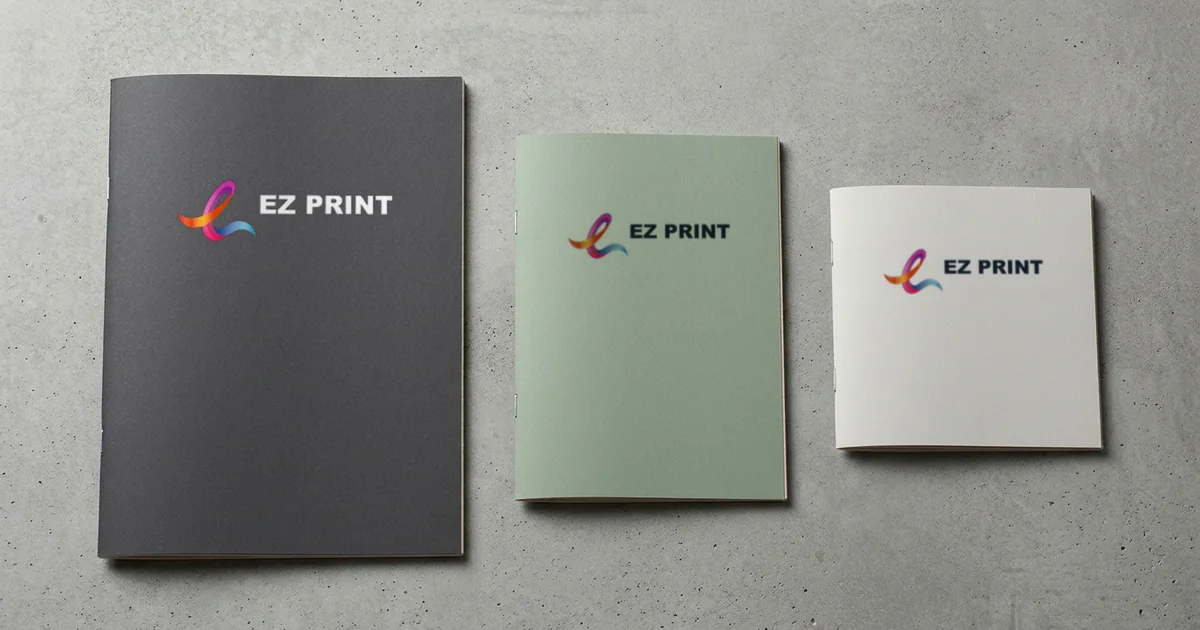
A5 (148 × 210 mm) is the default booklet size, comfortable at 16 to 32 pages, and A4 (210 × 297 mm) is the size for catalogues and technical documents. Square 210 × 210 mm trims from the same sheet as A4, and DL 99 × 210 mm is the narrow format. Whichever size you choose, the page count decides the binding: saddle stitch takes 8 to about 64 pages in multiples of four, and perfect binding starts at about 40.
What sizes can a booklet be printed in?
The booklet service lists four sizes: A5, A4, square and DL. A4 and A5 are ISO A-series paper sizes, and A5 is an A4 sheet halved, so the two share proportions and a layout scales between them cleanly. Square trims from the same sheet as A4, and DL is the narrow format, the same height as A5 but noticeably slimmer in the hand.
| Size | Finished size | What it is good at | What to watch |
|---|---|---|---|
| A5 | 148 × 210 mm | The default. Fits a bag and is comfortable at 16 to 32 pages | Small pages mean fewer words per spread, so long documents climb in page count |
| A4 | 210 × 297 mm | Catalogues and technical documents | Heavier to post, and it demands a good grid |
| Square | 210 × 210 mm | Trims from the same sheet as A4; distinctive, and generous for photography | It is not an ISO A-series size, so check that envelopes and folders fit it |
| DL | 99 × 210 mm | A narrow page, listed alongside A4, A5 and square on the booklet service page | Narrow columns; images and tables have to be designed for the width |
Every size is set up the same way: the trim size plus 3 mm bleed on all four sides, every page the same size including the cover. Beyond the grid, what the size changes is how many pages the content needs, and that is what decides the binding, the paper weight and whether the book will close.
Is A4 or A5 better for a company profile or catalogue?
A5 for most company profiles, programmes and handouts; A4 for catalogues and technical documents. A5 fits a bag and reads comfortably at 16 to 32 pages. A4 carries more on each spread, which is why catalogues and technical documents use it, but it is heavier to post and it demands a good grid. Choose by how the booklet will be carried and read.
Two combinations recur because they work. An A5 booklet of 24 pages on 157 gsm gloss art paper with a 310 gsm matt cover, saddle stitched and matt laminated on the outside only, is the first pairing the booklet service page lists as one that works. An A4 book of 64 pages on 128 gsm, perfect bound with the title printed on the spine, stands on a shelf and can be found there, which a stitched book cannot.
The question that settles it is where the book lives after it is handed over. A booklet that travels in a bag, sits on a conference table or is posted is an A5 book. A booklet that is read at a desk with a product range or a set of drawings open on it, or that is filed and kept, is an A4 book. Square is a deliberate choice for a photographic piece rather than a default, and DL is the narrow alternative.
How many pages suit each booklet size?
The page count matters more than the size, because it decides the binding. Saddle stitching takes multiples of four, from 8 pages to about 64, and opens nearly flat. Perfect binding starts at about 40 pages and gives a printable square spine. Wire-O takes any page count and opens completely flat. Between about 40 and 64 pages, more than one binding is possible.
| Binding | Page counts | Spine | How it opens |
|---|---|---|---|
| Saddle stitch | Multiples of four, 8 to about 64 | No printable spine | Nearly flat |
| Perfect binding | From about 40 pages | Square, printable spine | Does not open flat |
| Wire-O | Any page count | No printable spine | Completely flat, and folds back on itself |
A saddle-stitched book is built from folded sheets of four pages, so a 22-page document becomes a 24-page booklet with two blanks. Plan the two extra pages rather than discovering them. The same arithmetic applies at every size; an A4 book and an A5 book of the same content will simply land on different page counts, and the smaller page usually needs more of them.
That is the practical link between size and binding. Content that sits comfortably in an A4 saddle-stitched book can run past the saddle-stitch range at A5, which moves it towards perfect binding or wire-O. Count the pages at the size you intend before choosing the binding. How each binding behaves in use is compared in the booklet binding guide.
Which paper weights suit A4 and A5 booklets?
Text pages run 128–157 gsm gloss art paper, and covers run 310–350 gsm matt or gloss art card, laminated on the outside face. The heavier the text stock, the fewer pages a saddle stitch will take before the book stops closing. Past about 64 pages on 157 gsm, perfect binding is the honest answer rather than a heavier staple.
| Part | Stock | Why |
|---|---|---|
| Text pages | 128 gsm gloss art paper | Light enough that a 48-page book still closes properly, coated enough that photographs stay sharp |
| Text pages | 157 gsm gloss art paper | Held alongside 128 gsm as the standing text stock |
| Cover | 310–350 gsm matt or gloss art card | Heavy enough to protect the text block, and it takes lamination without silvering |
| Cover, notebook feel | 300 gsm uncoated woodfree | For a book that should feel like a notebook; it needs no lamination pass |
| High page counts | Simili text paper | The light uncoated paper most manuals, workbooks and internal reports run on |
Two stock mistakes recur. A 12-page book on 350 gsm text stock will not close, and the staple tears through the fold, so cover stock belongs on the cover only. And on a perfect-bound book, laminating both faces of the cover is a mistake: glue does not key to film, so the text block eventually pulls away from the spine. Laminate the outside only.
Simili is ordered in by named weight for the job, so its weight is settled on the quote rather than published. Say the page count and the finished size and it is specified against those. For single-sheet folded pieces rather than bound books, paper weights are covered in the brochure paper weights guide.
How should booklet artwork be set up?
Supply a PDF/X-4 as single pages in reading order, page one being the front cover, each page at the trim size plus 3 mm bleed. Do not supply printer spreads: the imposition depends on the binding, the page count and the creep, so a file already paired into spreads has to be taken apart before it can be used. Keep type clear of the spine.
| Setting | Requirement |
|---|---|
| Format | PDF/X-4, single pages in reading order, page one being the front cover |
| Artboard | Trim plus 3 mm bleed on all four sides, every page the same size including the cover |
| Page count | Divisible by four for saddle stitch, with blanks stated explicitly |
| Spine margin | 12 mm on saddle stitch, 15 mm on perfect binding, 18 mm on wire-O |
| Images across a spread | 5 mm of overlap at the gutter on saddle stitch; none across the gutter on perfect binding |
| Small text | K100, 8 pt minimum on text stock |
| Cover on a different stock | Supplied as a separate file, front and back as single pages |
On a thick saddle-stitched book, the inner pages push outward as the sheets nest, so the centre spread trims narrower on the outer edge than the cover does. That creep is compensated in the imposition rather than in your file, but keep anything critical 8 mm clear of the outer trim on a thick book. On a perfect-bound book, send the page count and the text stock before drawing the cover, and the spine width comes back as a figure to build to.
Worked example: an A5 company profile and an A4 product catalogue
Hypothetical planning example. Actual production timing, paper availability, and logistics are confirmed individually upon artwork and specification review. An organisation needs two booklets: a company profile to hand out at meetings and send by post, and a product catalogue that customers keep on a shelf and look things up in.
Company profile
- Size: A5, 148 × 210 mm.
- Pages: 24 pages plus cover, so the count divides by four.
- Stock: 157 gsm gloss art paper text, 310 gsm matt art card cover.
- Colour: 4C/4C throughout.
- Binding: saddle stitched, matt lamination on the outside cover.
- Artwork: print-ready PDF as single pages in reading order, with a 12 mm spine margin.
Product catalogue
- Size: A4, 210 × 297 mm.
- Pages: 64 pages, at the top of the saddle-stitch range, in a book that has to be found on a shelf.
- Stock: 128 gsm text.
- Binding: perfect bound, with the title printed on the spine so it can be found on a shelf.
- Artwork: single pages with a 15 mm spine margin, no image running across the gutter, and the spine width confirmed from the page count before the cover is drawn.
Both books are quoted inside the standard window of 7–14 working days, which on the catalogue includes the glue cure on the perfect-bound spine before it is trimmed.
Frequently asked questions
Which booklet size is the default?
A5, at 148 × 210 mm. It fits a bag, reads comfortably at 16 to 32 pages, and suits company profiles, programmes and handouts. A4, at 210 × 297 mm, is the size for catalogues and technical documents.
Can a square booklet be printed?
Yes. Square booklets are 210 × 210 mm and trim from the same sheet as A4. They are distinctive and generous for photography, but square is not an ISO A-series size, so check envelopes and folders before committing to it.
How many pages can an A5 booklet have?
It depends on the binding rather than the size. Saddle stitching takes multiples of four from 8 to about 64 pages, perfect binding starts at about 40 pages, and wire-O takes any page count.
What paper should a booklet be printed on?
Text pages on 128–157 gsm gloss art paper and covers on 310–350 gsm matt or gloss art card, laminated on the outside face. Use 300 gsm uncoated where the book should feel like a notebook, and simili text paper for manuals and high page counts.
Should booklet artwork be supplied as spreads?
No. Supply single pages in reading order, page one being the front cover, each at the trim size plus 3 mm bleed. The imposition depends on the binding, the page count and the creep, so it is worked out from single pages.
How do you order booklets from EZ Print?
EZ Print prints booklets, catalogues and company profiles in Singapore and has been trading since 2017. Every booklet is quoted from its specification: size, page count, binding, text stock and cover stock. Artwork is checked against the specification before production. Standard turnaround is 7–14 working days for every binding; express is quoted per job.
Sizes, stocks and spine margins are set out on the booklet printing page. Send the size, the page count and how the book will be used, and request a quote.
Same-day and urgent printing available. Subject to artwork approval, payment, print type and production availability. Timing confirmed per job.