

A brochure is handled more than a flyer and kept longer, so the sheet it is printed on has to survive being opened, closed and carried around. The paper weight, written as gsm, is the first number most people reach for when they describe that sheet. It is a useful number, but it does not tell the whole story on its own: how many panels the brochure has, whether it is creased and laminated, and whether the paper is coated all change how a given weight behaves in the hand.
This guide explains what gsm measures, which weights suit which folds, when a heavier sheet needs creasing, and how coating and lamination affect the choice. It is about the paper. For how a reader moves through the panels, see the brochure fold reading sequence guide, and for the folds and stocks quoted, see the brochure printing page.
What does gsm actually tell you about brochure paper?
Gsm means grams per square metre. It is the weight of one square metre of the sheet, so it describes how much paper there is, not exactly how thick it is. Two sheets of the same gsm can differ in thickness and stiffness, because coated paper is denser than uncoated paper. Use gsm to compare similar papers, and use a sample to judge the feel.
A few practical points follow from that definition:
- Weight is not thickness. Thickness is called caliper. An uncoated sheet is bulkier than a coated sheet of the same gsm, so it can feel more substantial at the same weight.
- Weight is useful for planning. Because gsm is per square metre, you can work out what a brochure weighs. An A4 sheet is one sixteenth of a square metre under the ISO 216 A-series sizes, so a 157 gsm A4 sheet weighs about 9.8 g before any lamination.
- Weight is per sheet, not per brochure. A folded tri-fold is still one sheet. A booklet is many, so its weight adds up much faster.
| Paper weight | Approximate weight of one A4 sheet | Approximate weight of 1,000 flat A4 sheets |
|---|---|---|
| 128 gsm | 8.0 g | 8.0 kg |
| 157 gsm | 9.8 g | 9.8 kg |
| 310 gsm | 19.4 g | 19.4 kg |
| 350 gsm | 21.9 g | 21.9 kg |
These figures are simple arithmetic from the gsm and the A4 area. Lamination, packing and cartons add to them. They are most useful when you plan carton handling for an event or estimate what a mailing pack will weigh.
Which paper weights suit which kind of brochure?
Most folded brochures fall into two groups. Lighter coated papers of 128 to 157 gsm suit brochures with four or more panels, because they fold cleanly and stay closed. Heavier cards of around 300 to 350 gsm suit two-panel brochures that should feel like a cover. The fold and the use decide which group you are in.
The brochure printing page lists 128 and 157 gsm gloss art paper, 310 to 350 gsm matt art card and 300 gsm uncoated woodfree for brochures. Other weights may be possible for a particular job; ask when you send the specification.
| Paper | Typical brochure use | What it does well | What to watch |
|---|---|---|---|
| 128 gsm gloss art paper | Tri-folds and Z folds handed out in quantity, inserts in event packs | Light, folds cleanly, keeps photographs bright | Very dark solids on both sides can show through slightly |
| 157 gsm gloss art paper | Product and service brochures with four to six panels | A firmer hand-feel while still folding without a creasing pass | Heavier than 128 gsm across a large run |
| 310–350 gsm matt art card | Two-panel bi-folds, capability statements, menus | Stands on a table and feels like a cover | Must be creased; too stiff for six-panel folds |
| 300 gsm uncoated woodfree | Brochures where a natural paper feel is part of the message | Warm surface that takes a pen | Colours print more muted; creasing needed |
A useful rule from the brochure page: the more panels, the lighter the sheet. Two panels can carry 350 gsm; six panels on the same card will not close.
How does the number of panels limit the paper weight?
Every fold stacks the sheet on top of itself, so a six-panel tri-fold is three layers thick when it is closed and an eight-panel roll fold is four. A heavy sheet that folds well once becomes springy and bulky when it is folded twice or three times. That is why panel count sets an upper limit on weight.
| Fold | Panels | Typical flat to folded size | Weight guidance |
|---|---|---|---|
| Bi-fold | 4 | A4 to A5, or A3 to A4 | Light paper or heavy card, creased above about 170 gsm |
| Tri-fold (letter fold) | 6 | A4 to DL 99 × 210 mm | 128–157 gsm is the usual range |
| Z fold | 6 | A4 to DL | 128–157 gsm; opens flat like a concertina |
| Gate fold | 6 | A4 with two flaps meeting at the centre | Lighter paper keeps the flaps lying flat |
| Roll fold | 8 | A3 to A4 | The lightest practical sheet, because the panels nest |
Two layout details depend on the weight as well:
- Tuck-in panels are cut narrower. On a tri-fold, the panel that tucks inside is about a millimetre narrower than the others so the brochure closes flat. A roll fold needs each inner panel progressively narrower. Ask for the fold template for your chosen stock rather than dividing the sheet into equal thirds.
- Folds need a safe margin. Keep text away from fold lines and trims. The brochure page asks for 3 mm bleed and a 7 mm safe margin from any fold or trim.
The guide to lamination, folds, spot UV and varnish covers how finishing choices interact with these folds.
When does a brochure need creasing before it is folded?
A coated sheet above about 170 gsm is creased before it is folded. Creasing presses a channel into the sheet along the fold line so it bends there instead of cracking. Without it, the coating on a heavier sheet can split along the fold and show a white line, which is most visible through dark colour.
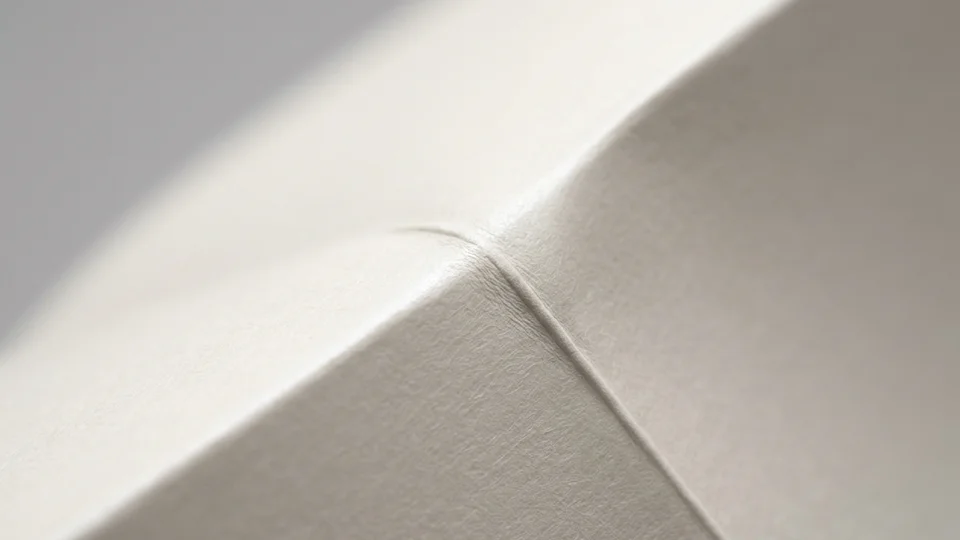
Why it happens: when a sheet folds, the outside of the bend stretches and the inside compresses. A thin sheet copes with that. A thicker sheet stretches more on the outside, and a brittle coating cannot stretch with it. The crease gives the sheet a hinge to bend around.
Points to plan for:
- 157 gsm usually folds without a creasing pass. The brochure page describes 157 gsm gloss art paper as folding cleanly at that weight.
- Card is always creased. 310 to 350 gsm matt art card and 300 gsm uncoated woodfree are creased before folding.
- Lamination comes first. Film is bonded to the flat sheet, then the sheet is creased, then it is folded. Reversing that order risks film lifting at the fold.
- Dark solids across folds need care. Heavy ink coverage makes a crack easier to see. The brochure page suggests keeping total ink under 300% on any panel folded through a solid, and avoiding a hard image edge exactly on a fold.
Creasing adds a step to the job, and it is included in the quoted schedule. Standard turnaround is 7–14 working days.
Should brochure paper be coated or uncoated?
Coated paper has a smooth mineral surface that holds ink on top, so photographs keep their contrast and colours stay bright. Uncoated paper absorbs more ink into the sheet, so images look softer and colours more muted, but the surface feels natural and takes a pen. Choose coated for image-led brochures and uncoated when writing or a natural feel matters.
| Surface | Look | Feel | Writable | Good for |
|---|---|---|---|---|
| Gloss coated | Bright colours, strong contrast, some reflection | Smooth and slick | Poorly, unless matt laminated | Product ranges, travel, property, food |
| Matt coated | Even colour without glare | Smooth, low sheen | Better than gloss | Corporate profiles, text-heavy brochures |
| Uncoated woodfree | Softer images, muted colour | Natural, slightly textured | Yes | Education, architecture, brochures with forms to fill in |
Two small-text points from the brochure page are worth applying whichever surface you choose: set small black text in 100% K, at no less than 7 pt on coated paper and 8 pt on uncoated paper, where ink spreads slightly into the fibres.
If you are unsure, a printed sample on each surface is more useful than a description. The guide on how to compare paper and material samples explains what to look at.
Does lamination change which paper weight you should choose?
Lamination bonds a thin plastic film to the printed sheet. It adds stiffness, protects dark colours from scuffing and helps the sheet resist handling, so a laminated 157 gsm brochure feels firmer than an unlaminated one. It also adds a production step, and the sheet must be laminated flat before it is creased and folded.
Things to weigh up:
- Humidity. Singapore’s mean annual relative humidity is around 82%, according to the Meteorological Service Singapore. Paper takes up and gives off moisture, and a brochure that moves between air-conditioned rooms and outdoor areas can turn slightly wavy. Lamination slows that exchange.
- Both sides or one. Laminating only one side can make a sheet curl towards the film. Laminating both sides keeps the pull balanced. Ask which suits your stock.
- Matt, gloss or soft-touch. Matt film cuts glare and is easier to write on with the right pen. Gloss film makes colours look stronger. Soft-touch has a velvety feel.
- Lighter papers. On a very light sheet, lamination changes the feel more than on card. If you want a light brochure that still feels sturdy, compare a laminated sample of the lighter paper with an unlaminated sample of the heavier one.
Lamination is a finishing choice rather than a fix for the wrong weight. If the brochure has six panels, choose a paper that folds well first and add film for protection.
How do you check a paper weight before committing to a run?
Ask for a blank folded dummy or paper samples at the proposed weight, and fold them to your actual panel layout. Check how the brochure closes, how it sits in a rack or folder, whether dark areas show through, and how it feels in the hand. A short physical check settles most weight decisions faster than comparing numbers.
A simple checklist:
- Fold it the real way. Use the same fold and panel widths as the artwork. A sheet that folds well in half may spring open as a tri-fold.
- Test show-through. Hold a printed sample with dark areas on one side up to the light you expect at the venue or in the office.
- Check the stack. Put twenty folded dummies together. Thickness and springiness are easier to judge in a stack than one at a time.
- Think about how it travels. If the brochure goes into envelopes, folders or event bags, check the folded size and weight fit.
- Write the decision down. Put the chosen stock, finish and fold in the quote request so everyone works from the same specification.
The materials page describes the papers and cards used across products.
Worked example: choosing the paper for a seminar tri-fold
Hypothetical illustration. Figures are assumptions for explanation, not a real transaction or advice. A training provider needs 1,000 A4 tri-fold brochures for a public seminar and a follow-up mailing. The example follows the paper decisions in order: the fold, the weight, the surface, the finish and the final specification sent for a quotation.
Step 1: Confirm the fold. The brochure has six panels: a cover, a back panel with contact details and four content panels. It folds from A4 to DL 99 × 210 mm. The designer asks for the tri-fold template so the tuck-in panel is cut about a millimetre narrower.
Step 2: Choose the weight. The team considers 310 gsm card for a premium feel, but six panels on card will not close flat. They compare 128 and 157 gsm samples, folded to the real layout. The cover has a solid navy background, and on 128 gsm the navy shows faintly through the inside panel. They choose 157 gsm.
Step 3: Choose the surface. The inside panels include a short registration form that attendees fill in. Gloss art paper would be harder to write on, so the team asks whether matt lamination on the outside only would keep the inside writable. They decide to laminate the outside face and leave the inside unlaminated.
Step 4: Check the weight for mailing. At about 9.8 g per sheet before film, 1,000 brochures are roughly 10 kg plus lamination and cartons. The team plans the carton split for the seminar venue and the mailing separately.
Step 5: Send the specification. The coordinator sends the brief through the quote request: 1,000 A4 tri-folds, 157 gsm gloss art paper, 4C/4C, matt lamination outside, folded to DL, print-ready PDF with folds on a separate layer, and the required date. The specification and schedule are confirmed in the quotation. Timing is agreed when the job is confirmed.
Frequently Asked Questions
What paper weight is usual for a folded brochure?
A six-panel A4 tri-fold is commonly printed on 128 or 157 gsm gloss art paper. A two-panel bi-fold can take a heavier card of 310 to 350 gsm, as long as it is creased before folding. The number of panels sets the upper limit more than the design does.
When does brochure paper need creasing before it is folded?
Sheets above about 170 gsm are creased before folding, otherwise the coating can crack along the fold and show a white line through dark colour. A laminated sheet is laminated flat first, then creased, then folded.
Is a heavier brochure always better?
No. Weight adds stiffness, but past a point it fights the fold. A six-panel brochure on heavy card will not close flat, and a heavier sheet adds to the weight of every carton and mailing. Choose the lightest sheet that does the job.
Can I see the paper before I order?
Yes, ask for paper samples or a blank folded dummy at the proposed weight. Folding a real sheet to your panel layout is the most reliable way to judge stiffness, show-through and how the brochure sits when closed.
What should go into a brochure paper specification?
A complete brochure paper specification names the flat and folded size, the fold, the paper weight and surface, any lamination and on which sides, the quantity and the required date. With those details fixed, the stock can be checked against the fold, and creasing and finishing can be planned into the schedule from the start.
- Flat size and folded size, with the fold named.
- Paper weight and surface: gloss, matt or uncoated.
- Creasing confirmed for anything above about 170 gsm.
- Lamination: none, one side or both, and matt, gloss or soft-touch.
- Print-ready PDF with folds on a separate, non-printing layer.
- Quantity and required date.
Standard turnaround is 7–14 working days. Same-day printing available. Subject to artwork, stock and production capacity confirmation. Timing is agreed for each job. To start, send your specification through the request a quote page.
Same-day printing available. Subject to artwork, stock and production capacity confirmation. Timing is agreed for each job.