
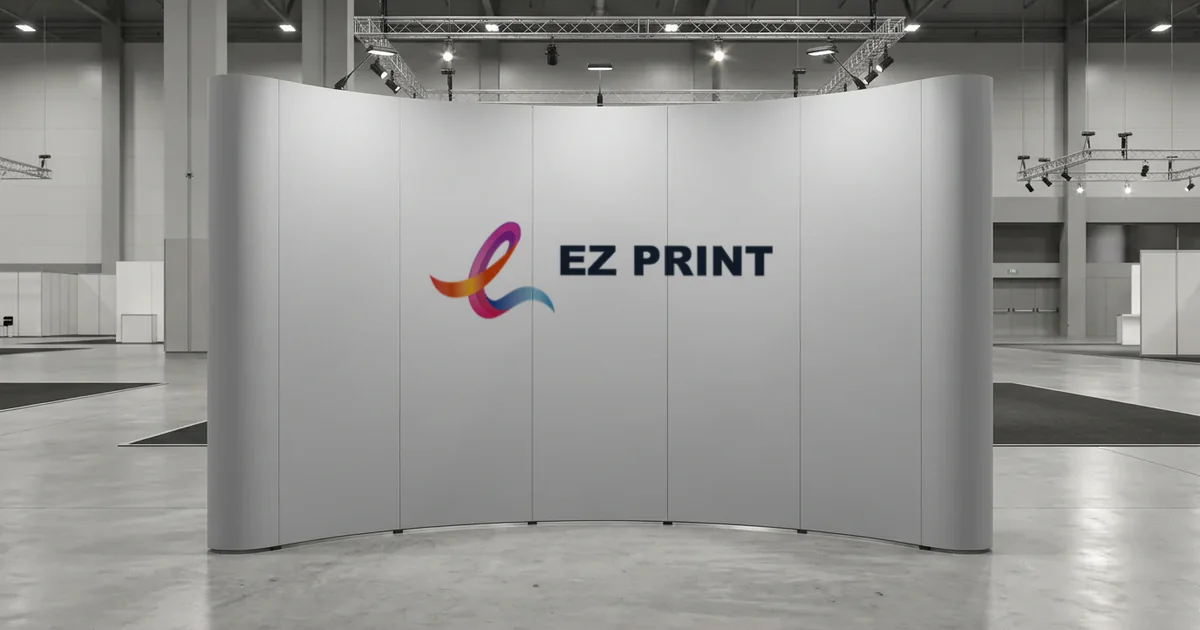
A pop-up display system is a folding lattice frame that opens into a wall without tools, dressed in printed panels that hang on magnetic bars and overlap so the joins are hidden. In Singapore the usual backdrop is a 3 × 3 set, straight or curved, about 2250 mm tall, and 3 × 4 is the other standard set. Getting it right is mostly about the panel grid: the artwork has to be composed to the joins the frame imposes.
What is a pop-up display system?
A pop-up display is a concertina lattice frame that opens and locks into a wall, carrying printed panels on magnetic bars across its face. The panels overlap slightly, so from a normal aisle distance the wall reads as one surface. Everything collapses into a wheeled case, which usually converts into a plinth once the wall is up.
The system has three parts, and each is specified separately:
- The frame: a folding lattice that is assembled without tools. Curved and straight are not two products; they are the same frame assembled with a different set of the same parts.
- The graphic panels: printed and laminated drops that attach magnetically to the frame, each overlapping the next so the joins are hidden.
- The case: a wheeled case that carries the frame and the rolled panels between events.
Pop-ups suit shell-scheme stands, roadshow modules and conference foyers, anywhere the same crew rebuilds the same wall repeatedly without tools. They do not suit an outdoor site, because the frame is a lattice rather than a wind-loaded structure. If you are still choosing between a pop-up and a fabric frame, read our comparison of tension fabric backdrops and pop-up displays.
Straight or curved: which pop-up configuration should you choose?
Choose straight for a flat wall at the back of a stand or as a media backdrop, and curved for a wall that wraps the visitor. Both are the same hardware set differently. The standard sets are 3 × 3 and 3 × 4, straight or curved, and a straight frame is also available dressed on both sides.
| Configuration | Shape | Typical use | Notes |
|---|---|---|---|
| 3 × 3 straight | Flat wall | Back wall of a stand, photo or interview backdrop | The usual backdrop, about 2250 mm tall |
| 3 × 3 curved | Arc | A wall that wraps the visitor on a stand | Same parts as straight, assembled differently |
| 3 × 4 straight | Flat wall | The other standard straight set | Ask for the panel template |
| 3 × 4 curved | Arc | The other standard curved set | Ask for the panel template |
| Straight, double-sided | Flat wall printed on both faces | A wall seen from both sides | Graphics on front and back |
| Lead time | All of the above | Standard 7–14 working days | Graphic and hardware |
The set name identifies the system; it does not give you the artwork size. The panel count, the panel widths and the overlap are hardware geometry that belongs to the specific frame, so ask for the template for the exact set before the design starts rather than estimating it from a photograph. Say the system and the visible size, and the printed size comes back as a figure.
What are pop-up panels printed on?
Pop-up panels are printed on laminated roll media: a printable film with a matt or satin laminate bonded over the face, stiff enough to hang flat off a magnetic bar and flexible enough to roll into the case without cracking. Matt is the right finish, because a gloss panel under exhibition lighting behaves like a mirror.
Exhibition lighting is directional, and a gloss-laminated panel reflects it straight into the visitor’s eyes. A matt laminate stops the join catching an aisle spotlight as well. The panelled version feels smooth, cool and slightly springy; run a fingertip across a seam and you find a step you cannot see from two paces back.
There is an alternative to separate panels: a one-piece stretch skin in woven polyester that goes over the whole frame like a pillowcase. It hides the joins completely, but it cannot be re-panelled when only one section of the message changes. Panels are the better choice when one part of the wall, such as a product panel or a date, changes between events while the rest stays the same.
Panels are printed in full colour, then laminated matt and magnetically fitted to the frame as a separate finishing step. Colour is built in CMYK, with Pantone references where a brand colour has to match across fabric and panel elements.
How should artwork be set up across the panel joins?
Get the panel grid first and compose to it. The grid is fixed by the hardware, not by the design, so a logo that straddles a join is cut by a physical step in the surface. Run background across the joins, and hold anything that must read cleanly, such as a logo, a headline or a phone number, inside a single panel.
The most common mistake is laying the artwork out as one flat rectangle and letting somebody else decide where it splits. The joins move slightly between builds, so a design with nothing critical near a panel join never notices. The working rules:
- Panel joins: marked on a separate layer, with the overlap shown, so every join is visible while you design.
- Safe margin: keep important content 60 mm inside the visible area, because frames and joins move slightly.
- Resolution: 100 dpi at final size. An exhibition graphic is read from two metres and up.
- Type size: a 40 mm cap height minimum for anything read across an aisle.
- File: PDF/X-4 at final size, or at a stated fraction with the scale in the file name.
- Colour: CMYK, with Pantone references for colours that must match other stand elements.
What to avoid on a join: a face, a wordmark or a hairline rule. Each of those breaks visibly at the overlap.
Can new graphics be printed for a pop-up you already own?
Yes. Replacement graphics fit existing frames where the system and the aperture match, and a print-only set of panels can be ordered without the structure. The hardware is the durable part and the message is what changes, so a reprint for a frame in the store cupboard is a much smaller job than a new stand.
To order replacement panels, send:
- The system: straight or curved, and the set, such as 3 × 3 or 3 × 4.
- The visible size: measured on the frame, or taken from the original order.
- Which panels change: a whole set, or only the panels whose message has moved on.
Because panels hang separately, a single panel can be reprinted while the rest stay in the case. That is the main reason to choose panels over a one-piece skin when a stand travels to several events a year. For new hardware with graphics, see exhibition stand printing.
How is a pop-up transported and rebuilt?
Hardware travels in cases and is rebuilt at each event, so a pop-up is judged on its fourth build rather than its first. A wheeled case sized to the system and a printed build sequence packed with the hardware are what keep later builds as good as the first one, whoever is on shift.
Panels roll into the case, which is why the laminate has to be flexible enough to roll without cracking. Keep the printed build sequence with the hardware so that anyone can follow it. For a portable banner to stand beside the wall, see pull-up banner printing.
Worked example: how would a 3 × 3 curved pop-up be specified?
A company exhibiting at several trade shows a year wants one backdrop that its own staff can rebuild, with one panel that changes per show. A 3 × 3 curved pop-up with laminated panels, a joins layer in the artwork and a wheeled case fits that brief, with the changing message held inside one panel.
Hypothetical planning example. Actual production timing, paper availability, and logistics are confirmed individually upon artwork and specification review.
A company sets out its requirements for an indoor exhibition backdrop:
- System: one 3 × 3 curved pop-up display, about 2250 mm tall, with frame, magnetic bars and wheeled case.
- Panels: printed in full colour on laminated roll media with a matt laminate.
- Template: the panel template for the exact frame is requested before design, with joins and overlaps on a separate layer.
- Layout: the logo and headline sit inside the centre panel; the background image runs across all joins; the event-specific message sits inside one end panel so it can be reprinted alone.
- Type and resolution: the headline above the 40 mm cap height minimum; images at 100 dpi at final size.
- File: PDF/X-4 at a stated fraction, with the scale in the file name.
Timing. The exhibition date is fixed, so the company counts back from the build day using the upper end of the standard 7–14 working day window and approves the artwork before that point. For the second show it orders only the end panel, quoting the same system and size.
Frequently asked questions
How tall is a standard pop-up display?
A 3 × 3 straight or curved pop-up is the usual backdrop and stands about 2250 mm tall, built from overlapping magnetic panels on a folding lattice frame. Ask for the exact panel sizes for the frame you choose before the artwork starts.
What is the difference between a straight and a curved pop-up display?
They are the same hardware assembled with a different set of the same parts. A straight pop-up makes a flat wall, a curved one bends the wall into an arc, and both carry printed panels on magnetic bars.
Should pop-up panels be matt or gloss?
Matt. Pop-up panels are printed on laminated roll media with a matt or satin laminate, because exhibition lighting is directional and a gloss panel reflects it straight into the visitor’s eyes.
Can new graphics be printed for a pop-up frame I already own?
Yes. Replacement graphics fit existing frames where the system and the aperture match, and a print-only set can be ordered without the structure. Say which system you own and its size, and the printed panel sizes come back as figures.
How long does a pop-up display take to produce?
Standard turnaround is 7–14 working days for the graphic and for the hardware, and the panels are laminated and fitted to the frame inside that window. Exhibition dates do not move, so ask for an express quotation if the date is tighter.
How do you get a quote for a pop-up display from EZ Print?
EZ Print produces exhibition and roadshow graphics in Singapore, including pop-up displays, and has traded since 2017. Send the system, straight or curved, the set size, whether you need hardware or panels only, and the event date. Standard turnaround is 7–14 working days; express is quoted per job, with island-wide courier delivery.
When the specification is ready, request a quote and include the event date so the schedule is confirmed against it.
Same-day and urgent printing available. Subject to artwork approval, payment, print type and production availability. Timing confirmed per job.