
EZ Print — Your Trusted Printing PartnerUrgent & ExpressRequest a quote
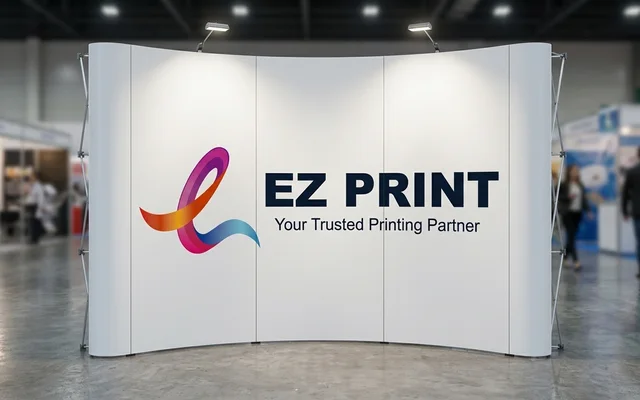
A curved tension fabric exhibition media backdrop with checkerboard EZ Print branding in an exhibition hall.

Exhibition and roadshow

Exhibition stands, and the frame that eats your artwork

Every display system takes a margin. A silicone edge is sewn into the graphic, a pop-up panel overlaps its neighbour, a gazebo valance wraps a bar. Design without knowing which, and the logo goes into a channel.

  • Standard7–14 working days
  • ExpressSame-day printing available

Exhibition stand graphics in Singapore, in one paragraph

EZ Print produces exhibition and roadshow graphics in Singapore, and has done since 2017. The systems are pop-up displays with magnetic panels on a folding frame, SEG fabric systems where a printed cloth with a silicone edge is tensioned into an extrusion, modular towers and counters, branded gazebos, and teardrop and feather flags. Every one of them takes an allowance off the artwork: an SEG graphic is printed larger than the visible aperture because the silicone bead is sewn into the seam, and a pop-up panel overlaps its neighbour along a magnetic strip. Fabric graphics are printed by dye sublimation, so the colour is in the fibre and the cloth can be folded for transport without creasing permanently. Hardware travels in cases and is rebuilt at each event, which is why the graphic has to tolerate handling rather than only look right on day one. EZ Print quotes from the specification and does not publish prices.

Products quoted on this page

Specifications, formats and enquiry details for each product quoted on this service.

6 formats
  • Curved pop-up display backdrops with magnetic graphic panels, with the EZ Print logo.
    Displays & events

    Pop-Up Display

    A collapsible frame dressed in printed panels that makes a backdrop wall at a booth, straight or curved.

    Also ordered as: Pop-Up Backdrop, Pop Up Stand, Magnetic Pop-Up, Curved Pop-Up, Straight Pop-Up

  • Tension fabric display stands with seamless stretch fabric cover, with the EZ Print logo.
    Displays & events

    SEG Fabric Display

    A dye-sublimated fabric held in an aluminium frame by a silicone edge sewn around its border.

    Also ordered as: Tension Fabric Display, Fabric Backwall, SEG Frame, Fabric Lightbox, Silicone Edge Graphic

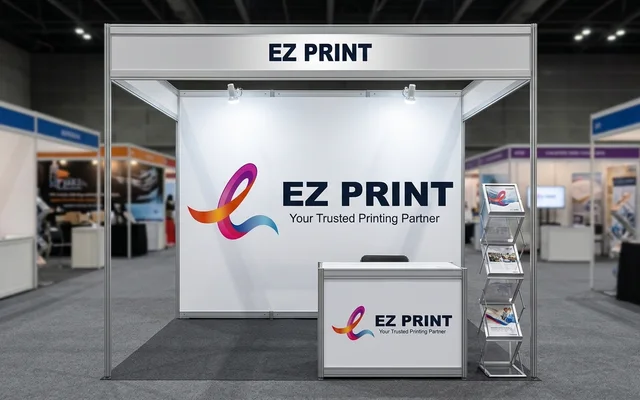
  • Modular exhibition booth display walls and branded counter graphics, with the EZ Print logo.
    Displays & events

    Exhibition Booth

    A complete stand of walls, towers and counters with graphics, fitted to the space allotted at a show.

    Also ordered as: Trade Show Booth, Roadshow Booth, Modular Booth, Shell Scheme Graphics, Exhibition Stand

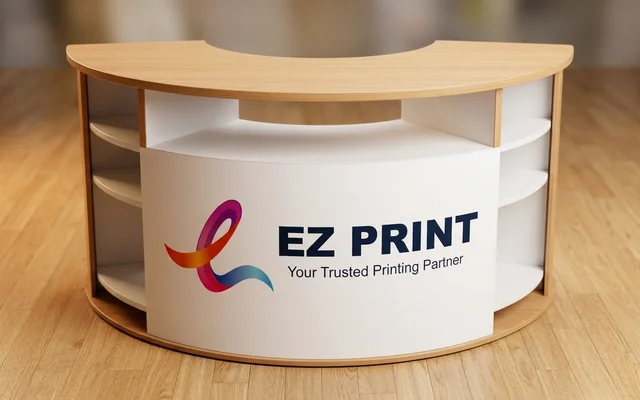
  • Portable promotion counters with wraparound graphic and top header board, with the EZ Print logo.
    Displays & events

    Promotion Counter

    A portable counter wrapped in printed panels, for sampling, sign-ups and roadshow sales.

    Also ordered as: Promo Counter, Roadshow Counter, Pop-Up Counter, Sampling Table, Portable Counter

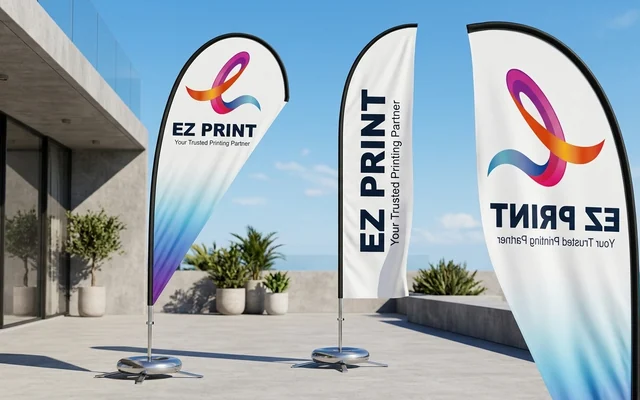
  • Feather flying banners with curved mast and ground stake base, with the EZ Print logo.
    Displays & events

    Flying Banner

    A tall printed flag on a flexible pole that catches the wind, on a ground spike or water base.

    Also ordered as: Feather Flag, Wind Flag, Teardrop Flag, Beach Flag, Blade Flag, Sail Flag

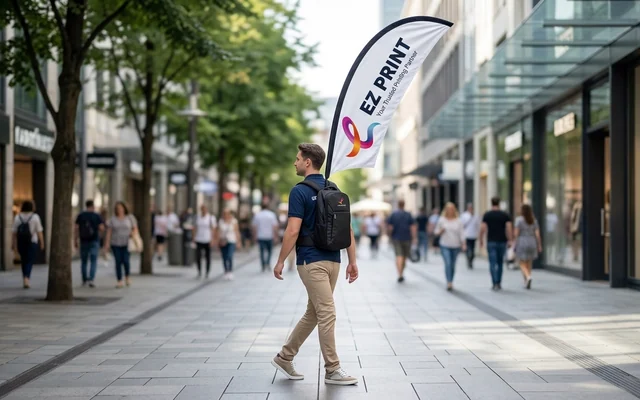
  • Wearable backpack banners for mobile outdoor event promotions, with the EZ Print logo.
    Displays & events

    Backpack Banner

    A printed flag or board worn on a harness, so a promoter can carry the message through a crowd.

    Also ordered as: Backpack Flag, Walking Billboard, Man Pack Sign, Wearable Banner, Wearable Sandwich Board

All 140 products, by family

The specification an exhibition graphic is quoted from

Which system, the finished visible size, and whether the hardware already exists. A replacement graphic for a frame in a store cupboard is a much smaller job than a new stand, and the frame decides every allowance.

An exhibition graphic is measured in metres and is not drawn here at true size. What is worth stating exactly is the allowance each system takes, because that is what a designer works to and it is the figure most often missing: about 20 mm beyond the visible aperture on an SEG fabric seam, an overlapping strip on each pop-up panel, and a wrap allowance on a gazebo valance. Those are stated as figures below. A reduced picture of a three-metre backdrop teaches nothing that the aperture dimension does not already say.

20mm


A typical seam allowance on an SEG fabric graphic — printed beyond the visible aperture so the silicone bead can be sewn in. Artwork inside it is artwork inside the extrusion.

Systems
Pop-up displays, SEG fabric frames, modular towers and counters, branded gazebos, teardrop and feather flags.
Sizes
Stated as the visible aperture in millimetres. The printed graphic is larger by the system allowance.
SEG allowance
About 20 mm beyond the aperture on every edge, taken by the seam and the silicone bead.
Pop-up panels
Overlapping magnetic panels. Each overlap hides a strip of the panel beneath it.
Fabric
Dye sublimated, so colour is in the fibre. Folds for transport without a permanent crease.
Hardware
Cases, frames, extrusions and poles supplied with the graphic and rebuilt at each event.
Reuse
Replacement graphics fit existing frames where the system and the aperture match.
Turnaround
Standard is 7–14 working days for the graphic and for the hardware. Express is quoted per job.

What to ask for

1 SEG fabric backdrop, 3000 × 2300 mm visible aperture
Dye-sublimated fabric with a silicone edge sewn all round
Printed 20 mm beyond the aperture on every edge for the seam
Aluminium extrusion frame with a wheeled case
Nothing important within 60 mm of any edge
Print-ready PDF at quarter size, scale stated in the file name
Needed by — your date

The material

Materials and systems

Exhibition graphics are cloth, film or board held flat by hardware, and the hardware is the reason each material behaves the way it does. None of this is a sheet from the caliper table, so none of it carries a caliper here.

Dye-sublimated display fabric

Also sold as SEG fabric, tension fabric, display cloth.

A woven polyester printed by heating dye into the fibre, so the colour is part of the cloth rather than a layer on top of it. It folds for transport and hangs out again.

Under ink
Sublimated dye. Colour is slightly softer than on vinyl and completely non-reflective, which is what an exhibition hall needs.
Best for
SEG frames, tension backdrops, table throws, anything transported repeatedly.
Avoid for
Hard-edged geometric artwork right at the seam. The cloth tensions and shifts a millimetre or two.
On the schedule
Printed, then the silicone edge is sewn in before it will grip an extrusion.

Pop-up display panel

Also sold as pop-up graphic panel, magnetic display panel, roll-up panel set.

Printed and laminated panels that attach magnetically to a folding lattice frame, each overlapping the next so the joins are hidden.

Under ink
Printed on a stay-flat material with a matt laminate. Gloss under exhibition lighting is a mirror.
Best for
Curved and straight pop-up backdrops, roadshow stands that are rebuilt weekly.
Avoid for
Fine detail across a panel join. The overlap is a physical seam and it moves slightly between builds.
On the schedule
Printed and laminated, then fitted panel by panel to the frame.

Aluminium extrusion frame

Also sold as SEG frame, tension frame, modular extrusion.

An aluminium channel with a groove that grips the silicone bead sewn into the fabric edge, pulling the cloth drum-tight across the opening.

Under ink
Not printed. Anodised silver or powder-coated black.
Best for
Backdrops, lightboxes, modular walls, anything that must look seamless.
Avoid for
Mixing systems. A silicone bead is sized to its own extrusion and is not interchangeable.
On the schedule
Supplied with the graphic.

Gazebo canopy and valance

Also sold as pop-up tent, event gazebo, branded canopy.

A printed polyester canopy on a folding frame, with a valance skirt around the edge that carries most of the branding.

Under ink
Dye sublimated for outdoor colour stability. The valance wraps a bar, so a wrap allowance is taken.
Best for
Roadshows, outdoor activations, market stands.
Avoid for
Artwork sized to the flat canopy panel. The panel is stretched over a curved frame and the shape changes.
On the schedule
Printed as panels, then stitched into a canopy and a valance.

Flag fabric and pole set

Also sold as teardrop flag, feather flag, beach flag.

A shaped printed cloth sleeved onto a flexible pole, with a base that is chosen for the ground — a spike for grass, a cross base or a water base for a hard floor.

Under ink
Dye sublimated and usually visible from both sides, with the reverse reading as a mirror image unless a blockout layer is specified.
Best for
Outdoor wayfinding, roadshow presence, anything seen from a distance in motion.
Avoid for
Detailed artwork. A flag moves, and it is read as a shape and a colour.
On the schedule
Printed, then hemmed and sleeved onto the pole.

If hardware already exists, say the system and the aperture size. A replacement graphic is a fraction of the work of a new stand, and the hardware is the part that was always meant to be kept.The materials library

The case is not an accessory. A stand that travels four times a year and is rebuilt by whoever is on shift lives or dies by how it packs, and a wheeled case is usually the difference.

Sewing, fitting and the case

Exhibition finishing is fabrication rather than print finishing. A silicone bead is sewn into a fabric edge, panels are laminated and fitted to a frame, a canopy is stitched, and everything is packed into a case that has to survive a loading bay.

Exhibition fabrication: what each operation needs, and whether the hardware is kept for the next event
FinishToolingWhat the reorder pays for
Silicone edge sewingA silicone bead sewn into the fabric edge, sized to its own extrusionNoneNothing to make, so nothing to remake.
Panel lamination and fittingPop-up panels laminated matt and magnetically fitted to the frameNoneNothing to make, so nothing to remake.
Frame assemblyExtrusions cut, corners fitted, and the graphic test-tensioned before it shipsNoneNothing to make, so nothing to remake.
Canopy stitchingGazebo canopy and valance sewn and fitted to the frameNoneNothing to make, so nothing to remake.
Case packingA wheeled or padded case sized to the system for repeat transportNoneNothing to make, so nothing to remake.

Scroll the table sideways to see every column.

Every operation here is quoted inside the standard window. What changes between a first order and a second is the tooling: a die, a block or a screen is made once and then kept on file with your approved artwork, which is why the reorder of a job carrying one is a different job from the first.

A stand is not judged on the day it is printed. It is judged on the fourth build, by somebody who was not at the first one, working from whatever is in the case.

Pairings that work

  • An SEG fabric backdrop with the artwork extended 20 mm beyond the aperture on every edge. It tensions drum-tight and the seam disappears.
  • A pop-up display with the message centred and nothing critical near a panel join. The joins move slightly between builds and the design never notices.
  • Dye-sublimated fabric for anything transported. It folds into a case, hangs out again and does not crease permanently.
  • A wheeled case and a printed build sequence packed with the hardware. The fourth build is as good as the first.

Combinations that fail

  • Artwork sized to the visible aperture on an SEG frame. The seam takes about 20 mm on every edge and the design is cropped by the extrusion.
  • A hard-edged geometric pattern meeting a fabric seam. The cloth tensions by a millimetre or two and every misalignment is visible.
  • Gloss-laminated pop-up panels. Exhibition lighting is directional and a gloss panel reflects it straight into the visitor’s eyes.
  • A gazebo design drawn on a flat rectangle. The canopy is stretched over a curved frame, so a centred logo drifts off centre once it is up.

Systems and their working sizes

Exhibition hardware is standardised because stands are rebuilt by different people in different halls. The sizes below are the ones that ship in a case and go up without tools.

Pop-up · 3 × 3 straight or curved
The standard backdrop. About 2250 mm tall, in overlapping magnetic panels.
SEG backdrop · to about 3000 × 2300 mm
A single seamless cloth in an extrusion. Larger sizes join at a frame member.
Modular tower
A freestanding column, usually 400–600 mm square and around 2200 mm tall.
Counter
A curved or straight desk with a printed wrap and a shelf inside.
Gazebo · 3 × 3 m
A folding frame with a printed canopy and valance. Walls optional.
Teardrop and feather flags
About 2.5 m to 4.5 m tall on a flexible pole, with a base chosen for the ground.

Draw to the printed size, not the visible size

One sentence solves most exhibition artwork problems: the printed graphic is bigger than the hole you see it through. Every system has an allowance, and the allowance is a number that can be asked for before the design starts.

The file

Format
PDF/X-4 at final size, or at a stated fraction with the scale in the file name.
Printed size
The visible aperture plus the system allowance — about 20 mm per edge on SEG fabric.
Safe margin
60 mm inside the visible aperture. Frames, seams and tension all move slightly.
Panel joins
Marked on a separate layer for pop-up systems, with the overlap shown.
Resolution
100 dpi at final size. An exhibition graphic is read from two metres and up.
Existing hardware
Say the system and the aperture. The exact printed size comes back as a figure.

The colour, and the detail

Colour mode
CMYK, with Pantone references where fabric and panel elements must match each other.
Fabric versus vinyl
The same file reads slightly softer on sublimated fabric than on a laminated panel. Match critical colours across the two deliberately.
Rich black
A four-colour black. K100 on fabric reads as charcoal under hall lighting.
Minimum type
40 mm cap height for anything read across an aisle; larger on a flag, which moves.
Edge patterns
Avoid a border or a hard geometric edge near a seam. Tension moves it and the eye catches it.
Flags
Artwork reads mirrored on the reverse unless a blockout layer is specified. Design for the shape, not the detail.

Say the system and the visible aperture before the design starts, and the exact printed size and safe area come back as figures — which is the difference between a backdrop that tensions perfectly and one that has a logo in the extrusion.

Turnaround

Fabrication time, and it is not compressible

  • Standard

    Standard turnaround is 7–14 working days.

    Standard orders. The schedule for specialist finishing is confirmed in your quotation.

  • Express

    Same-day printing available.

    Subject to artwork, stock and production capacity confirmation. Timing is agreed for each job.

What sets the date
Fabrication rather than printing. A silicone bead is sewn into a fabric edge, panels are laminated and fitted, a canopy is stitched, a case is packed to size. Every system here is assembled after it is printed, and all of it is quoted inside the standard window.
What a reorder skips
The hardware. Frames, extrusions, poles and cases were always meant to be kept, so a replacement graphic for a system already in your store cupboard is a fraction of the work of a new stand — say the system and the visible aperture and it fits.
If the date is tight
Exhibition dates do not move, so send the system, the visible aperture and the date and ask for an express quotation. We confirm the specification, production schedule and next steps in the quotation.

Exhibition dates do not move, so the specification is worth settling as early as the stand design allows. The graphic can change late; the hardware cannot.

Every answer here is in the page source at full opacity, open or closed. An answer engine has to be able to read it without executing anything.

Questions asked about exhibition stands

What is an SEG fabric display?

A silicone edge graphic. A printed cloth has a silicone bead sewn into its edge, and that bead pushes into a groove in an aluminium extrusion, pulling the fabric drum-tight across the frame. The result is seamless and frameless-looking, and the graphic packs into a bag rather than a crate.

How much bigger than the frame should my artwork be?

About 20 mm beyond the visible aperture on every edge for an SEG fabric graphic, because the seam and the silicone bead take that. Other systems take other allowances. Say which system you are using and the exact printed size comes back as a figure.

Can I get new graphics for a stand I already own?

Yes, and it is the point of a modular system. Say the system and the visible aperture size, and a replacement graphic is made to it. The hardware is the durable part; the message is what changes between campaigns.

Why is fabric better than vinyl for an exhibition backdrop?

Because it travels. Dye-sublimated fabric has the colour in the fibre, folds into a bag and hangs out again without a permanent crease, and it does not reflect hall lighting. A laminated vinyl panel has to be rolled or crated and it reflects every spotlight aimed at it.

What size is a standard pop-up display?

A 3 × 3 straight or curved system is the usual backdrop, roughly 2250 mm tall, built from overlapping magnetic panels on a folding lattice frame. The overlaps hide the joins, which is why nothing critical should sit on one.

How long do exhibition graphics take?

Standard turnaround is 7–14 working days, and it is the same window whether the graphic fits a frame you already own or the hardware is supplied with it. What fills the window is fabrication rather than printing: every system here is sewn, laminated, fitted or assembled after the graphic comes off the press. Where an exhibition date is tighter than that, ask for an express quotation with the system and the visible aperture on it, and the order is prepared against that specification.

Do flags read the same on both sides?

A single-layer flag reads as a mirror image on the reverse. Where both sides must read correctly, a blockout layer is specified between two printed faces. Either way, design a flag as a shape and a colour rather than as a detailed image — it moves.

  • Trading since 2017 — EZ PRINT PRIVATE LIMITED, UEN 201706183R.
  • Standard turnaround is 7–14 working days. For urgent orders or express schedules, please check with EZ Print.
  • Artwork is checked before production.
  • Island-wide courier delivery within Singapore.
  • Collection can be arranged on request.

Ask for a quote on this stand

Every job is quoted from its specification — stock, quantity, sides, finish, size and deadline.

  • Quantity
  • Stock — or the feel you want, if you do not know the stock
  • Sides printed
  • Finish
  • Flat and finished size
  • The deadline

Artwork is welcome but not required to start. Email sales@ezprint.com.sg if you would rather attach files.