
- What it is
- A rigid double-sided credential card worn on a neck lanyard at a conference, trade exhibition or corporate summit. One artwork master carries the event identity while a variable-data pass merges each attendee’s name, company, role tier and QR code from a spreadsheet onto individual sheets. The card is finished with film lamination, radiused corners and a single oblong slot or twin round holes along the top edge so it hangs flat without needing a separate plastic pouch.
- What it is printed on
Heavy coated art card sealed in matt or gloss film lamination, or tear-resistant synthetic stock when the pass must survive outdoor humidity and heavy handling at a multi-zone venue. Matt art card under a matt film is the standard specification for indoor halls because overhead truss lighting and smartphone cameras read the printed QR code and attendee name without specular glare.
- Matt art card, 350 gsm0.36 mmStiff enough to hang flat on a lanyard clip without bowing, and dull enough to keep names and QR codes legible under hall spotlights.
- Synthetic stock, 200 micron0.20 mmTear-resistant around the punched lanyard slot without needing a pouch, suited to outdoor or high-wear accreditation.
- Art card, 310 gsm0.28 mmA crisp coated sheet for vivid sponsor colour bars when paired with matt lamination to control glare.
- How it feels
- Stiff, sealed and balanced on the lanyard clip. Flush film lamination across a heavy card gives a smooth, slightly rounded edge that does not curl against a jacket or shirt, while radiused corners prevent the sharp points of a guillotined card from catching on clothing. A single central slot lets a single-hook lanyard spin; twin top slots clip to a double-ended lanyard so the attendee name always faces forward.
- What it suits
- Conferences, trade shows, AGM registration desks, VIP hospitality suites and speaker or crew accreditation where credentials must be read across a table or photographed cleanly. It does not suit last-minute handwritten changes if a gloss film is specified — a permanent marker smears on gloss laminate unless an unlaminated signature strip or a matt writable surface is planned into the layout.
- Lead time
- Standard turnaround is generally 7–14 working days. Counted from approved artwork rather than from the enquiry.
- The common mistake
- Centring the headline logo in the top 15 mm of the card and forgetting to order unprinted role-coded spares. The lanyard slot punch removes a physical rectangle of board near the top edge, slicing straight through any crest placed too high, and a guest list that changes after press sign-off leaves the registration desk short unless blank role-tinted spares are printed on the same run.
Print idea
Conference badge pass
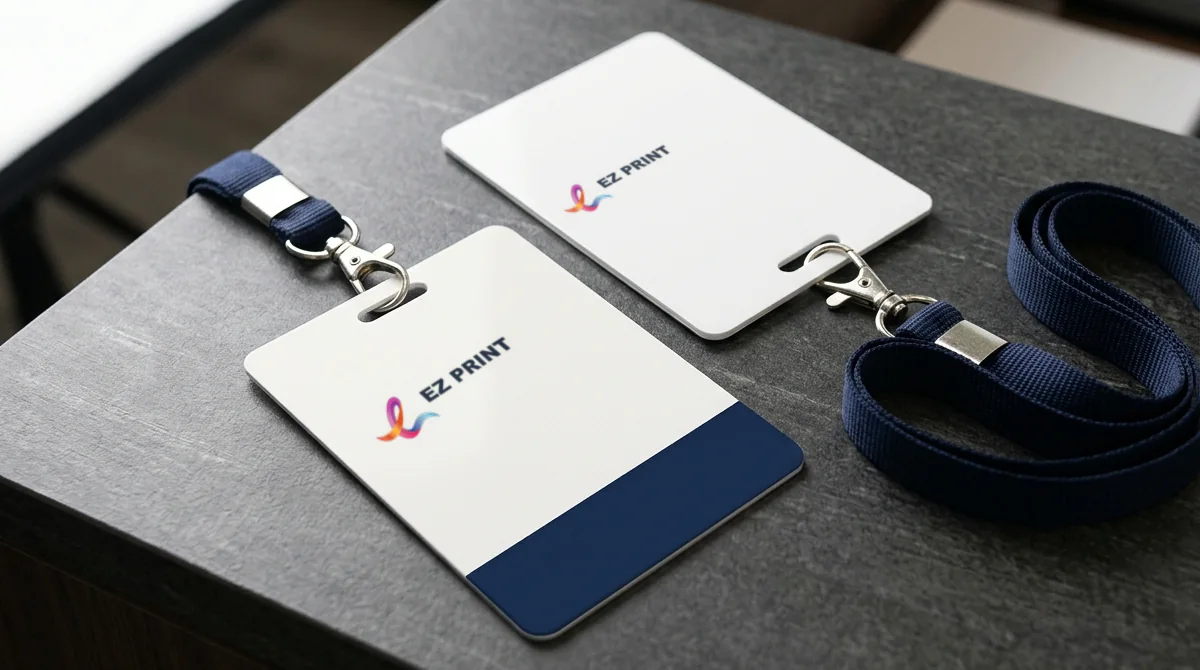
Laminated attendee credential pass printed with individual variable-data guest names, role colour bars and an oblong lanyard slot punch.
Standard turnaround is generally 7–14 working days.
What conference badge pass is
A rigid double-sided credential card worn on a neck lanyard at a conference, trade exhibition or corporate summit. One artwork master carries the event identity while a variable-data pass merges each attendee’s name, company, role tier and QR code from a spreadsheet onto individual sheets. The card is finished with film lamination, radiused corners and a single oblong slot or twin round holes along the top edge so it hangs flat without needing a separate plastic pouch.
Heavy coated art card sealed in matt or gloss film lamination, or tear-resistant synthetic stock when the pass must survive outdoor humidity and heavy handling at a multi-zone venue. Matt art card under a matt film is the standard specification for indoor halls because overhead truss lighting and smartphone cameras read the printed QR code and attendee name without specular glare.
No plateA conference pass is defined by its slot punch geometry, corner rounding and variable-data layout hierarchy rather than by a novel board core, so the cover shows a studio photograph of the finished laminated passes and lanyards.
The specification
Six fields, and the last one is the useful one.
The same six questions are answered for every entry in this section, in the same order, so two objects can be compared without reading two pages of prose. The mistake is stated last and stated plainly, because it is the one that costs a reprint and it is the reason this page is worth sending to a colleague.
Where this sits.
Every entry is indexed three ways, because a buyer arrives knowing the occasion, the object or the material and almost never all three.
- Application
- Format
- Material and effect
Also worth looking at
- Synthetic stock menus and tagsStandard turnaround is generally 7–14 working days.
- Die-cut shapesStandard turnaround is generally 7–14 working days.
- Perforation and scoringStandard turnaround is generally 7–14 working days.
- Every service, groupedSpecifications, stocks and finishing
- Every print idea, indexed three waysThe section index
- The materials libraryCaliper, weight and what each finish costs
Send the specification for this, and it comes back quoted.
Every job is quoted from its specification — stock, quantity, sides, finish, size and deadline.
- Quantity
- Stock — or the feel you want, if you do not know the stock
- Sides printed
- Finish
- Flat and finished size
- The deadline
Artwork is welcome but not required to start. Email sales@ezprint.com.sg if you would rather attach files.