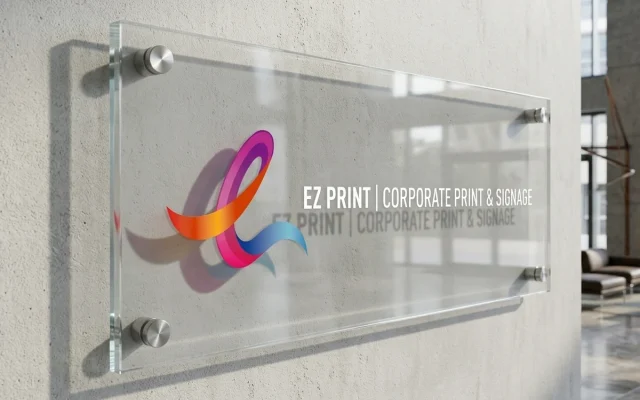
What is a custom acrylic sign?
A panel cut from acrylic sheet to your size and shape, printed, and finished at the edge. The sheet is clear, white, black or translucent, from 30 mm to 1200 mm wide, cut straight or laser-cut to an outline, and drilled for spacers if it goes on a wall. The material is part of the look: the edge and the depth of the sheet are what make it read differently from a printed board.
What is the difference between face print and reverse print on acrylic?
Face print puts the ink on the front of the panel, which suits white, black and translucent sheet. Reverse print puts it on the back of a clear panel, read through the sheet, with a white layer behind the colour, so the sheet protects the print and the front can be wiped. Only clear sheet takes a reverse print, and the file has to say which way round it reads.
How thick is an acrylic sign?
It depends on the sign. The ready-sized door and name strips are 4 mm sheet, and custom panels are quoted by thickness. A larger panel needs a thicker sheet and more fixings so that it does not bow, so give the finished size and the fixing and the thickness is quoted to suit.
How is an acrylic sign mounted on a wall?
Usually on spacers. The panel is drilled with one, two or four holes, positioned 25 mm in from the edges, and each spacer holds it off the wall so it throws a shadow. Spacers run from 8 mm to 19 mm in diameter and from 5 mm to 75 mm deep. The wall screw and plug are chosen for the wall, so give the wall type with the order.
Can an acrylic sign have a frosted look?
Yes, with a frosted sticker applied to the panel, printed with a white ink layer and cut to vector lines. Transparent and frosted stickers both need an Illustrator file with the cut lines drawn, because the white and the cut have to follow the artwork exactly.
Are acrylic sign holders made of acrylic?
Not all of them. The inverted-T holders and the two-block magnetic holders are clear acrylic; the lighter T-shaped bottom-loading holders and L-shaped slant-back holders are 2 mm clear polystyrene. Both take a printed insert, made to the holder’s graphic size, which can be larger than the window it shows through.
Why are borders a problem on acrylic signs?
Because a cut edge has a tolerance and a border makes it visible. A line running parallel to the edge turns any small variation in the cut into a margin that is wider on one side than the other. Run the design to the edge, or hold it well inside, rather than framing it.
How long does an acrylic sign take?
Standard is generally 7–14 working days, including cutting, edging, drilling and printing. Express is quoted per job: send the specification and the date, and ask for an express quotation.