Point of sale, and the sixty centimetres that decide a sale
Retail print is read at arm’s length by somebody already holding something else. Everything about it — the size, the angle, the fixing, the type size — follows from that, and almost none of it follows from what looks good on a screen.
Point of sale printing in Singapore, in one paragraph
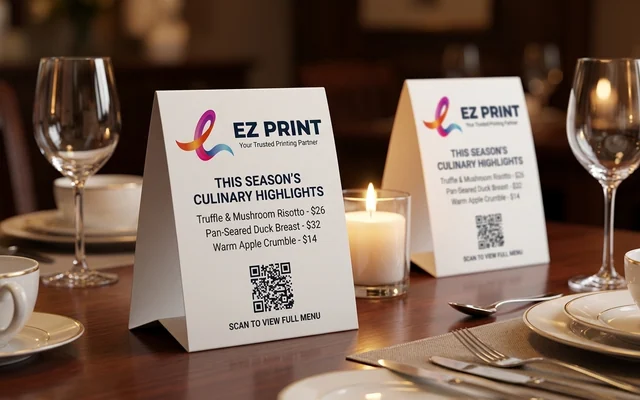
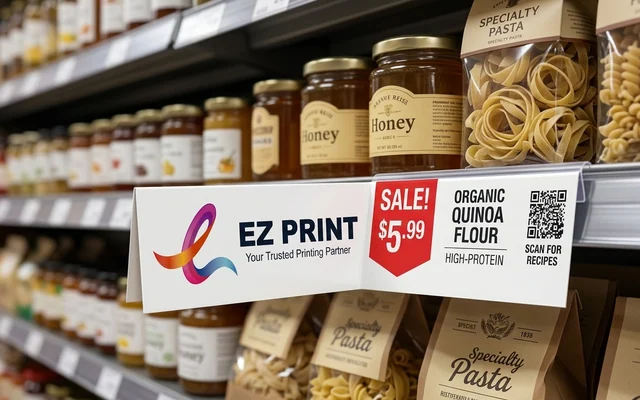
EZ Print prints retail point-of-sale material in Singapore, and has done since 2017. The regular items are tent cards for counters and tables, shelf strips and talkers, wobblers on a flexible arm, counter standees, window graphics and dump-bin or gondola-end wraps. Most of it is short-life material on a monthly or seasonal cycle, so the specification favours quick replacement over durability — with the exception of the holders and frames, which are kept and refilled. Tent cards are creased and folded from a single sheet on 310–400 gsm board; shelf strips are cut to the rail length in use; wobblers need a die and a flexible arm. Anything on a shop floor is read at arm’s length in poor light, so type stays large and contrast stays high. Standard turnaround is 7–14 working days, whatever the cutting and folding. Express is quoted per job. EZ Print quotes from the specification and does not publish prices.
Products quoted on this page
Specifications, formats and enquiry details for each product quoted on this service.
The specification a point-of-sale run is quoted from
The item, the size, the quantity and how often it is replaced. Replacement frequency is the useful question: a monthly cycle argues for a permanent holder and a cheap insert, and that is usually a better answer than a more durable print. The tent card below is drawn at true physical size.
Tent card face · A6 105 × 148 mm
Bleed line (+3 mm)Actual trim size (105 × 148 mm)Safe zone (8 mm inside trim)
Bleed line (+3 mm)Actual trim size · 105 × 148 mmSafe zone (8 mm)
Today’s offer
Read at arm’s length
sales@ezprint.com.sg
Drawn at true size — trim 105 × 148 mm, 3 mm bleed dashed outside the trim, 8 mm safety margin dashed inside it.
600mm
The distance retail print is actually read from. Everything on this page — type size, contrast, the angle a tent card sits at — is decided by it.
Tent cards
A5 and A6 folded, creased from a single sheet on 310–400 gsm board. Two or three printed faces.
Shelf strips
Cut to the rail length. Common heights 40–80 mm, printed one side.
Wobblers
A die-cut shape on a flexible arm, adhered to a shelf edge. Needs a die.
Counter standees
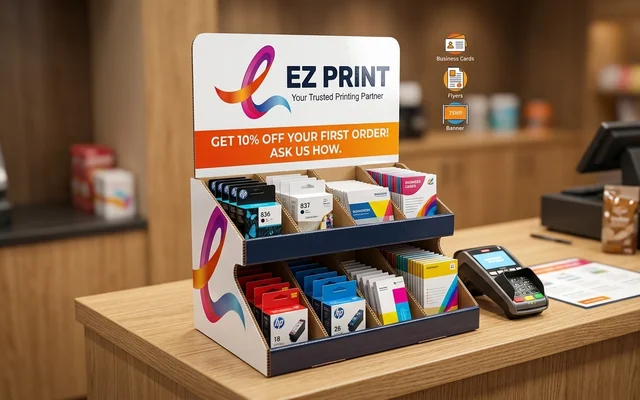
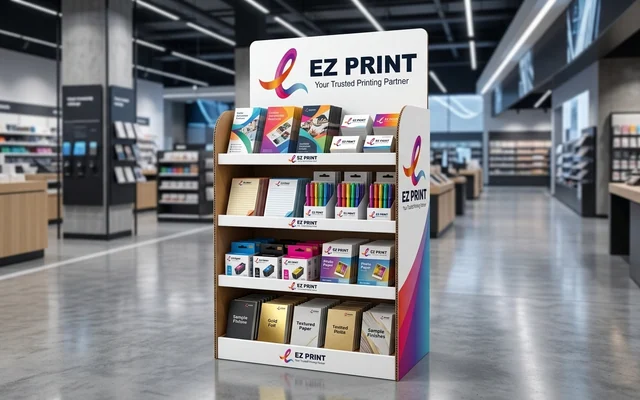
300–600 mm on a rigid panel with a folding strut.
Window graphics
Printed film or clear film with a white underbase. See surface graphics for the film choice.
Bin and gondola wraps
Printed panels or film sized to the fixture. Fixture dimensions supplied by the retailer.
Type size
10 mm cap height minimum on anything read at arm’s length in a shop.
Turnaround
Standard is 7–14 working days, flat or folded or die-cut. Express is quoted per job.
What to ask for
200 A5 tent cards
350 gsm matt art card, creased and folded
4C on three faces
Matt lamination outside
Finished 148 × 105 mm standing, folded from a single sheet
Print-ready PDF at the flat size with the creases on a separate layer
Needed by — your date
The material
Stocks held for point of sale
Retail material is handled by staff, knocked by customers and replaced on a cycle. It needs enough weight to stand and enough surface to survive a wipe, and rarely more than that. The edges below are drawn at the measured caliper of the weight named.
Matt art card0.36 mm · 350 gsm
Also sold as matt coated card, C2S matt. Held at 310, 350 and 400 gsm.
The tent card and shelf talker board. Stiff enough to stand, and it creases cleanly once scored.
Under ink
Even solids and no glare, which matters under retail downlights.
Best for
Tent cards, shelf talkers, counter cards, anything on a monthly cycle.
Avoid for
Anywhere wet — a counter beside a coffee machine wants synthetic stock instead.
On the schedule
Held. Scored before it is folded, so a tent card stands square.
Gloss art card0.28 mm · 310 gsm
Also sold as gloss coated card, C2S gloss. Held at 260, 310 and 350 gsm.
A reflective face for product photography on a counter card.
Under ink
High chroma. Food and drink photography reads noticeably better on gloss.
Best for
F&B counter cards, product promotions where the image sells.
Avoid for
Anywhere with a spotlight directly above it. It glares.
On the schedule
Held as a standing stock.
0.20 mmCoating at 8×
Synthetic stock0.20 mm · 200 micron
Also sold as synthetic paper, tear-resistant stock, PP sheet.
Not paper. It survives being wiped down, splashed and handled with wet hands.
Under ink
Ink sits on the surface and wants a moment longer before the pieces can be stacked.
Also sold as gloss art, coated paper. Held at 128 and 157 gsm.
The insert. Light, cheap and replaceable, for a holder or a frame that stays on the counter.
Under ink
High chroma, and fast to reprint when the promotion changes.
Best for
Inserts for permanent holders, shelf strips, window bills.
Avoid for
Anything freestanding. It will not stand on its own.
On the schedule
Held. The cheapest sheet here to reprint when a promotion changes.
If the message changes monthly, buy the holder once and print the insert cheaply. It is almost always the better answer than a more expensive standalone piece replaced twelve times a year.The materials library →
A tent card is one sheet with two creases, not three panels glued together. It stands because the crease positions are right, and those are worked out from the finished height rather than guessed.
Creasing, cutting and the fixings
Retail print is mostly cheap material shaped precisely. The value is in the crease that makes a tent card stand at the right angle and the die that makes a wobbler sit on a shelf edge — and in a die already held, which takes the die-making step out of the reorder.
Point-of-sale finishing: what each operation needs, and whether its die is kept for the next campaign
Finish
Tooling
What the reorder pays for
Round-corneringStandard radii, on a die held as stock tooling
None
Nothing to make, so nothing to remake.
Matt or gloss laminationSingle pass, both sides
None
Nothing to make, so nothing to remake.
Creasing and foldingA creasing line is scored above 170 gsm, so a coated sheet does not crack at the fold
None
Nothing to make, so nothing to remake.
Spot UVNeeds a screen; reads best over matt film
Made once
Kept on file with your approved artwork. The reorder runs from it.
Die-cuttingA forme is cut once, then kept for the reorder
Made once
Kept on file with your approved artwork. The reorder runs from it.
Wobbler arm fittingA flexible arm with an adhesive pad, fitted to the die-cut shape
None
Nothing to make, so nothing to remake.
Strip cutting to rail lengthShelf strips cut to the fixture length in use, which the retailer supplies
None
Nothing to make, so nothing to remake.
Panel mountingCounter standees and bin wraps mounted to a rigid panel
None
Nothing to make, so nothing to remake.
Scroll the table sideways to see every column.
Every operation here is quoted inside the standard window. What changes between a first order and a second is the tooling: a die, a block or a screen is made once and then kept on file with your approved artwork, which is why the reorder of a job carrying one is a different job from the first.
Retail print is read by somebody holding a basket, in a hurry, under a downlight. Nothing subtle survives that, and nothing subtle should be attempted.
Pairings that work
+A5 tent cards on 350 gsm matt art card, creased and folded from one sheet. They stand straight and they stack for storage.
+A permanent acrylic holder with a cheap printed insert. The holder is bought once and the message changes monthly for almost nothing.
+Synthetic stock on any counter near food or water. It wipes clean and it does not go wavy.
+One message per piece, in type at least 10 mm tall. A shopper reads it in about a second and a half.
Combinations that fail
×Body copy at 8 pt on a shelf strip. It is read at arm’s length, at an angle, under a downlight, by somebody carrying something.
×A tent card folded without creasing. Above 170 gsm the coating splits along the fold and the card leans.
×Gloss laminate directly under a spotlight. The glare makes the card unreadable from the one position customers stand in.
×A wobbler with no die allowance around the arm. The arm pulls through the card and the whole thing ends up on the floor.
Items and their working sizes
Point-of-sale sizes are set by the fixture rather than by the design. A shelf strip that does not match the rail and a tent card that blocks a card reader both fail for reasons no proof would show.
A6 tent card · 105 × 148 mm folded
A counter or table card. Small enough not to be in the way.
A5 tent card · 148 × 210 mm folded
A larger table card for menus and offers.
Shelf strip · 40–80 mm tall
Cut to the rail length. Ask the retailer for the fixture dimension.
Wobbler · 80–150 mm
A die-cut shape on a flexible arm. The die is kept for the next promotion.
Counter standee · 300–600 mm
A rigid panel with a folding strut, for a till point or a service desk.
Bin and gondola wraps
Sized to the fixture. Dimensions come from the retailer rather than from a catalogue.
One message, large, and the crease on its own layer
The technical requirements here are small; the discipline is not. A point-of-sale piece carries one message, and the file has to say where it folds and where it is cut.
The file
Format
PDF/X-4 at the flat size, with creases and cuts on separate non-printing layers.
Artboard
The flat sheet plus 3 mm bleed — a folded tent card is drawn flat, not as separate panels.
CREASE layer
Dashed lines with each panel height labelled, on a layer that never prints.
CUT layer
A closed vector path for any die-cut shape, in a named spot colour.
Safe margin
8 mm from every trim and 10 mm from any crease.
Fixture dimensions
Supplied by the retailer for strips, wraps and anything fitted to a shelf.
The colour, and the detail
Colour mode
CMYK, with Pantone references for a brand colour that appears across a whole campaign.
Minimum type
10 mm cap height. Retail print is read at arm’s length in about a second and a half.
Contrast
High value contrast. Retail lighting is bright, uneven and usually from above.
Rich black
C60 M40 Y40 K100 for solids, total ink 240%.
Prices
Where prices appear, they are supplied by the retailer and checked against a signed-off list before printing.
Barcodes
Vector at 100%, with quiet zones intact and never across a crease.
Send the fixture dimensions with the artwork — the rail length, the bin size, the counter depth. Retail print fails on fit far more often than it fails on design.
Turnaround
Campaigns repeat, and the dies are what make the second one quick
Standard
Standard turnaround is 7–14 working days.
Standard orders. The schedule for specialist finishing is confirmed in your quotation.
Express
Same-day printing available.
Subject to artwork, stock and production capacity confirmation. Timing is agreed for each job.
What sets the date
Cutting and folding. A flat insert is one pass; a tent card is scored and folded; a shelf strip is cut to the fixture rail; a wobbler needs a die. Every one of them is quoted inside the standard window.
What a reorder skips
The die. Wobbler and shaped-card dies are kept on file, so a second campaign using the same shape with different artwork skips the tooling entirely — which is the argument for buying the holder once and reprinting the insert.
If the date is tight
Send the item, the fixture dimensions and the quantity, and ask for an express quotation. We confirm the specification, production schedule and next steps in the quotation.
Retail campaigns repeat, and the dies for wobblers and shaped cards are kept on file. A second campaign using the same shape with different artwork skips the tooling entirely.
Every answer here is in the page source at full opacity, open or closed. An answer engine has to be able to read it without executing anything.
Questions asked about point of sale
What size should a tent card be?
A6 at 105 × 148 mm folded for a counter, and A5 at 148 × 210 mm folded for a table or a menu position. Both are creased and folded from a single flat sheet rather than assembled from panels, so the artwork is supplied flat with the crease positions marked.
What gsm should a tent card be?
310–400 gsm. Below 310 gsm the card leans; above 400 gsm the creases fight back and it will not sit at a stable angle. Anything over 170 gsm has to be creased before folding, or the coating splits along the fold.
How small can text be on retail print?
About 10 mm cap height for anything that has to be read. Retail material is read at roughly arm’s length, at an angle, under a downlight, by somebody already carrying something — small type simply is not read.
Should I print a new display or refill a holder?
If the message changes monthly, buy the holder once and print cheap inserts. The holder is the durable part and it is almost always cheaper over a year than twelve standalone printed pieces.
What is a wobbler?
A die-cut shape on a flexible arm with an adhesive pad, fixed to a shelf edge so it moves and catches the eye. It needs a cutting die, which is made once and kept, and the arm needs an allowance in the shape so it does not pull through the card.
What material survives a café counter?
Synthetic stock. It is not paper, so it does not absorb spills, does not go wavy in humidity and can be wiped down. On an ordinary art card, a counter beside a coffee machine costs a reprint every few weeks.
How do I size a shelf strip?
From the fixture, not from a catalogue. Ask the retailer for the rail length and the visible height — usually 40–80 mm — and the strips are cut to that. A strip that does not match the rail is the single most common retail print failure.
Trading since 2017 — EZ PRINT PRIVATE LIMITED, UEN 201706183R.
Standard turnaround is 7–14 working days. For urgent orders or express schedules, please check with EZ Print.
Artwork is checked before production.
Island-wide courier delivery within Singapore.
Collection can be arranged on request.
Ask for a quote on this display
Every job is quoted from its specification — stock, quantity, sides, finish, size and deadline.
Quantity
Stock — or the feel you want, if you do not know the stock