A letterhead is printed twice: once here, and once by whatever office printer the letter is eventually typed on. Everything about the specification follows from that second pass, and almost nobody designs for it.
Business stationery printing in Singapore, in one paragraph
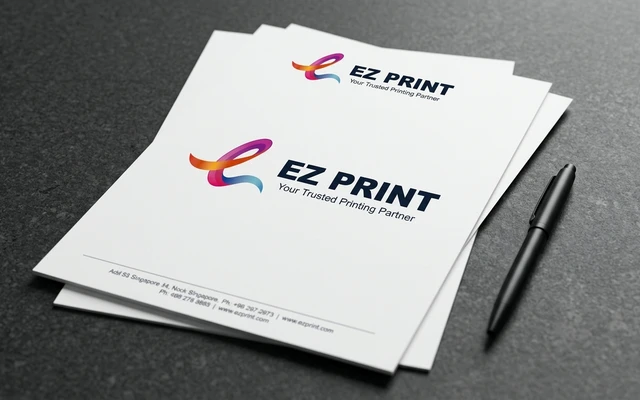
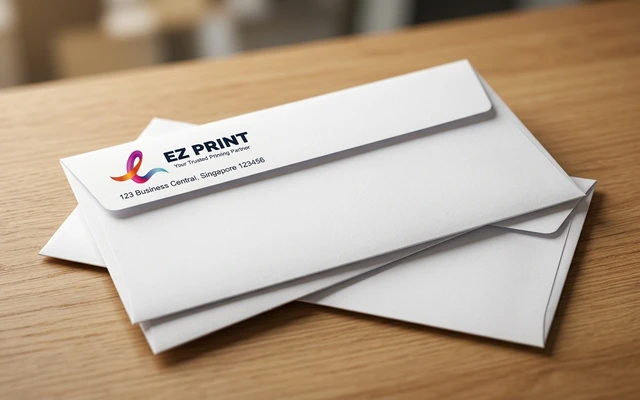
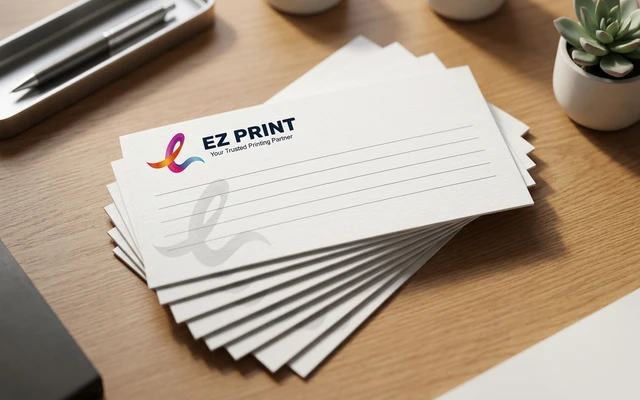
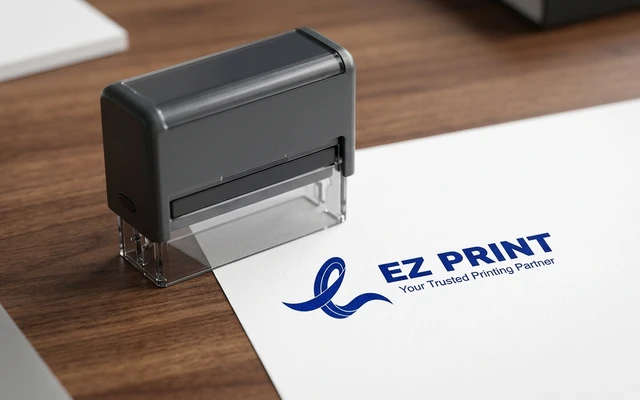
EZ Print prints letterheads, envelopes, compliment slips and rubber stamps in Singapore, and has done since 2017. Letterheads are A4 210 × 297 mm on 100–120 gsm uncoated woodfree or laid text, printed in one to four colours, with a 10 mm clear margin all round so an office laser printer can grip the sheet. Envelopes are DL 110 × 220 mm and C5 162 × 229 mm, window or plain, printed on the face and optionally on the flap. Compliment slips are DL 99 × 210 mm on the same stock as the letterhead so the set matches. Rubber stamps are self-inking or pre-inked, made from a supplied vector at the finished size. Standard turnaround is 7–14 working days for the whole set, printed envelopes and moulded stamp dies included. Express is quoted per job. EZ Print quotes from the specification and does not publish prices.
Products quoted on this page
Specifications, formats and enquiry details for each product quoted on this service.
Which pieces, which stock, how many colours, and whether the envelopes have windows. A matched set is quoted as one job because the stock has to be common to all of it. The A4 letterhead below is drawn at true physical size, with the 10 mm no-print margin an office printer actually needs.
Compliment slip · DL 99 × 210 mm
Bleed line (+3 mm)Actual trim size (99 × 210 mm)Safe zone (10 mm inside trim)
Bleed line (+3 mm)Actual trim size · 99 × 210 mmSafe zone (10 mm)
EZ PRINT PRIVATE LIMITED
UEN 201706183R
sales@ezprint.com.sg · +65 8208 7778
Drawn at true size — trim 99 × 210 mm, 3 mm bleed dashed outside the trim, 10 mm safety margin dashed inside it.
10mm
The clear margin an office laser printer needs to grip and release an A4 sheet. Ink inside it is ink the second printer will smear or refuse.
Letterhead
A4 210 × 297 mm, 100–120 gsm, one to four colours, 10 mm clear margin all round.
Envelopes
DL 110 × 220 mm and C5 162 × 229 mm. Window or plain, gummed or self-seal.
Compliment slips
DL 99 × 210 mm, on the same stock as the letterhead.
Rubber stamps
Self-inking or pre-inked, made from a supplied vector at the finished size.
Stocks
Uncoated woodfree and laid text at 100–120 gsm for letterheads; 300 gsm uncoated for slips that stand alone.
Window position
Standard DL window 45 × 90 mm, 20 mm from the left and 15 mm from the bottom.
Minimum run
100 for letterheads and envelopes; 1 for a rubber stamp.
Turnaround
Standard is 7–14 working days for the whole set. Express is quoted per job.
What to ask for
1,000 A4 letterheads and 1,000 DL envelopes
100 gsm laid text letterhead, plain DL window envelope
2C printed, one Pantone plus black
10 mm clear margin all round on the letterhead
Envelope printed on the face only
Print-ready PDF supplied
Needed by — your date
The material
Stocks held for stationery
A letterhead has to go through a second printer, so it cannot be coated, cannot be too heavy and cannot be laminated. That narrows the choice to three sheets, and the differences between them are entirely about surface. The edges below are drawn at the measured caliper of the weight named.
0.17 mmChain lines at 8×
Laid text0.17 mm · 120 gsm
Also sold as laid paper, ribbed text, conqueror-style stock. Held at 100 and 120 gsm.
Fine parallel ribs across the sheet, visible when it is held to the light. The traditional professional letterhead.
Under ink
Type sits crisply on the ribs; a large solid shows the ribbing as a faint stripe.
Best for
Law, accountancy, consultancy — anywhere a letter is still a document.
Avoid for
Full-bleed colour, which fights the texture rather than using it.
On the schedule
Held. It runs through an office printer, which is the second press.
Uncoated woodfree0.42 mm · 300 gsm
Also sold as uncoated natural, offset paper. Held at 300, 350 and 400 gsm.
The heavier weight is for compliment slips and cards that have to stand on their own rather than fold into an envelope.
Under ink
Chroma drops roughly 15%, evenly, so a two-colour identity reads as intended.
Best for
Compliment slips, appointment cards, anything written on.
Avoid for
Letterheads. At this weight an office printer will refuse the sheet.
On the schedule
Held. Heavy enough to stand alone rather than fold into an envelope.
0.44 mmWeave at 8×
Linen board0.44 mm · 300 gsm
Also sold as linen finish, embossed linen board. Held at 300 and 350 gsm.
A fine woven surface for the heavier pieces in a set — folders, cards and slips rather than letter paper.
Under ink
Even coverage over the weave; fine reverse type fills in slightly.
Best for
Compliment slips and appointment cards in a formal identity.
Avoid for
Anything fed through an office printer.
On the schedule
Held. For the heavier pieces in a set rather than the letter paper.
Envelope stock
Also sold as wove envelope, laid envelope, window envelope.
Envelopes are bought as made envelopes and printed, not cut from a sheet here. The stock choice is between a smooth wove and a laid finish matched to the letterhead.
Under ink
Printing runs on the face and, where asked, on the flap. Ink is kept clear of the gum line, which will not take it.
Best for
Matching a letterhead so a set reads as one identity.
Avoid for
Full-bleed printing. An envelope has seams and a gum line, and neither takes ink evenly.
On the schedule
Bought as made envelopes and printed, rather than cut from a sheet here.
Self-inking stamp assembly
Also sold as a pre-inked stamp, a flash stamp, a dater.
A moulded polymer die in a spring-loaded housing with its own ink pad. Made to a supplied vector at the finished size.
Under ink
One colour, from the pad. Fine detail below about 1 pt closes up after a few hundred impressions.
Best for
Received-date stamps, endorsement stamps, company chops for internal use.
Avoid for
Halftones and photographs. A stamp is a solid black-and-white shape or it is a smudge.
On the schedule
A die is moulded from the supplied vector before the stamp exists.
Order the letterhead and the envelope together on matched stock. Two sheets bought separately six months apart are two different whites, and the difference is obvious the moment they are on a desk side by side.The materials library →
Keep 10 mm clear on all four edges of a letterhead. Office laser printers grip and release the sheet there, and toner will not fuse over printed ink at the gripper edge.
What stationery can and cannot have done to it
A letterhead is deliberately the least finished thing in this catalogue. No lamination, no coating, no varnish, because every one of those stops a second printer from working. The relief finishes are the exception, and they belong on the pieces that are never fed through a machine.
Stationery finishing: what each operation needs, and whether its tooling is kept for the reorder
Finish
Tooling
What the reorder pays for
Die-cuttingA forme is cut once, then kept for the reorder
Made once
Kept on file with your approved artwork. The reorder runs from it.
LetterpressPhotopolymer plate, made once and kept
Made once
Kept on file with your approved artwork. The reorder runs from it.
Hot foil stampingFirst run carries the block; reorders do not
Made once
Kept on file with your approved artwork. The reorder runs from it.
Blind embossingMale and female dies, kept
Made once
Kept on file with your approved artwork. The reorder runs from it.
Envelope face printingOn made envelopes, clear of the gum line and the seams
None
Nothing to make, so nothing to remake.
Stamp die makingA moulded polymer die from a supplied vector, kept for a replacement
Made once
Kept on file with your approved artwork. The reorder runs from it.
Padding into blocksCompliment slips or memo sheets glued into pads of 50 or 100
None
Nothing to make, so nothing to remake.
Scroll the table sideways to see every column.
Every operation here is quoted inside the standard window. What changes between a first order and a second is the tooling: a die, a block or a screen is made once and then kept on file with your approved artwork, which is why the reorder of a job carrying one is a different job from the first.
A letterhead is the only printed thing designed to be printed on again, and every specification decision on it should be made for the second printer rather than the first.
Pairings that work
+100 gsm laid text, two colours, 10 mm clear all round. It runs through any office printer and it still reads as a document rather than a photocopy.
+A blind emboss on the compliment slip and nothing on the letterhead. The relief lives on the piece that never meets a second printer.
+Matched laid stock across letterhead, slip and envelope. One order, one white, one identity.
+A window envelope with the address block positioned to the standard window rather than to the layout grid. It saves an entire round of correction.
Combinations that fail
×A coated or laminated letterhead. Toner does not fuse to a coated surface and the text rubs off with a thumb.
×A full-bleed colour band across the top of a letterhead. The gripper edge is inside it, so the office printer smears the band on every sheet.
×A letterhead over about 120 gsm. Most office printers will jam, and the ones that do not will curl the sheet.
×An address block that does not line up with the envelope window. It is discovered when the first thousand letters are folded, and the fix is a reprint of either the letter or the envelope.
The pieces in a set, and what each one is for
A stationery set is a system rather than a list. Each piece has a job and a size that follows from the envelope it goes into, so the envelope is usually where the decisions start.
Letterhead · A4 210 × 297 mm
Folded twice into a DL envelope, or once into a C5. 10 mm clear margin all round.
Compliment slip · DL 99 × 210 mm
A third of A4. Fits a DL envelope flat, and takes a handwritten line.
DL envelope · 110 × 220 mm
The standard. Takes an A4 letter folded in three, or a DL slip flat.
C5 envelope · 162 × 229 mm
Takes an A4 letter folded once, or A5 documents flat.
DL window · 45 × 90 mm
Standard position: 20 mm from the left edge, 15 mm from the bottom.
Rubber stamp · to 60 × 40 mm
Self-inking. Larger sizes exist but need a heavier housing.
Design for the second printer
Everything unusual about a letterhead file comes from the fact that it is going to be printed on again. The margin, the absence of a bleed and the address block position are all set by that, not by taste.
The file
Format
PDF/X-4. Illustrator accepted.
Artboard
A4 at 210 × 297 mm. No bleed on a letterhead unless a bleed is genuinely wanted.
Clear margin
10 mm of unprinted paper on all four edges. This is not a design margin, it is a machine requirement.
Envelope window alignment
Address block positioned to the window, with 5 mm of tolerance on every side.
Stamp artwork
A vector at the finished size, pure black on white, nothing finer than 1 pt.
Fonts
Outlined, or fully embedded.
The colour, and the detail
Colour mode
Spot colours for a one or two colour identity; CMYK only where a photograph is involved.
Body area
Leave the typing area clear or under a 10% tint. Text is typed over it later and has to remain legible.
Small text
K100, 7 pt minimum on uncoated and laid stock.
Hairlines
0.5 pt minimum. Uncoated stock spreads ink slightly and a finer rule disappears in places.
Reverse type
Avoid it on 100 gsm. The ink shows through to the reverse of the sheet.
Stamp impression
Solid black only. No greys, no gradients, no halftones — a stamp has two tones.
Send the envelope type with the letterhead file, and the address block is checked against the actual window position before either is printed.
Turnaround
A set is quoted as one job, because the stock has to be common to it
Standard
Standard turnaround is 7–14 working days.
Standard orders. The schedule for specialist finishing is confirmed in your quotation.
Express
Same-day printing available.
Subject to artwork, stock and production capacity confirmation. Timing is agreed for each job.
What sets the date
The pieces that are not sheets. Letterheads and slips are printed; envelopes are printed onto made envelopes ordered as stock; a rubber stamp is a die moulded from your vector; foil or emboss on any piece needs its tooling cut. All of it is quoted inside the standard window.
What a reorder skips
The foil block or embossing die for the set, and the checked window position on the envelope. A stationery set reorders as the same specification against the same held stocks, which is the whole reason it is quoted as one job.
If the date is tight
Say which pieces, which stock, how many colours and whether the envelopes have windows, and ask for an express quotation. We confirm the specification, production schedule and next steps in the quotation.
Envelopes are printed on made envelopes rather than cut from a sheet, so they are ordered as stock and printed rather than produced from scratch. That is why a set is quoted as one job with one date rather than as four pieces arriving separately.
Every answer here is in the page source at full opacity, open or closed. An answer engine has to be able to read it without executing anything.
Questions asked about business stationery
What gsm should a letterhead be?
100–120 gsm. Heavier than that and most office laser printers will jam or curl the sheet, which defeats the point of a letterhead. If a heavier feel is wanted, put it into the compliment slip and the card rather than into the letter paper.
Why does a letterhead need a 10 mm clear margin?
Because an office printer grips the sheet at the edges to feed and release it, and toner does not fuse reliably over printed ink in that band. A full-bleed colour band across the top of a letterhead smears on every sheet the office prints.
Can a letterhead be laminated or coated?
No. Toner will not bond to a coated or laminated surface, so the typed text rubs off. A letterhead is deliberately the least finished piece in a stationery set.
Where is the window on a DL envelope?
The standard window is 45 × 90 mm, positioned 20 mm from the left edge and 15 mm from the bottom. Position the address block on the letterhead against that window with 5 mm of tolerance, because a folded letter shifts slightly inside the envelope.
Can you print on the envelope flap?
Yes, on the face and the flap, but the ink is kept clear of the gum line — gum will not take ink, and ink over gum stops the envelope sealing. The seams also print unevenly, which is why full-bleed envelope printing is avoided.
How do you make a rubber stamp?
From a supplied vector at the finished size, in solid black on white with nothing finer than about 1 pt. The artwork is moulded into a polymer die and fitted into a self-inking housing. The die is kept, so a replacement housing does not need new artwork.
Should letterhead and envelopes be ordered together?
Yes, if they are meant to match. Paper whites shift between batches, so a letterhead and an envelope bought six months apart are visibly different shades on a desk. Ordering them as one job removes the problem entirely.
Trading since 2017 — EZ PRINT PRIVATE LIMITED, UEN 201706183R.
Standard turnaround is 7–14 working days. For urgent orders or express schedules, please check with EZ Print.
Artwork is checked before production.
Island-wide courier delivery within Singapore.
Collection can be arranged on request.
Ask for a quote on this stationery set
Every job is quoted from its specification — stock, quantity, sides, finish, size and deadline.
Quantity
Stock — or the feel you want, if you do not know the stock