
EZ Print — Your Trusted Printing PartnerUrgent & ExpressRequest a quote
A concertina-folded leaflet with printed panels.

NCR and carbonless sets

Bill books, and the ply order that has to be right

A carbonless set works by pressure, and it only works in one direction. The top sheet coats the one below it, that one coats the next, and the last has no coating at all — so the order of the plies is the product, not a preference.

  • Standard7–14 working days
  • ExpressSame-day printing available

NCR bill book printing in Singapore, in one paragraph

EZ Print prints NCR bill books, invoice books and delivery order sets in Singapore, and has done since 2017. A carbonless set is two, three or four plies, each around 50–55 gsm, coated so that pressure from a pen transfers the writing down the set without carbon paper. The standard sizes are A5 148 × 210 mm and A4 210 × 297 mm, padded into books of 50 sets with a card back and a glued head. Sequential numbering is printed in a separate pass and repeated on every ply of a set so all copies carry the same reference. Sets are perforated at the head so the top copy detaches and the file copy stays in the book. Standard turnaround is 7–14 working days, and the numbering, the perforation and the padding are separate passes inside it. Express is quoted per job. EZ Print quotes from the specification and does not publish prices.

Products quoted on this page

Specifications, formats and enquiry details for each product quoted on this service.

2 formats
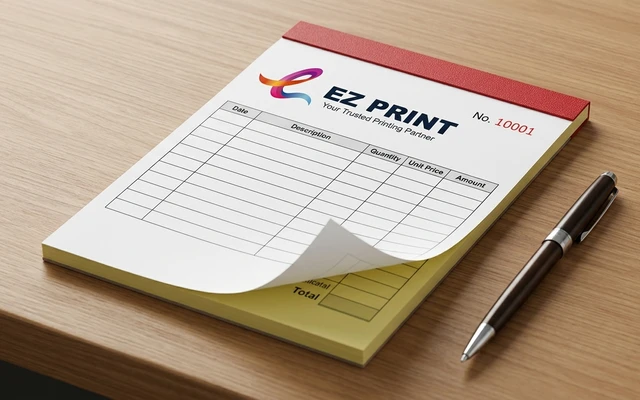
  • NCR bill books with numbered duplicate sets, with the EZ Print logo.
    Business stationery

    NCR Bill Book

    Numbered carbonless sets bound into books, so every receipt, invoice or delivery order keeps its copy.

    Also ordered as: Receipt Book, Invoice Book, Delivery Order Book, Quotation Book, Carbonless Book, NCR Form, Bill Book

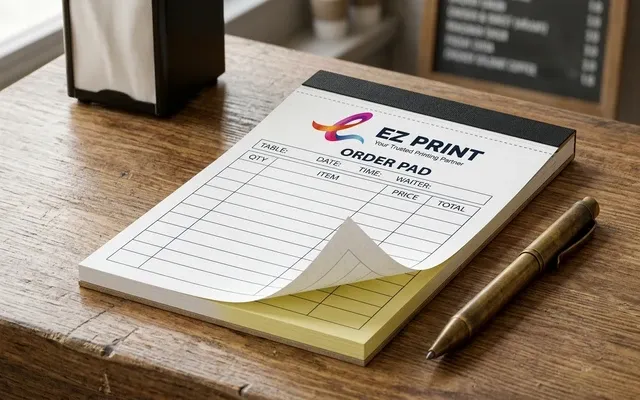
  • Waitstaff dining order pads with carbonless duplicate sheets, with the EZ Print logo.
    Occasions & hospitality

    Order Pad

    A numbered tear-off pad for taking table orders, single sheet or with a carbonless copy.

    Also ordered as: Order Chit, Menu Order Sheet, Captain Order Pad, Waiter Pad, Order Form Pad

All 140 products, by family

The specification a bill book is quoted from

Ply count, ply colours, size, numbering scheme and how many sets to a book. Those five decide the whole job, and the ply colours matter more than they look — they are how a person at a counter knows which copy is theirs.

No bill book is drawn here at true size. A5 is the smaller of the two sizes and it is 148 mm across, wider than this column — and reducing it would misstate the two measurements a form is actually laid out against: the 20 mm at the head where the glue and the perforation sit, and the 10 mm margin round the rest. Both are stated below. The thing worth seeing at true size on a bill book is the cut edge of the set, and that is drawn in the materials band at the measured caliper of all three plies together.

3plies


White, pink, yellow. The customer copy, the accounts copy and the book copy — and the order they are bound in is the order the coating transfers.

Sizes
A5 148 × 210 mm and A4 210 × 297 mm. Half-A4 at 210 × 148 mm landscape also runs.
Plies
Two, three or four, each around 50–55 gsm. Conventionally white, pink, yellow, then blue.
Sets per book
50 sets is standard. 25 and 100 also run.
Binding
Glued at the head with a card back, and perforated so the top copy detaches.
Numbering
Sequential, repeated on every ply of a set, with a stated start value and prefix.
Colour
1C or 2C. A form is read, not admired, and a second colour is usually enough.
Minimum run
10 books.
Turnaround
Standard is 7–14 working days: numbering, perforating and padding are separate passes inside it. Express is quoted per job.

What to ask for

50 NCR invoice books
A5 148 × 210 mm, 3 plies — white, pink, yellow
50 sets per book, card back, glued head
1C printed on all plies
Perforated at the head, sequential numbering from 00001 on every ply
Print-ready PDF supplied, one page per ply where they differ
Needed by — your date

The material

The carbonless set, and what it is made of

A carbonless set is one material behaving as three. The top ply carries a coating on its back; the middle plies carry a coating on both faces; the last carries one on its front only. Getting that sequence wrong produces a book that writes on nothing. The edge below is drawn at the measured caliper of the whole set.

Carbonless set0.24 mm · 3 plies, 50–55 gsm each

Also sold as NCR paper, carbonless copy paper, CB/CFB/CF sets, bill book paper.

Three thin plies, each around 50–55 gsm, tinted so a person at a counter can tell the copies apart at a glance.

Under ink
Print stays light. Solid areas are avoided because the coating is what makes the sheet work and heavy ink sits on top of it.
Best for
Invoices, delivery orders, service reports, anything signed in duplicate at a counter or a doorstep.
Avoid for
Photographs, heavy solids and fine reverse type. The paper is thin and the surface is a working coating.
On the schedule
Held. Numbered, perforated and padded in three passes after the print.
Matt art card0.32 mm · 310 gsm

Also sold as matt coated card, C2S matt. Held at 310, 350 and 400 gsm.

The card back a book is padded against. It is what gives a book something to write on when it is held in one hand.

Under ink
Usually printed on the outside face only, with the company name and a book number.
Best for
The back of every padded book.
Avoid for
Being left out. A book with no card back folds over while it is being written on.
On the schedule
Included in the padding pass.

The ply colours are a convention, not a decoration: white to the customer, pink to accounts, yellow stays in the book. Changing the order without telling anybody is how a filing system quietly breaks.The materials library

The number is the reference the whole document depends on. It is printed in one pass across all plies of a set, so a set can never end up with three different numbers on it.

Numbering, perforating and padding

Three operations turn printed plies into a bill book, and each is a separate pass. The numbering has to hit every ply of a set with the same number, the perforation has to land inside the glue line, and the padding has to hold the set together while the top copy is torn out of it.

Bill book finishing: what each operation needs, and whether its setup is kept for the reorder
FinishToolingWhat the reorder pays for
Perfect bindingIncludes the glue cureNoneNothing to make, so nothing to remake.
Sequential numberingSame number on every ply of a set, from a stated start valueNoneNothing to make, so nothing to remake.
Head perforationSo the top copy detaches and the file copy stays in the bookNoneNothing to make, so nothing to remake.
Padding into booksGlued at the head with a card back, 25, 50 or 100 setsNoneNothing to make, so nothing to remake.
Wrap-around coverA stiff flap tucked under the set being written on, so the pen does not mark the next oneNoneNothing to make, so nothing to remake.

Scroll the table sideways to see every column.

Every operation here is quoted inside the standard window. What changes between a first order and a second is the tooling: a die, a block or a screen is made once and then kept on file with your approved artwork, which is why the reorder of a job carrying one is a different job from the first.

A bill book is the only thing here judged entirely on whether the third copy is legible, and that is decided by the ply order and the ink coverage rather than by the design.

Pairings that work

  • Three plies, one colour, a 15% tint for the ruled boxes. Everything is legible on the third copy, which is the only test that matters.
  • Numbering repeated on every ply of a set, with a prefix per book. Reconciliation works even when the copies have been separated for a month.
  • A wrap-around cover flap on a book used out of the office. It stops the pen marking the set underneath while a delivery is being signed for.
  • A card back and a glued head. The book stays flat in one hand, which is how it is actually used.

Combinations that fail

  • Heavy solid ink on the writing area. The coating is what transfers the writing, and printing over it in solid reduces what the lower plies pick up.
  • A four-ply set with a light pen. Pressure has to reach the bottom ply, and four plies plus a soft ballpoint gives a fourth copy nobody can read.
  • Perforating below the glue line. The whole set tears out instead of the top copy, and the book stops being a book.
  • Numbering only the top copy. The moment the copies are separated, nothing reconciles.

Sizes, ply counts and book sizes

A bill book is specified as a set inside a book. Both counts matter: the plies decide what a single transaction produces, and the sets per book decide how often somebody has to fetch a new one.

A5 · 148 × 210 mm
The standard invoice and delivery order size. Fits a clipboard and a counter.
A4 · 210 × 297 mm
For forms with line items, service reports and job sheets.
210 × 148 mm landscape
Half of A4 the other way round. Common for receipts and collection notes.
Two plies
Customer and file. The lightest set and the most legible second copy.
Three plies
Customer, accounts, file. The usual specification.
Four plies
Adds a driver or site copy. Needs firm pen pressure to reach the bottom sheet.

Draw a form, not a page

An NCR set is a form that will be filled in with a ballpoint by somebody standing up. Everything in the file should serve that: wide ruled boxes, light tints, no bleed and no solids where a pen has to go.

The file

Format
PDF/X-4, one page per ply where the plies differ, in ply order from the top copy down.
Artboard
Trim size with no bleed. A padded book is trimmed as a block, so nothing runs to the edge.
Safe margin
10 mm all round, and 20 mm at the head where the glue and the perforation sit.
Ply differences
Where a ply says "ACCOUNTS COPY" or similar, supply that ply as its own page.
Number position
Marked as an empty box with the typeface, size and colour stated.
Writing areas
Left clear or under a 15% tint. Nothing solid where a pen has to leave a mark.

The colour, and the detail

Colour mode
One or two spot colours. Four-colour printing on a 50 gsm ply shows through to the copy below.
Rules and boxes
0.5 pt minimum, in a tint rather than a solid.
Text size
7 pt minimum. Field labels are read at speed by someone holding a pen.
Tints
Under 15% anywhere handwriting has to be legible over the top.
Reverse type
Avoid it. On a thin ply it shows through to the ply below.
Ply identification
A word rather than a colour alone — the copies get photocopied, and a photocopy has no ply colour.

Send the ply count, the ply colours, the sets per book and the numbering scheme as a sentence, and the layout comes back with the glue margin, the perforation line and the number position already positioned.

Turnaround

Three passes after printing, and none of them can be skipped

  • Standard

    Standard turnaround is 7–14 working days.

    Standard orders. The schedule for specialist finishing is confirmed in your quotation.

  • Express

    Same-day printing available.

    Subject to artwork, stock and production capacity confirmation. Timing is agreed for each job.

What sets the date
Three passes after the print, and none of them can be skipped: the sets are numbered, then perforated at the head, then padded into books with a card back. A non-standard size, a wrap-around cover or an unusual ply count adds another. All of it is quoted inside the standard window.
What a reorder skips
The numbering. Say the last number issued and the sequence picks up from there rather than starting again, on the same laid-out form with the glue margin and the perforation line already proved.
If the date is tight
Send the ply count, the ply colours, the size, the sets per book and the numbering scheme, and ask for an express quotation. We confirm the specification, production schedule and next steps in the quotation.

A reorder that continues the numbering from the last book is straightforward — say the last number issued and the sequence picks up from there rather than starting again.

Every answer here is in the page source at full opacity, open or closed. An answer engine has to be able to read it without executing anything.

Questions asked about NCR bill books

What is NCR paper?

Carbonless copy paper. Each ply is coated so that the pressure of a pen on the top sheet transfers the writing to the sheets below without any carbon paper between them. The coatings differ by position in the set, which is why the ply order is fixed rather than a preference.

How many plies can a bill book have?

Two, three or four. Three is the usual specification — customer, accounts, file. Four works but needs firm pen pressure, because the writing has to reach the bottom ply through three sheets above it.

What are the standard ply colours?

White, then pink, then yellow, then blue. It is a convention rather than a rule, and it is worth keeping: people at counters recognise which copy is theirs by colour without reading anything.

Can bill books be numbered?

Yes, and they should be. Sequential numbering is printed in a separate pass and lands on every ply of a set, so all copies of one transaction carry the same reference. Say the start value and any prefix with the specification.

How many sets are in a book?

50 is standard, with 25 and 100 also common. The sets are glued at the head against a card back and perforated so the top copy tears out cleanly while the file copies stay in the book.

Why does the third copy come out faint?

Usually one of three things: a soft pen, too many plies, or heavy printed ink across the writing area. The coating is what transfers the impression, so a solid printed panel where somebody has to write reduces what the lower plies pick up.

Can I get a bill book in a custom size?

Yes, within the parent sheet. A5 and A4 are the lightest work because they trim from standard stock; anything else is a cutting decision that should be specified before the form is laid out, not after.

  • Trading since 2017 — EZ PRINT PRIVATE LIMITED, UEN 201706183R.
  • Standard turnaround is 7–14 working days. For urgent orders or express schedules, please check with EZ Print.
  • Artwork is checked before production.
  • Island-wide courier delivery within Singapore.
  • Collection can be arranged on request.

Ask for a quote on these bill books

Every job is quoted from its specification — stock, quantity, sides, finish, size and deadline.

  • Quantity
  • Stock — or the feel you want, if you do not know the stock
  • Sides printed
  • Finish
  • Flat and finished size
  • The deadline

Artwork is welcome but not required to start. Email sales@ezprint.com.sg if you would rather attach files.