

Every quotation in commercial printing starts with two linked decisions: how heavy the sheet is (gsm, grams per square metre) and how its surface is finished (coated gloss, coated matt, or uncoated woodfree). Specifying a sheet that is too heavy jams office laser trays and cracks brochure folds; specifying a coated sheet for a form or stamp card causes ballpoint pens and cashier rubber chops to skid across the surface. Trading since 2017, EZ Print prints across the full commercial paper and board spectrum in Singapore — from 50–55 gsm carbonless plies and 80–100 gsm business stationery to 128–157 gsm flyers, 260–350 gsm business cards and 300–400 gsm packaging board.
How does the GSM ladder divide between paper (under 200 gsm) and card (200 gsm and above)?
In commercial pressrooms, sheets below 200 gsm are classified as flexible papers (50–55 gsm NCR sets, 80–100 gsm uncoated stationery, 128–157 gsm coated flyer and booklet text stocks), whereas sheets from 200 gsm to 600 gsm are classified as rigid cards and boxboards that require channel creasing before any fold.
Although GSM measures mass per square metre rather than physical thickness (caliper in millimetres), within the same paper family a higher GSM directly increases stiffness and snap. Importantly, an uncoated sheet feels noticeably thicker and stiffer in the hand than a gloss art sheet of the exact same GSM, because clay-coated art paper is calendered under heavy steel rollers to compress the fibres into a smooth, glossy surface.
| GSM Tier & Stock Name | Surface & Ink Behaviour | Best Commercial Applications | What to Avoid |
|---|---|---|---|
| 50–55 gsm Carbonless NCR Paper | Micro-encapsulated reactive clay coating on white, pink, yellow and blue plies | 2-, 3- and 4-ply padded NCR invoice, receipt and delivery order books (25, 50 or 100 sets) | Heavy solid ink areas over writing boxes or 4-colour photos (which show through thin 50 gsm plies) |
| 80 gsm – 100 gsm Uncoated Woodfree | Open absorbent fibre; laser toner and fountain pen ink bond cleanly | A4 (210 × 297 mm) letterheads, matched compliment slips (DL 99 × 210 mm), and disposable dining placemats (A4 / A3) |
Reverse white type on dark solids (ink shows through to the back of 80–100 gsm sheets) |
| 128 gsm – 157 gsm Gloss or Matt Art Paper | Smooth clay-coated surface; high CMYK chroma and sharp halftone dots | High-volume flyers, tri-fold leaflets, and inner pages of saddle-stitched or perfect-bound booklets | Standalone cards or vouchers that must stand upright in a holder without flopping over |
| 250 gsm – 260 gsm Art Card | Light rigid coated board; folds cleanly once pre-creased | Loyalty stamp cards (250 gsm unlaminated), door hangers (240 × 89 mm), booklet covers and economical name cards | Folding without a crease pass (coating splits above 170 gsm) |
| 300 gsm Uncoated Woodfree / Linen Board | Natural tactile tooth; colour drops roughly 15% in chroma; immediately writable | Standalone compliment slips, appointment cards, handwritten gift vouchers and invitations | Feeding through an office desktop printer (rollers refuse 300 gsm board) |
| 310 gsm – 350 gsm Art Card / Matt Art Card | Stiff, smooth coated card; ideal base for matt/gloss lamination, Spot UV and hot foil | Corporate business cards (90 × 54 mm), presentation folders, packaging sleeves (50–297 mm) and gift boxes |
Writing with ballpoint or gel pens on gloss-laminated faces (ink skids and smudges) |
| 300 gsm – 400 gsm Folding Boxboard / Kraft | Structural packaging board with high burst and crease strength | Custom tuck-end product cartons, F&B sleeves and retail header cards | Uncreased sharp folds or direct wet contact without barrier film |
| 600 gsm Bonded Duplex Board | Two heavy plies bonded together for maximum rigid caliper | Ultra-thick executive name cards, gilded-edge plates and blind-debossed cards | Any folding or scoring (bonded duplex delaminates at a crease) |
Why do 80–100 gsm letterheads and 300 gsm compliment slips use different weights in the same stationery set?
A letterhead must feed through an office laser printer a second time without curling or jamming, which restricts it to 80 gsm or 100 gsm uncoated paper with a 10 mm clear gripper margin. A standalone compliment slip (DL 99 × 210 mm) never enters an office printer, so it can use 80–100 gsm to match the letter or 300 gsm uncoated board for a rigid note card.
When ordering a corporate stationery suite, buyers often ask whether to print their A4 letterhead (210 × 297 mm) on heavy 157 gsm or 260 gsm stock so it feels substantial. In practice, any letterhead above about 120 gsm fails inside standard office laser printers: the tight fuser rollers either jam or impart a permanent curl, and laser toner will not fuse over coated paper or lamination.
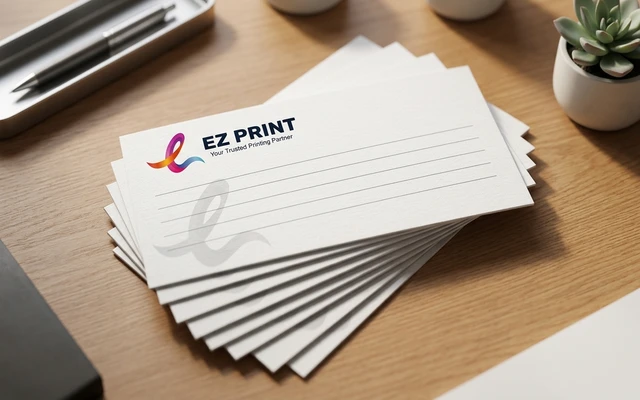
Instead, put the tactile weight into the pieces that never meet a second printer:
- A4 Letterhead (
210 × 297 mm): Print on 80 gsm or 100 gsm uncoated woodfree in full colour on one side (4C + 0C), keeping 10 mm clear unprinted margin on all four edges so office printer rollers never smear wet toner across a header band. - Compliment Slip (
DL 99 × 210 mm): Order on matched 80 gsm or 100 gsm paper when it is a light enclosure slip (or glued into pads of 50 or 100 sheets), or upgrade to 300 gsm uncoated woodfree or 300 gsm linen board with blind embossing when it acts as an executive desk card enclosed with client gifts. - Dining Placemats (
A4 210 × 297 mmorA3 297 × 420 mm): Printed single-sided on uncoated 80 gsm woodfree paper so F&B outlets get a crisp, non-glare table setting that also accepts crayons or pens.
Coated art card vs uncoated woodfree: Which card takes a rubber stamp or ballpoint pen?
Coated art card (250 gsm, 260 gsm, 310 gsm, 350 gsm) delivers punchy CMYK saturation and crisp detail because ink sits on top of the clay coating, whereas uncoated woodfree card (260 gsm, 300 gsm, 350 gsm) absorbs ink into its open fibres so cashier stamps and ballpoint signatures dry quickly without smearing.
Choosing between coated and uncoated board is an operational decision as much as an aesthetic one:
- When the card is looked at and carried in a wallet (
310–350 gsmmatt art card + lamination):- Coated matt art card sealed under matt or gloss lamination gives you maximum colour density, crisp 7 pt
K100typography, and moisture resistance.
- Coated matt art card sealed under matt or gloss lamination gives you maximum colour density, crisp 7 pt
- When the card is stamped or signed at a counter (
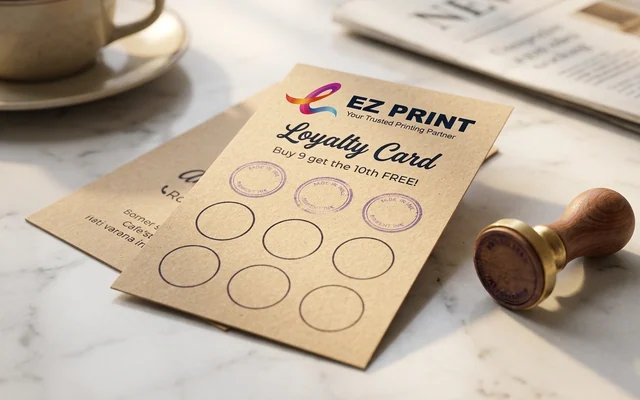
250 gsmunlaminated art card or300 gsmuncoated woodfree):- Standard loyalty stamp cards (
90 × 54 mmlandscape or54 × 90 mmportrait, flat or folded) run on unlaminated 250 gsm art card or 300 gsm uncoated stock. Never put gloss lamination over a stamp grid — stamp pad ink sits as wet droplets on plastic film and wipes straight onto the customer’s pocket. Even on unlaminated 250 gsm art card, allow a brief moment for rubber-stamp ink to dry before stacking. - On uncoated woodfree (
300 gsm) and kraft board (300–350 gsm), account for the 15% chroma drop in CMYK photographs by boosting mid-tone contrast slightly and keeping fine rules at 0.5 pt minimum (compared with 0.25 pt on coated card).
- Standard loyalty stamp cards (
Worked example: Matching GSM across a 4-item corporate launch kit
For a coordinated Singapore exhibition launch kit, pairing 157 gsm gloss art A5 flyers, a 16-page A4 booklet (260 gsm creased cover over 128 gsm text), 350 gsm matt-laminated name cards and a 100 gsm letterhead with 300 gsm DL compliment slips assigns each stock to its mechanical task.
- Handout Flyer (
A5 148 × 210 mm,2,000pcs): 157 gsm gloss art paper (4C + 4C) — substantial enough not to flop in one hand, light enough for 2,000 sheets to fit in two carry cartons. - 16-Page Product Booklet (
A4 210 × 297 mmportrait,500pcs): 260 gsm matt-laminated art card cover creased at the spine + 128 gsm matt art paper inner pages, saddle-stitched with 12 mm inner spine margin and 3 mm outer bleed. - Executive Business Cards (
90 × 54 mm,500pcs): 350 gsm matt art card with matt lamination on both sides and Spot UV on the brand mark (96 × 60 mmartboard with 3 mm bleed and 4 mm safe margin). - Follow-Up Correspondence Set (
500A4 letterheads +500DL compliment slips): 100 gsm uncoated woodfree A4 letterhead (10 mm clear margin all round) paired with 300 gsm uncoated woodfree compliment slips (DL 99 × 210 mm) and 114 × 241 mm DL window envelopes ordered together on the same paper shade.
Pre-press checklist for specifying paper weight and stock
Before sending your print specification, verify that office laser stationery stays at 80 gsm or 100 gsm uncoated with a 10 mm clear margin, specify channel creasing on any folded board above 170 gsm, and leave stamp or signature panels unlaminated so ink dries into the paper fibre.
- Match the GSM to how the sheet is handled: Use 80–100 gsm for office laser re-printing, 128–157 gsm for folded flyers and booklet text, 250–260 gsm for stamp cards and covers, and 310–350 gsm for rigid business cards and sleeves.
- Add creasing for any folded board above
170 gsm: Never specify an uncreased fold on 250–350 gsm card, and never fold 600 gsm bonded duplex. - Keep lamination off writing and stamping zones: Leave loyalty stamp cards, appointment cards and voucher signature panels unlaminated (or use a matt laminate only where a permanent marker or ballpoint is tested).
- Confirm your artwork and request a tailored quote: Check your PDF in the Interactive Artwork Preflight Checker and submit your specification on request a quote.
Same-day and urgent printing available. Subject to artwork approval, payment, print type and production availability. Timing confirmed per job.