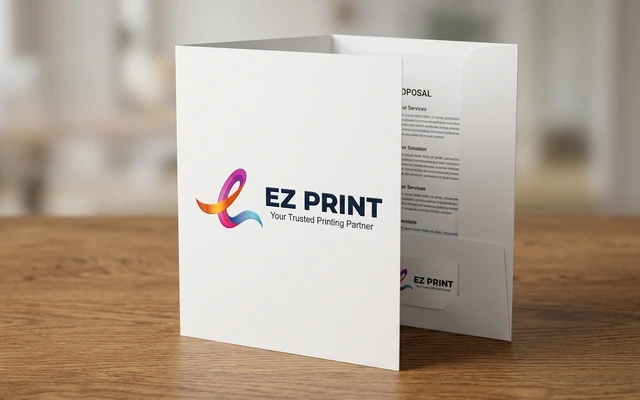
A folder is not a printed sheet. It is a flat net — a shape cut from a board, creased in five places and glued in two — and the net is cut by a steel die that has to exist before anything can be made.
Presentation folder printing in Singapore, in one paragraph
EZ Print prints corporate presentation folders in Singapore, and has done since 2017. The standard holds A4 documents: a finished folder around 220 × 307 mm, cut from a flat net of roughly 460 × 320 mm before folding. Pockets are glued or interlocking, and a business card slit can be cut into the right-hand pocket. Stocks run 300–400 gsm matt or gloss art card, creased before folding and usually laminated on the outside face so the spine survives handling. A cutting die is made once and kept on file with the approved artwork, so a first run carries the die and every reorder does not. Standard turnaround is 7–14 working days, and the die-cutting, creasing and gluing all happen inside it. Express is quoted per job. EZ Print quotes from the specification and does not publish prices.
Products quoted on this page
Specifications, formats and enquiry details for each product quoted on this service.
Capacity, pocket type, whether a card slit is needed, and the stock. A folder with an existing die is a different job from one without, and that is usually the largest single variable in the schedule.
A folder is not drawn here at true size, and the reason is arithmetic rather than reluctance. The flat net is around 460 × 320 mm before it is folded — wider than any screen this page is read on — and the finished folder is about 220 × 307 mm, which is also past it. A drawing shrunk to fit and captioned as a trim would state a measurement it was not drawing, and that is the one thing a specification page cannot do. The net, the creases and the pocket depth are stated as figures below instead, and the dieline template comes back as a file you can measure yourself.
1die
Cut once from steel rule, and kept on file with the approved artwork. The first run waits for it; every run after it does not.
Finished size
About 220 × 307 mm to hold A4 comfortably. A5 and custom capacities cut from their own dies.
Flat net
Roughly 460 × 320 mm before folding, plus 3 mm bleed all round.
Pockets
Two glued pockets, or interlocking pockets that need no glue. Depth around 90 mm.
Card slit
A 55 mm diagonal slit in the right pocket, cut by the same die.
Stocks
300–400 gsm matt or gloss art card. 350 gsm is the usual choice.
Finishing
Matt or gloss lamination on the outside face, spot UV, hot foil, blind emboss.
Spine
A creased gusset of 5 mm or 10 mm where the folder has to hold a thick document.
Turnaround
Standard is 7–14 working days including die-cutting, creasing and gluing. Express is quoted per job.
What to ask for
500 A4 presentation folders
350 gsm matt art card
4C outside, 1C inside
Matt lamination outside face, gloss spot UV on the logo
Two glued pockets, 90 mm deep, with a card slit in the right pocket
Print-ready PDF at the flat net size with the dieline on its own layer
Needed by — your date
The material
Stocks held for folders
A folder carries paper, so it has to be stiffer than the paper it carries. Below 300 gsm the pockets sag; above 400 gsm the creases fight back and the folder springs open on a desk. The edges below are drawn at the measured caliper of the weight named.
Matt art card0.36 mm · 350 gsm
Also sold as matt coated card, C2S matt. Held at 310, 350 and 400 gsm.
The default. Stiff enough to hold twenty sheets, creases cleanly once scored, and does not show finger marks.
Under ink
Even solids and no glare, which is why it is the right ground for spot UV on a logo.
Folding without creasing. At this weight the coating splits along the spine.
On the schedule
Held. Laminated flat, then die-cut and creased in one pass, then glued.
Gloss art card0.32 mm · 350 gsm
Also sold as gloss coated card, C2S gloss. Held at 260, 310 and 350 gsm.
The same board with a reflective face. Photographs on the cover gain about a tenth in apparent contrast.
Under ink
High chroma, and a full-bleed image reads sharper than it does on matt.
Best for
Property, travel, product ranges, anything where the cover is an image.
Avoid for
A folder that is written on, and anywhere fingerprints matter.
On the schedule
Held. Laminated flat, then die-cut and creased in one pass, then glued.
Uncoated woodfree0.55 mm · 400 gsm
Also sold as uncoated natural, offset card. Held at 300, 350 and 400 gsm.
A folder that feels like paper rather than packaging, and takes a pen on the cover.
Under ink
Chroma drops roughly 15%, evenly, so a muted identity reads as intended rather than as weak.
Best for
Architecture, education, legal, anything where restraint is the point.
Avoid for
A full-bleed photographic cover.
On the schedule
Held. Laminated flat, then die-cut and creased in one pass, then glued.
If the folder has to hold more than about twenty sheets, ask for a creased gusset at the spine. It costs nothing on the die and it is the difference between a folder that closes and one that gapes.The materials library →
Interlocking pockets need no glue at all, so the folder skips a pass. They hold slightly less and they show a slot on the pocket face, which is a design decision rather than a compromise.
The die, the crease and the glue, and what each costs
Three operations turn a printed sheet into a folder, and they happen in a fixed order: the sheet is laminated flat, then die-cut and creased in one pass, then glued. The die is the item with the longest lead and the only one that is kept afterwards.
Folder finishing: what each operation needs, and whether its die is kept for the reorder
Finish
Tooling
What the reorder pays for
Matt or gloss laminationSingle pass, both sides
None
Nothing to make, so nothing to remake.
Soft-touch laminationThe film settles before the sheet is guillotined
None
Nothing to make, so nothing to remake.
Spot UVNeeds a screen; reads best over matt film
Made once
Kept on file with your approved artwork. The reorder runs from it.
Die-cuttingA forme is cut once, then kept for the reorder
Made once
Kept on file with your approved artwork. The reorder runs from it.
Hot foil stampingFirst run carries the block; reorders do not
Made once
Kept on file with your approved artwork. The reorder runs from it.
Blind embossingMale and female dies, kept
Made once
Kept on file with your approved artwork. The reorder runs from it.
Pocket gluingTwo pockets, glued and pressed. Interlocking pockets skip this pass
None
Nothing to make, so nothing to remake.
Creasing to the dielineFive creases on a standard folder, cut into the same die
None
Nothing to make, so nothing to remake.
Scroll the table sideways to see every column.
Every operation here is quoted inside the standard window. What changes between a first order and a second is the tooling: a die, a block or a screen is made once and then kept on file with your approved artwork, which is why the reorder of a job carrying one is a different job from the first.
The die is the job. Everything else about a folder can be decided in an afternoon; the steel rule that cuts its shape cannot.
Pairings that work
+350 gsm matt art card, matt laminated outside, gloss spot UV on the logo. The standard corporate folder, and it reorders cheaply because the die and the screen are already made.
+Interlocking pockets on a short run. No glue pass at all, and the slot reads as deliberate rather than as a shortcut.
+A 10 mm creased gusset where the folder holds a full tender submission. It closes flat instead of gaping open on a table.
+400 gsm uncoated with a blind deboss. No ink, no film, and it still outperforms a four-colour folder in the hand.
Combinations that fail
×A pocket depth over about 100 mm. The pocket flexes away from the board and documents slide out of the top corner.
×Artwork drawn to the finished size rather than the flat net. A folder file is a net: the pockets, the flaps and the gusset are all part of the same flat sheet.
×A card slit cut through a heavy solid. The slit edges show white board, and on a dark cover that reads as damage rather than as a feature.
×Gloss lamination on the inside faces. Documents slide out, and every fingerprint from filling the folder stays on it.
Capacities and constructions
A folder is specified by what it has to hold, then by how it holds it. Every construction below cuts from its own die, and a die that already exists is worth more than any other saving on the job.
A4 capacity · about 220 × 307 mm
The standard. Holds A4 with a few millimetres of clearance so sheets go in easily.
A5 capacity · about 155 × 220 mm
For half-size documents, sample cards and event packs.
Two glued pockets
The default. Pockets around 90 mm deep, glued at the sides and pressed.
Interlocking pockets
Slotted rather than glued. One pass fewer, slightly less capacity.
Creased gusset · 5 mm or 10 mm
A spine that lets the folder hold a thick document and still close flat.
Business card slit
A 55 mm diagonal slit in the right pocket, cut by the same die as the net.
A folder file is a net with a dieline on top
Draw the flat net, not the finished folder. Every crease, every pocket and every slit belongs on one artboard, with the dieline drawn as a vector on its own layer so it can be separated from the artwork and sent to be cut.
The file
Format
PDF/X-4 at the flat net size, artwork and dieline in one file.
Dieline
A closed vector path on a layer named DIELINE, in a spot colour, never printed.
Creases
Dashed lines on the same DIELINE layer, distinguished from the cut path.
Bleed
3 mm outside every cut edge of the net, including the pocket flaps.
Safe margin
8 mm from any cut or crease. Type across a crease is type that will be creased.
Existing die
If the die already exists, say so — the net comes back as a template rather than being drawn again.
The colour, and the detail
Colour mode
CMYK. A corporate colour running across a whole cover is worth a Pantone reference.
Rich black
C60 M40 Y40 K100 for large solids, total ink 240%.
Inside faces
Often 1C or blank. A folder’s inside is seen for two seconds and printing it doubles the ink.
Spot UV layer
100% K vector named SPOTUV, in register with the flat net.
Foil layer
100% K vector named FOIL. Keep foil 5 mm clear of any crease — a block will not strike over a fold.
Cut edges
Solids running to a cut edge show the white board core. Allow for it, or choose a board dyed through.
Say the capacity, the pocket type and whether a card slit is needed, and the flat net comes back as an Illustrator template with the dieline, the creases and the bleed already drawn.
Turnaround
The die decides the schedule
Standard
Standard turnaround is 7–14 working days.
Standard orders. The schedule for specialist finishing is confirmed in your quotation.
Express
Same-day printing available.
Subject to artwork, stock and production capacity confirmation. Timing is agreed for each job.
What sets the date
The die, and it is the one item on a folder with a real lead of its own. After printing the sheet is laminated flat, die-cut and creased in one pass, then glued and pressed. All of it is quoted inside the standard window.
What a reorder skips
The steel rule die, kept on file with the approved artwork and the spot UV screen beside it. A folder on a die already held is a materially different job from one that has to be cut for the first time, and that is the largest single variable on the page.
If the date is tight
Say the capacity, the pocket type, the stock and whether a die already exists, and ask for an express quotation. We confirm the specification, production schedule and next steps in the quotation.
The die is kept on file with the approved artwork, so the second run of a folder is materially faster than the first. If a folder is likely to reorder, that is worth knowing before the shape is designed.
Every answer here is in the page source at full opacity, open or closed. An answer engine has to be able to read it without executing anything.
Questions asked about folders
What size is an A4 presentation folder?
About 220 × 307 mm finished, so A4 sheets go in without being forced. The flat net before folding is roughly 460 × 320 mm, which is the size the artwork is drawn at — a folder file is a net, not a finished shape.
What is a dieline and why do you need one?
A dieline is the vector outline of the flat net: every cut edge, every crease and every slit, drawn on its own layer. A steel rule die is made to that outline, so it is the drawing the cutting tool is built from. Without it the shape has to be redrawn before anything can be cut.
Do you keep the folder die for reorders?
Yes. A cutting die is made once and kept on file with the approved artwork. The first run of a new shape carries the die and waits for it to be cut from steel rule; every run after it skips that step entirely, which is the single biggest difference between a first order and a repeat.
What gsm should a presentation folder be?
300–400 gsm art card, with 350 gsm the usual choice. Below 300 gsm the pockets sag under a few sheets of paper. Above 400 gsm the creases fight back and the folder tends to spring open when it is put down.
What is the difference between glued and interlocking pockets?
Glued pockets are bonded at the sides in a separate pass, hold more, and look seamless. Interlocking pockets slot into the board and need no glue, so they skip that pass and show a small slot on the pocket face. Both are cut by the same die.
Can a folder hold a business card?
Yes — a diagonal slit about 55 mm long is cut into the right-hand pocket by the same die as the net. Keep artwork clear of it: the slit edges expose the white board core, which shows against a dark cover.
How long does presentation folder printing take?
Standard turnaround is 7–14 working days. After printing, a folder is laminated flat, die-cut and creased in one pass, then glued and pressed — three physical operations on every copy, all inside that window. A folder on a die already held is the lighter job of the two, because the steel rule does not have to be cut again. Where the date is tighter, ask for an express quotation with the capacity, the pocket type and the stock on it.
Should the inside of a folder be printed?
Usually not in four colours. The inside faces are seen briefly while the folder is being filled, and printing them doubles the ink for very little return. A single colour or a plain board is the common choice, and it also stops fingerprints showing.
Trading since 2017 — EZ PRINT PRIVATE LIMITED, UEN 201706183R.
Standard turnaround is 7–14 working days. For urgent orders or express schedules, please check with EZ Print.
Artwork is checked before production.
Island-wide courier delivery within Singapore.
Collection can be arranged on request.
Ask for a quote on this folder
Every job is quoted from its specification — stock, quantity, sides, finish, size and deadline.
Quantity
Stock — or the feel you want, if you do not know the stock