Packaging, which is a flat net until the last minute
A box is printed as a flat sheet, cut to a net by a steel die, creased along every fold and glued in one or two places. The design lives on that flat net, and so does every mistake.
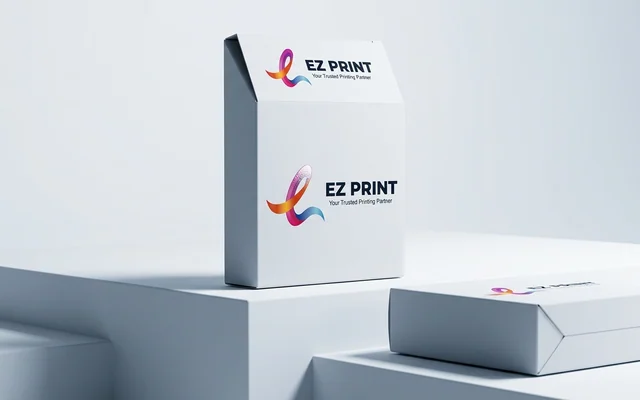
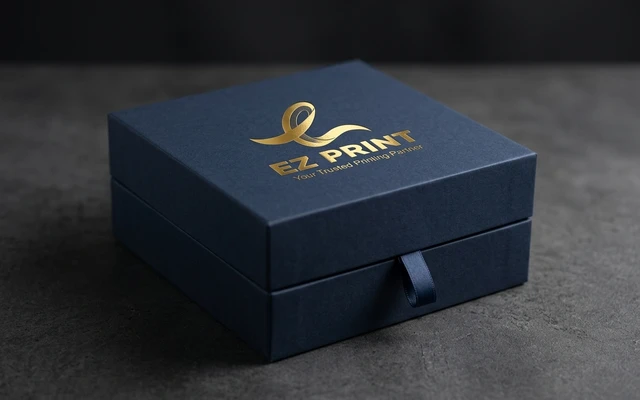
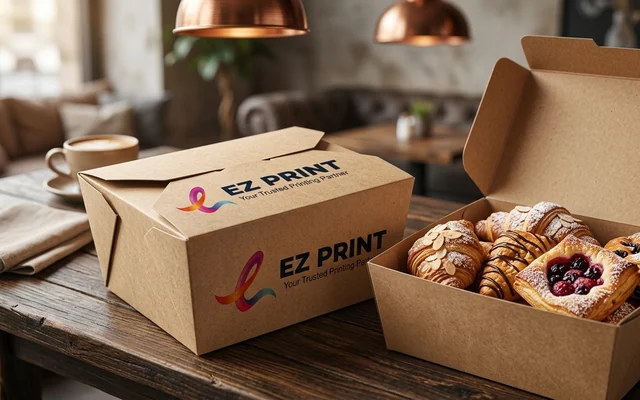
EZ Print prints custom packaging in Singapore, and has done since 2017. Folding cartons are printed flat on 300–400 gsm board, die-cut to a net, creased and glued — the standard tuck-end box, the crash-lock base, and the sleeve. Rigid gift boxes are a separate construction: a greyboard shell wrapped in a printed sheet, which is why they cannot be flat-packed. Corrugated mailers use a fluted board for protection and are printed on the outer liner. Every one of them starts from a dieline: a vector drawing of every cut and every crease on the flat net, which the cutting die is made from and kept on file. Standard turnaround is 7–14 working days, and the die-cutting, the creasing, the gluing and the hand assembly of a rigid box all happen inside it. Express is quoted per job. EZ Print quotes from the specification and does not publish prices.
Products quoted on this page
Specifications, formats and enquiry details for each product quoted on this service.
Internal dimensions, construction, board and finish. Internal, not external: a box is specified by what goes into it, and the board thickness is added afterwards. Everything else follows from the dieline.
A box is not drawn here at true size, and there is no honest way to do it. The object is three-dimensional and the file is a flat net that is wider than the finished box in both directions — a 120 × 80 × 45 mm carton opens out to roughly 300 × 250 mm of board before the glue flap. Drawing the net shrunk to fit and captioning it as a trim would state a measurement it was not drawing. The dieline is supplied instead as a vector file at full size, which can be printed, folded and measured — which is what a physical mock-up is for, and why one is worth asking for before a run of a thousand.
L × W × H
Internal dimensions, always in that order. A box quoted on external dimensions is a box the product does not fit into, and it is the most common error on a packaging enquiry.
Constructions
Straight tuck-end and reverse tuck-end cartons, crash-lock base, sleeve, rigid two-piece gift box, corrugated mailer.
Dimensions
Stated as internal length × width × height in millimetres.
Board
300–400 gsm folding boxboard for cartons; greyboard shell for rigid boxes; E-flute corrugated for mailers.
Dieline
A vector net with every cut and crease, supplied or drawn here. The die is made from it and kept.
Bleed and safe area
3 mm bleed outside every cut edge, 5 mm safe margin from any cut or crease.
Finishing
Matt, gloss and soft-touch lamination, spot UV, hot foil, blind emboss, window patching.
Minimum run
100 for folding cartons; 50 for rigid boxes.
Turnaround
Standard is 7–14 working days, whatever the construction and whether or not the die exists. Express is quoted per job.
What to ask for
1,000 folding cartons
Internal 120 × 80 × 45 mm, straight tuck-end
350 gsm folding boxboard
4C outside, unprinted inside
Matt lamination outside, gloss spot UV on the logo
Dieline supplied as a vector, or drawn from the internal dimensions
Needed by — your date
The material
Boards, and what each one is doing structurally
Packaging board is chosen for stiffness first and appearance second, which is the reverse of every other product here. A carton has to hold a shape under load; the printed face is what it looks like while doing it.
Matt art card0.41 mm · 400 gsm
Also sold as folding boxboard, FBB, matt coated board. Held at 310, 350 and 400 gsm.
The standard folding carton board. Stiff enough to hold a tuck end closed, and it creases without splitting once scored.
Under ink
Even solids and no glare, and it is the better ground for spot UV on a printed carton.
Best for
Cosmetics, food cartons, retail boxes, anything folded and glued.
Avoid for
A box carrying real weight. Board holds a shape; it does not carry a load.
On the schedule
Held. Die-cut to a net, creased along every fold, then glued.
Gloss art card0.32 mm · 350 gsm
Also sold as gloss coated board, C2S gloss. Held at 260, 310 and 350 gsm.
The same board with a reflective face, for packaging where a photograph of the product is the design.
Under ink
High chroma, which is why food and beverage cartons tend to use it.
Best for
Food packaging, product photography on the face, retail shelf presence.
Avoid for
Anywhere fingerprints matter, and any surface written on.
On the schedule
Held. The board food and beverage cartons are usually printed on.
Kraft board0.46 mm · 350 gsm
Also sold as brown kraft board, natural board, recycled board. Held at 300 and 350 gsm.
Brown through the whole thickness, so the cut edge and the inside of the box are the same colour as the outside.
Under ink
CMYK goes muddy on brown. One or two spot colours, white ink or foil are the honest options.
Best for
Food, craft, wellness and anything positioned as unbleached.
Avoid for
Any design that needs white space — there is no white on this board.
On the schedule
Held. White ink is a separate pass, laid down before the colour.
1.24 mmCoating lay at 8×
Bonded triplex1.24 mm · 900 gsm bonded
Also sold as triplex board, laminated board, rigid box board.
Three plies bonded to a caliper no single board reaches. Used where the box has to feel structural rather than folded.
Under ink
The face takes ink normally; the bonded edge is visible and is part of the design.
Best for
Premium sleeves, heavy tags, rigid box lids.
Avoid for
Folding or creasing. Bonded board delaminates at a fold.
On the schedule
Bonded to order — the board is made before the box is printed.
Greyboard with a printed wrap
Also sold as rigid board, chipboard, set-up box board.
A thick unprinted board cut and formed into a shell, then wrapped in a separately printed sheet. This is what a rigid gift box actually is, and it is why one cannot be flat-packed.
Under ink
All printing happens on the wrap, which is a thin coated paper. The board itself is never printed.
Best for
Premium gift boxes, watch and jewellery packaging, anything with a lift-off lid.
Avoid for
High volumes on a tight schedule. Every box is assembled rather than folded.
On the schedule
Every box is formed and wrapped by hand rather than folded.
E-flute corrugated board
Also sold as fluted board, single-wall corrugated, e-flute.
Two liners with a fluted core between them. The flute is the structure: it is what lets a thin board resist a crush.
Under ink
Printed on the outer liner. Fine detail and heavy solids both suffer where the flute pattern shows through.
Fine type and large flat solids, both of which show the flute.
On the schedule
Printed on the outer liner, then cut and creased through the flute.
Printed wrapping paper
Also sold as wrapping paper, gift wrap, tissue wrap, branded wrap.
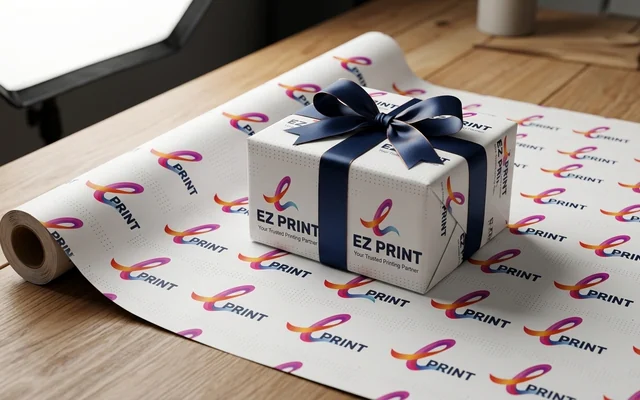
A light printed sheet that is wrapped around a product rather than folded into a structure. It is the cheapest branded packaging there is, because it carries no structure and needs no tooling — which is also its limit: it protects nothing.
Under ink
On a light uncoated sheet, colour lands soft and ink shows through from the reverse. A repeating pattern hides both; a single large solid shows both.
Best for
Retail gift wrapping, hamper and box liners, tissue between garments, seasonal packaging that changes every year.
Avoid for
Anything that needs to hold a shape or take a weight. That is a box, not a wrap.
On the schedule
No die, no crease, no glue. Say the sheet size and whether the pattern must repeat across it.
Ask for a physical mock-up before a run of a thousand. A flat net folded once in your hands answers questions about fit, closure and stiffness that no drawing settles.The materials library →
A crease is not a fold line drawn on a file. It is a channel pressed into the board by the same die that cuts it, and it is why a carton folds in the same place every time.
The die, the crease, the glue and the window
Packaging finishing is structural before it is decorative. The die cuts the net, the crease decides where it folds, the glue holds it and a window patch puts film behind a cut-out. Each is a separate pass and each has a fixed cost.
Packaging finishing: what each operation needs, and whether its die is kept for the reorder
Finish
Tooling
What the reorder pays for
Matt or gloss laminationSingle pass, both sides
None
Nothing to make, so nothing to remake.
Soft-touch laminationThe film settles before the sheet is guillotined
None
Nothing to make, so nothing to remake.
Spot UVNeeds a screen; reads best over matt film
Made once
Kept on file with your approved artwork. The reorder runs from it.
Die-cuttingA forme is cut once, then kept for the reorder
Made once
Kept on file with your approved artwork. The reorder runs from it.
Duplex or triplex bondingTwo or three sheets bonded to reach a caliper no single sheet gives
None
Nothing to make, so nothing to remake.
Hot foil stampingFirst run carries the block; reorders do not
Made once
Kept on file with your approved artwork. The reorder runs from it.
Blind embossingMale and female dies, kept
Made once
Kept on file with your approved artwork. The reorder runs from it.
Creasing to the dielinePressed by the same die that cuts the net
None
Nothing to make, so nothing to remake.
Carton gluingOne or two glue flaps, folded flat for delivery
None
Nothing to make, so nothing to remake.
Window patchingClear film bonded behind a die-cut aperture
None
Nothing to make, so nothing to remake.
Rigid box assemblyA greyboard shell formed and wrapped by hand. Never flat-packed
None
Nothing to make, so nothing to remake.
Scroll the table sideways to see every column.
Every operation here is quoted inside the standard window. What changes between a first order and a second is the tooling: a die, a block or a screen is made once and then kept on file with your approved artwork, which is why the reorder of a job carrying one is a different job from the first.
Give the internal dimensions and the product, not the external dimensions and a picture. Board has a thickness, and every millimetre of it is on the inside of the box.
Pairings that work
+350 gsm folding boxboard, straight tuck-end, matt laminated, spot UV on the logo. The most reliable retail carton there is.
+Kraft board with a one-colour print and a die-cut window. Unbleached, honest, and the window sells the product rather than a photograph of it.
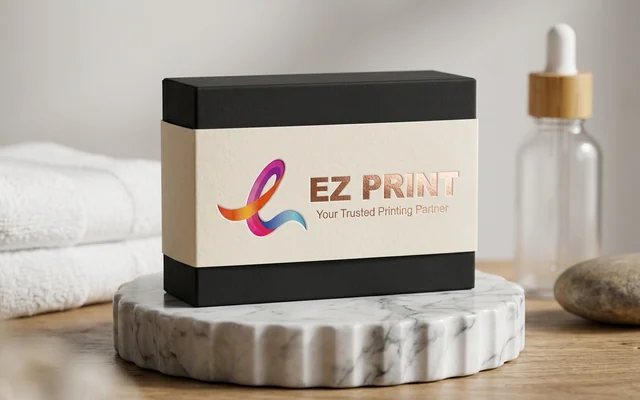
+A printed sleeve over a plain rigid box. The expensive part is made once and the sleeve changes per product or per season.
+E-flute corrugated mailer with a crash-lock base. It assembles in one movement and survives a courier.
Combinations that fail
×External dimensions on the enquiry. Board thickness comes off the inside, so a box quoted externally is a box the product does not fit.
×Fine type and large flat solids on corrugated board. Both show the flute pattern through the liner, and neither can be corrected after the die is made.
×Folding a bonded triplex board. It delaminates at the crease — bonded board is for sleeves and lids, not for folded cartons.
×A gloss laminate on a food carton that will be handled with wet hands. It becomes slippery, and every fingerprint stays on it.
Constructions, and what each is for
Construction is chosen for how the box is filled and how it is closed, not for how it looks flat. Each one below cuts from its own die, and a die that already exists is worth more than any other saving.
Straight tuck-end
Flaps tuck in from the same side. The simplest carton, and the cheapest die.
Reverse tuck-end
Flaps tuck from opposite sides. Slightly stronger, and the front face stays cleaner.
Crash-lock base
The base locks as the box is opened out. Faster to fill, and it takes more weight.
Sleeve
An open band around a tray or a rigid box. One die, no glue, and it can be reprinted alone.
Rigid two-piece box
A greyboard shell with a lift-off lid, wrapped in a printed sheet. Assembled, never flat-packed.
Corrugated mailer
E-flute board with a crash-lock or tuck construction, printed on the outer liner.
The dieline is the file
A packaging file is a flat net with artwork registered to it. If the dieline is wrong the artwork is wrong, however good it looks — so the dieline is settled and approved before the design is finished rather than after.
The file
Format
PDF/X-4 or Illustrator at the flat net size, with the dieline as a live vector.
DIELINE layer
Cuts as solid lines, creases as dashed lines, in named spot colours, on a layer that never prints.
Bleed
3 mm outside every cut edge, including every flap and glue tab.
Safe margin
5 mm from any cut or crease. Type across a crease is type that will be creased.
Glue flap
Left unvarnished and unlaminated — glue does not key to film.
Existing die
If a die already exists, say so and the net comes back as a template rather than being redrawn.
The colour, and the detail
Colour mode
CMYK plus named Pantone references for any brand colour that has to match between print runs.
Rich black
C60 M40 Y40 K100 on coated board, total ink 300%.
White ink on kraft
Supplied as a 100% K vector on a layer named WHITE, under any colour that must stay bright.
Barcodes
Vector at 100%, with quiet zones intact, and never printed across a crease.
Small text
K100, 6 pt minimum on board, 8 pt on corrugated.
Regulatory text
Supplied by the customer and positioned clear of every crease and glue flap.
Send the product’s internal dimensions and what it weighs, and a dieline comes back with the construction, the board and the crease positions drawn — printable, foldable and measurable before anything is cut.
Turnaround
The die first, then everything else
Standard
Standard turnaround is 7–14 working days.
Standard orders. The schedule for specialist finishing is confirmed in your quotation.
Express
Same-day printing available.
Subject to artwork, stock and production capacity confirmation. Timing is agreed for each job.
What sets the date
The die first, then everything else. A carton is printed, laminated, cut to its net, creased and glued; a window is patched with film in a further pass; a rigid box is formed and wrapped by hand rather than folded at all. All of it is quoted inside the standard window.
What a reorder skips
The steel rule die, kept on file with the approved artwork and the proved dieline. The second run of a carton starts from a shape that has already been folded and checked — which is worth knowing before the shape is designed, if the product is likely to repeat.
If the date is tight
Send the internal dimensions, the construction, the board and whether a die already exists, and ask for an express quotation. We confirm the specification, production schedule and next steps in the quotation.
The cutting die is kept on file with the approved artwork, so the second run of a carton is materially faster than the first. If a product is likely to repeat, that is worth knowing before the shape is designed.
Every answer here is in the page source at full opacity, open or closed. An answer engine has to be able to read it without executing anything.
Questions asked about packaging
What is a dieline?
A vector drawing of the flat net: every cut edge as a solid line and every crease as a dashed one, on a layer that is never printed. The steel rule cutting die is made from it, so it is the drawing everything else is registered to. Without one, the shape has to be drawn before anything can be quoted.
Should I give internal or external box dimensions?
Internal, as length × width × height in millimetres, plus what the product weighs. Board has a thickness and it all sits on the inside, so a box quoted on external dimensions is usually a box the product does not fit into.
What is the difference between a folding carton and a rigid box?
A folding carton is printed board cut to a net, creased and glued, and it ships flat. A rigid box is a thick greyboard shell formed into a shape and then wrapped in a separately printed sheet, so it cannot be flat-packed and it takes considerably longer to make.
Can you print on kraft board?
Yes, but CMYK goes muddy on brown. One or two spot colours, a white underprint or a foil block are the options that actually read. Kraft board is brown all the way through, so the cut edges and the inside of the box are brown as well.
Can a box have a window?
Yes. The aperture is cut by the same die as the net, and a clear film is bonded behind it in a separate pass called window patching. The aperture needs a radius at every internal corner rather than a sharp point, or the die tears the board there.
Do you keep the die for a repeat order?
Yes. A cutting die is made once and kept on file with the approved artwork. The first run of a new construction carries the die and waits for it to be cut from steel rule; every run after it skips that step entirely.
Can I get a sample before the full run?
Ask for a mock-up. A printed and folded sample answers the questions a drawing cannot — whether the product fits, whether the closure holds, whether the board is stiff enough — and it is far cheaper than discovering any of those on a run of a thousand.
Is your packaging suitable for food?
Food-contact packaging has requirements about the board and the coatings used, and those are set by the product rather than by the print. Say the contents on the enquiry and the material is specified against that requirement rather than assumed.
Trading since 2017 — EZ PRINT PRIVATE LIMITED, UEN 201706183R.
Standard turnaround is 7–14 working days. For urgent orders or express schedules, please check with EZ Print.
Artwork is checked before production.
Island-wide courier delivery within Singapore.
Collection can be arranged on request.
Ask for a quote on this packaging
Every job is quoted from its specification — stock, quantity, sides, finish, size and deadline.
Quantity
Stock — or the feel you want, if you do not know the stock