EZ Print — Your Trusted Printing PartnerSame-day & ExpressRequest a quote

Popular searches

Can't find it? Tell us what you need and we will quote it.

Luxury bespoke commercial print showcase with gilded business cards, open lookbook, and embossed presentation box.

Glass graphics

Window stickers, and the side of the glass they are read from

Every window sticker is read from one side of the glass or from both, and that single fact decides whether it is printed the right way round or in reverse, whether white goes behind the colour, and whether it sticks with adhesive or clings without any.

  • Standard7–14 working days
  • ExpressSame-day and urgent printing available

Glass and window sticker printing in Singapore, in one paragraph

EZ Print prints glass and window stickers in Singapore, and has done since 2017. The materials are printed and white-frost frosted film, ready-patterned frosted film, printable solar window film, perforated one-way vision film, static cling decals that hold without adhesive, and cut frosted lettering. The first decision is the viewing side: a sticker applied inside and read from the street is reverse printed, with white laid behind the colour. Printed frosted film reads grey rather than white, and colour on frost stays translucent unless it is white-backed. Frosted and solar films run to 1220 mm wide in one panel; wider glass is tiled with a 25 mm overlap. Standard turnaround is generally 7–14 working days. Express is quoted per job. EZ Print quotes from the specification and does not publish prices.

Products quoted on this page

Specifications, formats and enquiry details for each product quoted on this service.

2 formats
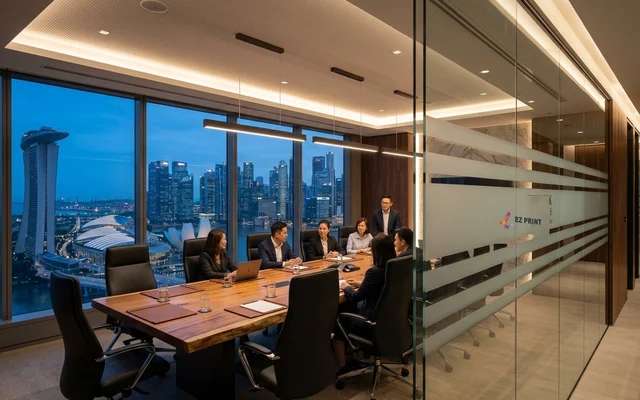
  • Frosted film privacy graphics installed on office glass panels, with the EZ Print logo.
    Large format & signage

    Frosted Film

    A translucent film on glass for privacy, safety bands or a cut logo that reads like etched glass.

    Also ordered as: Frosted Sticker, Privacy Film, Glass Manifestation, Etched Glass Film, Window Frosting

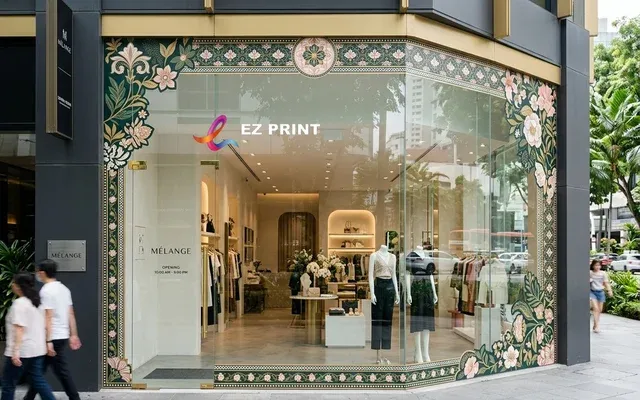
  • Window film printed graphics for architectural glass displays, with the EZ Print logo.
    Large format & signage

    Printed Window Film

    A clear or white film printed for shop windows and glass doors, with a white layer where colour must hold.

    Also ordered as: Window Graphic, Window Decal, Clear Window Sticker, Glass Sticker

All 140 products, by family

The specification a window sticker is quoted from

Material, size per pane, viewing side, white layer and how it holds to the glass. The viewing side is the line briefs usually leave out, and it is the one that decides how the file is printed. The static cling below is drawn at true physical size.

Static window cling · 90 × 54 mm
Bleed line (+0 mm)Actual card size (90 × 54 mm)Safe zone (5 mm inside trim)

Season parking

Face out · white base

5 mm clear border

Drawn at true size — trim 90 × 54 mm, 0 mm bleed dashed outside the trim, 5 mm safety margin dashed inside it.
90 mm

5mm


The clear border a static cling needs around its artwork. It is the margin that grips the glass; artwork run to the edge leaves the edge with nothing to hold by.

Frosted film
Printed frost in grey, or a white-frost film with colour optionally white-backed. Single panels 148–1220 mm wide.
Ready frosted film
A ready-patterned decorative frosted film, 1200 mm wide. No artwork needed.
Solar window film
A printable solar film with frosted options. 148–1220 mm wide, with no clear area left in the finished print.
One-way vision
Perforated film, 152–1320 mm wide or at A-sizes from A4 to 2A0, with an optional laminate.
Static clings
Printed film on a clear liner that holds to glass without adhesive. Direct, reverse or double-sided print.
Viewing side
Face in, face out or both. Read from outside through the glass means a reverse print with a white base.
Tiling
Glass wider than one panel is split into panels with a 25 mm overlap at each join.
Turnaround
Standard is generally 7–14 working days. Express is quoted per job; fitting is arranged separately.

What to ask for

2 printed frosted panels, 1180 × 600 mm each
Grey frost, logo white-backed so it reads solid
Applied to the corridor face, read from the corridor
Band height marked from the finished floor on site
Vector PDF, white on its own layer, fonts outlined
Needed by — your date

The material

Films, and which side of the glass each one works from

Seven materials, and they divide by what the glass has to do: hide a room, carry an image, keep a view out, take heat, or hold a notice that will be moved. Nothing here is a sheet from the caliper table, so nothing carries a caliper — the films are described by behaviour rather than measured.

Printed frosted film

Also sold as printed frosted sticker, frosted glass sticker, etched-look film.

A self-adhesive frosted film printed to order in single panels from 148 mm to 1220 mm wide, and tiled beyond that. The frost itself reads grey on the glass rather than white.

Under ink
Colour printed on frost has no white behind it, so it stays translucent and glows when light comes through. Logos and text are given a solid white behind them so they read as solid marks.
Best for
Meeting rooms, clinic doors and office partitions where a printed pattern or logo sits within the frost.
Avoid for
Expecting a bright white frost. This film reads grey; a white frost is a different film.
On the schedule
The clear adhesive takes time to settle after fitting, so a faint haze just after fitting is normal.

White-frost film

Also sold as white frosted sticker, white etch film, white frost window sticker.

A frosted film whose background can be specified in grey or in white, with optional white backing behind the printed colour. It is the film for a frost that has to read light rather than smoky.

Under ink
With white backing, colour reads solid and opaque; without it, colour stays translucent over the frost. The background is filled with the frost chosen, never with ink.
Best for
Shopfronts and reception glass where a brand colour has to hold against daylight on a frosted ground.
Avoid for
Filling the frosted background in the artwork. Leave it empty and name the frost on the specification.
On the schedule
Printed, white-backed where specified, cut to shape, then tiled into panels for wide glass.

Ready-patterned frosted film

Also sold as decorative window film, window decor film, frosted pattern film.

A decorative frosted film supplied 1200 mm wide in ready patterns, cut to the pane. Nothing is printed to order, so there is no artwork to prepare.

Under ink
No ink. The pattern is in the film.
Best for
Privacy on a whole run of glazing where no logo is needed — bathrooms, back offices, ground-floor flats.
Avoid for
Brand colour or a logo. Those need a printed frosted film.
On the schedule
Cut to the pane from stock; its clear adhesive takes longer to settle than the printed films.

Printable solar window film

Also sold as solar film, window tint film, printed solar film.

A solar control film that can be printed and frosted. Solar films are compared on three published figures: visible light transmitted, ultraviolet rejected and infrared rejected, each as a percentage.

Under ink
Every area of the finished film is printed, white or frosted. There is no clear area left in it, so plan the artwork as a full surface.
Best for
Sun-facing glazing that also needs privacy or a printed design.
Avoid for
A design that relies on clear windows through the film. There are none.
On the schedule
Printed to the pane, frosted where specified, and tiled into panels with a 25 mm overlap for wide glass.

One-way vision film

Also sold as perforated window film, see-through window graphic, one way vision sticker.

A perforated printed film from 152 mm to 1320 mm wide, also set up at standard A-sizes from A4 to 2A0. It carries an image outside while the view out is kept.

Under ink
Printed on the solid face, with a clear laminate available over it. The laminate closes the perforations against rain and dust.
Best for
Street-facing shop glazing and vehicle windows where the people inside must still see out.
Avoid for
Glass that has to be read from inside. The image faces outward only.
On the schedule
Printed, laminated where specified, then cut to the pane.

Static cling decal

Also sold as static decal, window cling, static sticker, blockout static decal.

A printed film on a clear liner that holds to clean glass without adhesive, so it can be peeled off, moved and put back. Single-sided and double-sided clings are made from different films.

Under ink
Printed direct, in reverse or on both sides, with a white base where it has to read solid. On a clear double-sided cling light colours look translucent, which is what the blockout version exists to stop.
Best for
Parking permits, car window notices, opening notices and seasonal promotions that come down and go back up.
Avoid for
Artwork printed to the edge. A 5 mm clear border is what lets the cling grip.
On the schedule
Printed, then die-cut or kiss-cut on the liner to the shape.

Cut frosted vinyl

Also sold as frosted lettering, cut frosted sticker, etched-look lettering.

Frosted film cut to a vector outline — letters, a logo, a band — with the background weeded away so only the shape is left on the glass.

Under ink
No ink. The shape is the film.
Best for
Door names, room numbers, logos and manifestation bands that should read like etched glass.
Avoid for
Lettering 25 mm high or less, or strokes 2 mm or less. Below that it is supplied unweeded and has to be picked by hand.
On the schedule
Cut, weeded and taped so each piece transfers as one, then left to settle after it is applied.

Say which side of the glass the sticker goes on and which side it is read from. Those two answers choose the print direction, the white layer and very often the material, before the design has been looked at.The materials library

A kiss-cut leaves the liner whole so a shape lifts off cleanly; a die-cut goes through the liner so each piece is separate. Clings and stickers can take both on the same piece.

Cutting, tiling and laminating

Glass graphics are usually printed and then cut, and many are then tiled into panels or laminated. Each of those is a pass of its own, and each changes what the graphic looks like once it is on the glass.

Glass graphic finishing: what each operation needs, and whether its cut file is kept for the reorder
FinishToolingWhat the reorder pays for
Contour cuttingKiss-cut, die-cut, or both, to closed vector paths. The cut file is keptMade onceKept on file with your approved artwork. The reorder runs from it.
Weeding and application tapeCut frosted lettering over 25 mm high, weeded and taped to transfer as one pieceNoneNothing to make, so nothing to remake.
Panel tilingFilm for glass wider than one panel, split with a 25 mm overlap at each joinNoneNothing to make, so nothing to remake.
One-way vision overlaminateA clear film over the perforated print, closing the holes against rain and dustNoneNothing to make, so nothing to remake.

Scroll the table sideways to see every column.

Every operation here is quoted inside the standard window. What changes between a first order and a second is the tooling: a die, a block or a screen is made once and then kept on file with your approved artwork, which is why the reorder of a job carrying one is a different job from the first.

A window sticker that reads backwards was not printed wrongly. It was printed for the other side of the glass, and nobody said which side it was going on.

Pairings that work

  • A reverse-printed static cling with a white base, applied inside a car or shop window and read from outside. No adhesive, and it moves when the notice changes.
  • Grey printed frost across a partition with the logo white-backed. The frost gives privacy and the logo reads as a solid mark rather than a tint.
  • One-way vision with a clear laminate on street-facing glazing. The image reads from the street, the view out is kept, and the laminate closes the perforations.
  • A blockout static cling for a glass door read from both sides. Each face reads solid instead of showing the other through it.
  • Cut frosted lettering over 25 mm high, weeded and taped. It goes on as one piece and reads like etching.

Combinations that fail

  • Light colours on a clear double-sided cling without blockout. They look translucent, and each face shows through the other.
  • A static cling with artwork printed to its edge. Without the 5 mm clear border the edge has nothing to grip by.
  • A mirrored file sent for a reverse print. Artwork is supplied reading the right way round and mirrored in prepress; a file mirrored twice reads backwards on the glass.
  • Expecting white frost from the printed frosted film. It reads grey; a white frost is a separate film.
  • Solar film designed with clear windows through it. Every area of the finished film is printed, white or frosted.
  • Cut frosted lettering 25 mm high or less expected weeded. It arrives as a sheet to be picked by hand.

Sizes, widths and panels

Glass graphics are sized per pane, as width × height in millimetres. The widths below are what each film runs to in one piece; glass wider than that is tiled.

Car window cling · 90 × 54 mm
The name-card size. Face in, face out, or both-side view with colour on each face.
Car window cling · 115 × 120 mm and 130 × 170 mm
Two mid sizes, in the same three viewing options.
Car window cling · 90 × 420 mm
A long strip, in the same three viewing options.
Static decals · 50–900 mm wide
Custom sizes and shapes; template squares from 80 × 80 to 120 × 120 mm.
Frosted and solar film · 148–1220 mm wide
Per panel. Wider glass is tiled with a 25 mm overlap.
One-way vision · 152–1320 mm wide
Custom widths, or set up at A4, A3, A2, A1, A0 and 2A0.
Ready frosted film · 1200 mm wide
Cut to the pane from a 1200 mm width.

Say the viewing side, and draw white on purpose

On clear and frosted film, white is not the colour of the paper. It is a layer of its own, printed only where the file asks for it, so anything left blank is clear or frosted on the glass.

The file

Format
Vector PDF or AI with all type outlined. Frosted, solar and fine-detail cling work needs vector.
White layer
Every white area drawn on its own named layer. White is printed only where it is drawn.
Clear areas
Left empty. No fill, not even white, where the glass is meant to show.
Frosted background
Left empty in the file. The frost is named on the specification and filled in production.
Reverse print
Supplied reading the right way round. Mirroring for the inside face is done in prepress.
Cut paths
Closed vector paths on their own layer, kiss-cut and die-cut on separate layers.
Cling border
5 mm clear on every side of a static cling, inside the cut line.

The colour, and the detail

Colour on frost
Translucent unless white-backed. Logos and text are white-backed by default so they read solid.
Frost tone
Grey on the printed frosted film; grey or white on the white-frost film.
Double-sided clings
Light colours show through on clear film. Specify blockout where both faces must read solid.
Minimum type on a cling
8 pt (about 3 mm) on the fine-detail grade; 14 pt (about 5 mm) on the standard grade.
QR codes on a cling
Over 15 mm square on the fine-detail grade, over 20 mm on the standard grade, or they will not scan.
Colour mode
CMYK, with Pantone references for brand colours that must match across panes.

Send the pane sizes, which face the sticker goes on and which side it is read from, and the white layer, the print direction and the material come back as a specification that can be checked against the glass.

Turnaround

Print, white, cut, tile

  • Standard

    Standard turnaround is generally 7–14 working days.

    Standard orders. The schedule for specialist finishing is confirmed in your quotation.

  • Express

    Same-day and urgent printing available.

    Subject to artwork approval, payment, print type and production availability. Timing confirmed per job.

What sets the date
The layers. A reverse print carries a white layer in register behind the colour; a cut graphic is then contour cut and, for lettering, weeded and taped; wide glass is tiled into panels. All of it is quoted inside the standard window.
What a reorder skips
The cut file and the panel split. Once a set of panes has been measured and split, a replacement for the same glass reprints straight to those figures.
If the date is tight
Send the pane sizes, the material, the viewing side and the quantity, and ask for an express quotation. The quotation confirms the specification, production schedule and next steps.

Fitting large film is arranged separately and planned against access to the glass. A static cling or a small sticker is applied by hand by whoever receives it.

Every answer here is in the page source at full opacity, open or closed. An answer engine has to be able to read it without executing anything.

Questions asked about window stickers

What is the difference between a frosted sticker and a static cling?

A frosted sticker is a self-adhesive film that stays where it is put; it gives privacy and can carry printed colour. A static cling holds to clean glass without adhesive, so it can be peeled off and moved. Frost is for glass that changes once; a cling is for notices that change often.

Can a window sticker be read from both sides of the glass?

Yes, as a both-side cling or a double-sided static decal, with colour printed on each face around a white base. On clear film, light colours show through from the other side; a blockout cling stops that so both faces read solid.

What is a reverse-printed window sticker?

One applied to the inside of the glass and read from outside through it. The image is mirrored and the white goes on behind the colour, so the right-reading face lies against the glass. Supply the artwork the right way round; the mirroring is done in prepress.

Why does printed frosted film look grey?

Because that frost is grey on the glass, not white. Colour printed on it stays translucent unless white is put behind it, which is why logos and text are white-backed. Where the frost itself must read white, a white-frost film is specified instead.

How high should a frosted privacy band be?

Measure it in the room, not on the drawing. Stand and sit where the people using the room will, mark the top and bottom of the sightline on the glass with tape, and state both heights from the finished floor. A band set from the elevation usually misses one of the two.

How wide can one panel of window film be?

Frosted and solar films run to 1220 mm wide in one panel, one-way vision to 1320 mm, and ready-patterned frosted film comes 1200 mm wide. Wider frosted or solar glass is tiled into panels with a 25 mm overlap at each join.

What do VLT, UVR and IRR mean on a solar film?

Three percentages. VLT is how much visible light passes through; UVR is how much ultraviolet is blocked; IRR is how much infrared is blocked. Ask for the three figures for the exact film being quoted rather than comparing films by name.

  • Trading since 2017 — EZ PRINT PRIVATE LIMITED, UEN 201706183R.
  • Need it today? Same-day and express printing for urgent jobs. Subject to artwork approval, payment, print type and production availability. Timing confirmed per job. Non-urgent orders: generally 7–14 working days.
  • Artwork is checked before production.
  • Island-wide courier delivery within Singapore.
  • Collection can be arranged on request.

Ask for a quote on these window stickers

Every job is quoted from its specification — stock, quantity, sides, finish, size and deadline.

  • Quantity
  • Stock — or the feel you want, if you do not know the stock
  • Sides printed
  • Finish
  • Flat and finished size
  • The deadline

Artwork is welcome but not required to start. Email sales@ezprint.com.sg if you would rather attach files.