
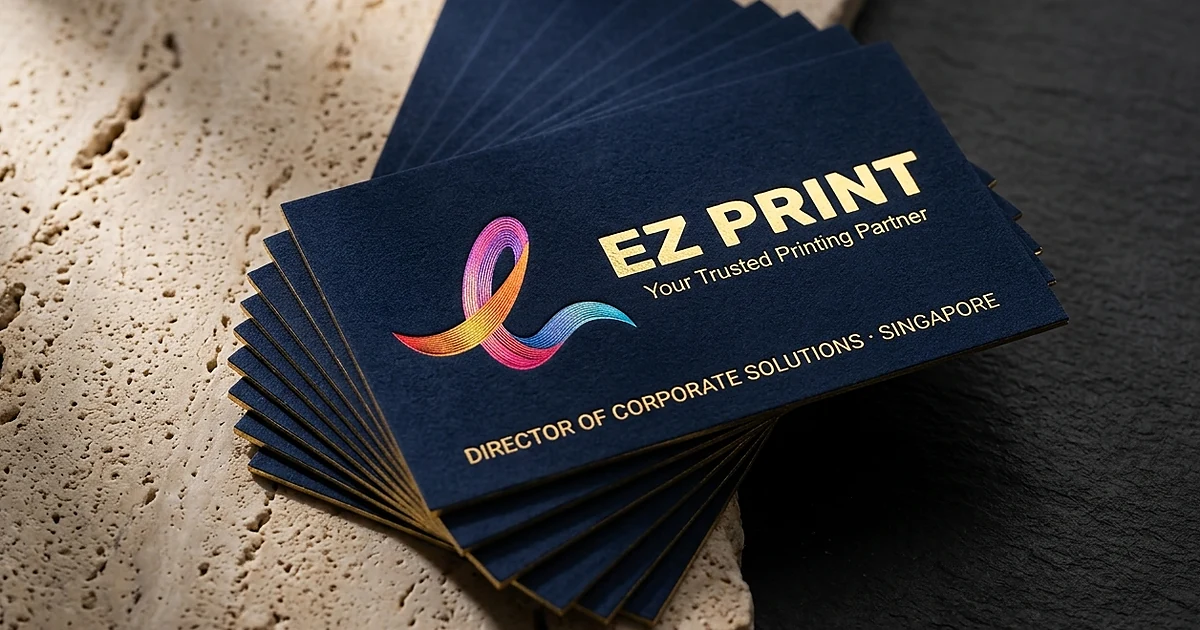
Every folded brochure, tent card, folded name card, loyalty stamp card and tear-off gift voucher relies on a mechanical finishing pass between printing and packing. When a designer treats a fold or a tear stub as a flat line on screen without accounting for paper thickness, fibre grain and blade clearance, the printed batch comes back with cracked dark spines, telescoping roll-fold panels that refuse to close flat, or vouchers that tear through the serial number. Trading since 2017, EZ Print produces creased, folded and perforated print collateral in Singapore across brochure printing, cards and padded forms.
Why does heavy card crack at the fold, and how does creasing prevent it?
Above about 170 gsm, folding a sheet directly in a buckle folder stretches the outer surface coating past its elastic limit, splitting the clay coat and ink layer to expose raw white paper fibres. Creasing presses a rounded rule into a counter-matrix channel before folding, delaminating the internal plies controllably so the outer surface bends as a smooth hinge.
Light leaflet papers at 128 gsm and 157 gsm are flexible enough to machine-fold directly on a buckle or knife folder without a separate creasing pass. Once a specification steps up to 250 gsm, 260 gsm, 300 gsm, 310 gsm or 350 gsm art card — whether for a folded name card, a heavy 4-page brochure cover, a presentation folder or a loyalty stamp card — the sheet has real beam stiffness.
When a heavy card is bent through 180°, the inside of the bend compresses while the outside arc must travel a longer path around the caliper of the board. Without a pre-stamped crease channel:
- Solid CMYK ink and clay coatings split along the outer spine, showing an irregular white jagged line — especially visible on Rich Black (
C60 M40 Y40 K100, 240% total ink) or dark corporate navy covers. - Cross-grain folds resist the fold rollers, causing the spine to spring back open on the counter instead of lying flat.
- Ultra-thick laminated boards (
600 gsmbonded duplex) cannot be creased or folded at all because bonded stock delaminates at a crease; keep 600 gsm specs strictly as flat single-leaf cards.
| Stock Weight & Substrate | Folding Behaviour Without Creasing | Required Finishing Specification | Typical Print Applications |
|---|---|---|---|
| 80 gsm – 100 gsm uncoated woodfree | Folds cleanly by hand or machine | Machine fold only (no crease required) | A4 letterheads folded into 114 × 241 mm DL envelopes |
| 128 gsm – 157 gsm gloss or matt art paper | Folds cleanly on high-speed buckle folders | Machine fold (half-fold, roll-fold, Z-fold) |
High-volume brochures and folded leaflets |
| 250 gsm unlaminated art card | Outer coating splits if folded raw | Channel crease before folding | Flat and folded loyalty stamp cards (90 × 54 mm folded) |
| 260 gsm – 350 gsm art card or uncoated board | Severe fibre cracking along dark spines | Mandatory channel crease (1 or 2 crease rules); matt/gloss lamination reinforces the hinge |
Folded name cards, brochure covers, presentation folders, tent cards |
| 600 gsm bonded duplex board | Delaminates at a crease | Do not fold or score — flat guillotine or die-cut only | Flat luxury business cards and rigid invitation plates |
How do you calculate panel widths for roll-folds, Z-folds and folded cards?
In a roll-fold (letter fold), the third panel folds inside the outer two panels, so it must be narrowed by 2 mm to 3 mm (99 mm + 99 mm + 97 mm on a 297 mm wide A4 sheet) to prevent buckling. In a Z-fold (accordion fold), no panel nests inside another, so all three panels measure an equal 99 mm.
The most frequent preflight error on folded brochures is dividing a 297 mm wide A4 landscape artboard into three identical 99 mm columns on both sides of the sheet for a roll-fold. When the right-hand panel is tucked inside the left-hand cover, the paper thickness at the outer fold pushes the inner flap outward. If all three panels are 99 mm, the inner edge hits the outer crease, forcing the closed leaflet to bow open.
- A4 6-page roll-fold (
210 × 297 mmflat ->DL 99 × 210 mmfolded):- Flat artboard with
3 mmbleed: 216 × 303 mm (for landscape 303 × 216 mm). - Outside spread (left to right): 97 mm (tuck-in flap) + 99 mm (back cover) + 99 mm (front cover) = 295 mm (or 97 mm + 100 mm + 100 mm = 297 mm).
- Inside spread (left to right): 99 mm (inside left) + 99 mm (inside centre) + 97 mm (inside right flap).
- Avoid six-panel roll folds on heavy stock, as the nested panels get too stiff to close.
- Flat artboard with
- A4 6-page Z-fold / concertina fold (
210 × 297 mmflat ->DL 99 × 210 mmfolded):- Because the sheet folds back and forth in an accordion
Zprofile, none of the panels tuck inside another. All three panels are set to an equal 99 × 210 mm.
- Because the sheet folds back and forth in an accordion
- Half-fold brochures (
A4->A5,A3->A4,210 × 210 mm->105 × 210 mm):- Both panels share the exact same width (148.5 mm each on A4 folding to A5 148 × 210 mm, or 210 mm each on A3 297 × 420 mm folding to A4).
- Folded name cards & folded loyalty stamp cards (
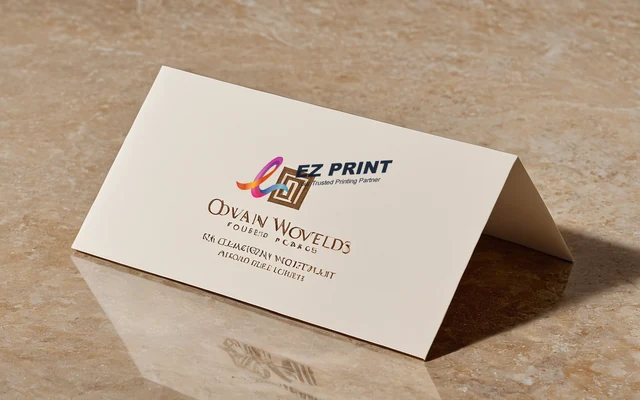
90 × 54 mmor54 × 90 mmfolded):- A landscape folded card starts at 180 × 54 mm open (or 90 × 108 mm open for a tent-style fold) and creases down the centre to finish at 90 × 54 mm landscape or 54 × 90 mm portrait. Keep a 4 mm safe margin from both the outer trim and the centre crease.
How does micro-perforation work for tear-off vouchers, tickets and NCR books?
Perforation punches a line of tiny alternating cuts and paper ties across a sheet so a voucher stub, event ticket butt or top NCR invoice copy detaches cleanly by hand without scissors. Keep all text, serial numbers and barcodes at least 5 mm clear of the perforation rule so the tear never splits a character.
Unlike a crease rule (which compresses the board without cutting through it), a perforation rule is a toothed steel blade or rotary wheel that slices short slots through the stock while leaving narrow uncut paper bridges (“ties”) to hold the stub attached during packing and distribution.
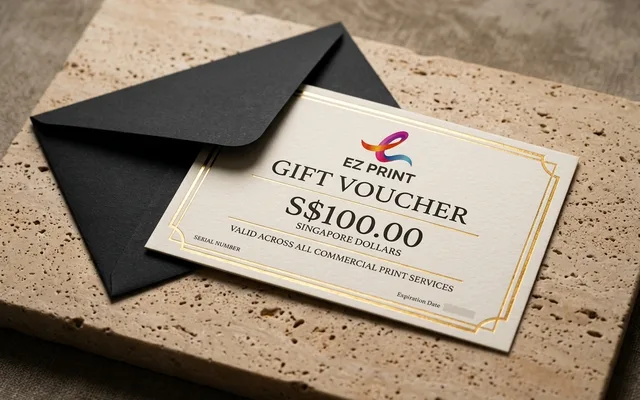
To prevent tear-off failures on press and at the cashier counter, follow three structural rules from perforation and scoring:
- Safe margin on both sides of the perforation: Leave 5 mm of clear margin on the main voucher and 5 mm on the retained stub. Perforation registration can shift slightly, and a tear line placed right against a border or sequential number will clip the digits.
- Padded NCR bill books (
A5 148 × 210 mmandA4 210 × 297 mm): Keep 10 mm safe margin all round and 20 mm at the head where the glue and the perforation sit. Never place the perforation above the binding glue or staples — perforating below the glue line allows the top copy to tear out cleanly while the yellow file copy stays anchored in the book. - Matching sequential numbers: When a gift voucher or event ticket has a perforated stub, print the sequential number on both the main body and the tear-off stub so cashiers can reconcile redeemed vouchers against issued butts.
Worked example: Setting up a folded loyalty card and a perforated gift voucher
When ordering a 1,000-piece run of folded 90 × 54 mm loyalty stamp cards alongside 500 perforated DL (99 × 210 mm) gift vouchers, pairing an unlaminated 250 gsm centre-creased card with a 300 gsm uncoated perforated voucher ensures crisp folds, smudge-free stamping and clean stub detachment.
- Folded Loyalty Stamp Card (
90 × 54 mmfinished landscape):- Stock & finish: 250 gsm art card, printed double-sided (
4C + 4C), unlaminated so cashier rubber stamps mark the grid boxes (allowing a brief moment for stamp ink to dry so it does not smudge). - Open flat size & crease: 180 × 54 mm open size with a centre crease rule at 90 mm (
186 × 60 mmartboard including 3 mm bleed all round) and a 4 mm safe margin on both sides of the centre crease.
- Stock & finish: 250 gsm art card, printed double-sided (
- Perforated Gift Voucher (
DL 99 × 210 mmfinished):- Stock & finish: 260 gsm or 300 gsm uncoated woodfree card so staff can handwrite the expiry date and signatory initials without ballpoint smearing.
- Perforation & numbering: A vertical micro-perforation line placed 50 mm from the left edge (creating a 50 × 99 mm merchant stub and a 160 × 99 mm customer voucher), with 5 mm safe margin on both sides of the perforation line and matching sequential numbers on both halves.
Pre-press checklist for creased, folded and perforated artwork
Before exporting your press PDF, place all crease and perforation paths on dedicated non-printing spot-colour vector layers at 0.5 pt stroke weight, verify 3 mm outer bleed and 4 mm to 5 mm internal safe margins around every fold or tear line, and check roll-fold flap widths.
- Draw crease and perforation lines as non-printing vector spot layers: Place fold/crease lines on a vector layer named
CREASEand perforation lines on a layer namedPERFat 0.5 pt stroke weight (100%Magenta or Cyan spot colour set to overprint) so they never print as visible ink on the sheet. - Verify your flat artboard includes
3 mmouter bleed: Set an A4 folded brochure artboard to 216 × 303 mm (210 × 297 mmplus 3 mm bleed on all four outer edges). - Check panel width compensation on roll-folds: Confirm the inner tuck-in panel is 2 mm to 3 mm narrower (97 mm alongside two 99 mm or 100 mm outer panels) and orient the page sequence so the inner flap opens in the right reading order.
- Run the preflight check: Drop your PDF into the Interactive Artwork Preflight Checker before submitting your brief via request a quote. Standard turnaround is generally 7–14 working days with island-wide courier delivery across Singapore.
Same-day and urgent printing available. Subject to artwork approval, payment, print type and production availability. Timing confirmed per job.