
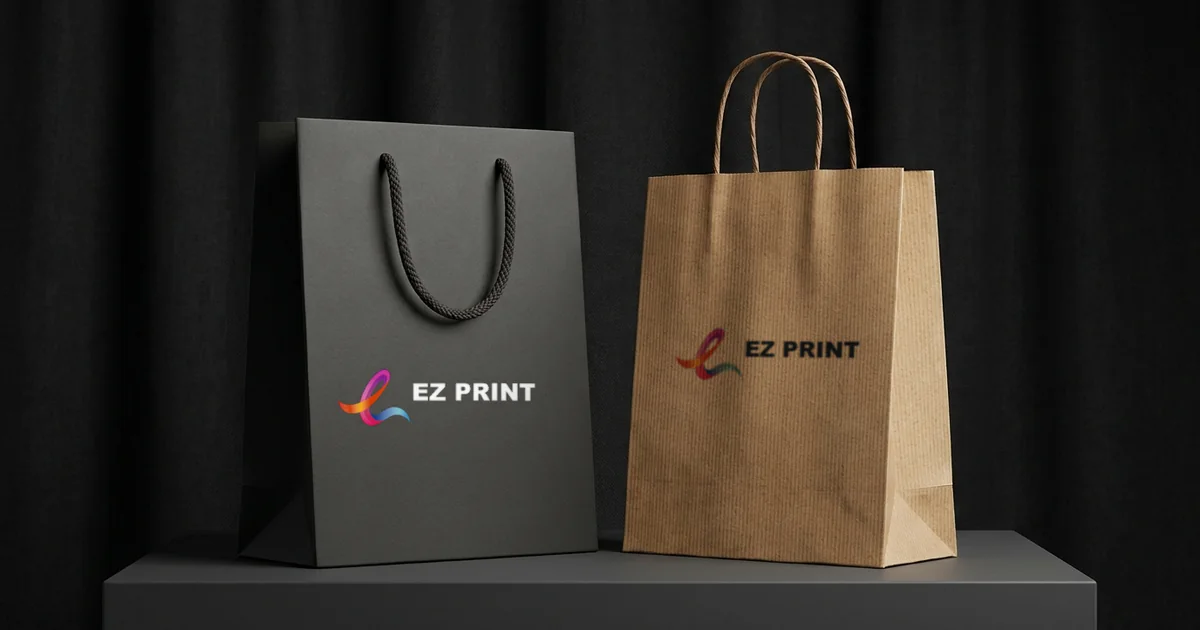
A custom paper bag is specified by three dimensions, width × gusset × height, then by the board, the handle and the finish. Kraft board suits an unbleached look and spot colours; coated art board suits photographic print and lamination. The handle is the part that decides whether the bag survives being carried full, so it is chosen for the weight it carries and fitted with a reinforced top hem.
How is a custom paper bag specified?
A paper bag is specified by three numbers in one order: width × gusset × height, in millimetres. The gusset is the side fold that gives the bag its capacity, so a bag described with only two dimensions is a bag whose depth nobody has decided. After the size come the board, the handle type and the finish.
The common retail sizes give a starting point:
- Small retail, about 200 × 100 × 250 mm. Accessories, cosmetics and small gifts, usually with twisted paper or ribbon handles.
- Medium retail, about 250 × 100 × 320 mm. The general-purpose shop bag and the most commonly ordered size.
- Large, about 320 × 120 × 400 mm. Apparel and boxed goods. It needs heavier board and a reinforced hem.
A bag is sized to what goes in it, plus enough height for the contents to sit below the handle. Measure the largest item it has to carry, add room for it to go in without forcing, and set the gusset from the item’s depth rather than from the look of the bag.
A bag is a flat net before it is a bag. A 250 × 100 × 320 mm retail bag opens out to a flat net roughly 620 mm wide before the glue flap and the top hem are added. That is why a folded mock-up is the practical way to check capacity, stiffness and handle position before a run.
Which paper or board should a printed bag use?
Board for retail bags runs 157–250 gsm, heavier where the contents have weight. Kraft board is used unbleached and suits spot colours, white ink and foil. Coated art board is used where the print has to carry a photograph, and it laminates cleanly. Printed bags are also made on 157gsm art paper, 210gsm art card and 250gsm coated art card.
| Board | Weights listed | Surface and print | Suits | Avoid |
|---|---|---|---|---|
| Kraft board | Held at 300 and 350 gsm | Brown through the thickness. CMYK goes muddy; one or two spot colours, white ink or foil read cleanly | Food, craft, wellness and brands positioned as unbleached | Photographic artwork and designs relying on white space |
| Matt coated art board | Held at 310, 350 and 400 gsm | Even solids, no glare, takes spot UV on a logo, laminates cleanly | Retail, fashion and gift bags that customers reuse | Being left unlaminated on a bag carried in the rain |
| Gloss coated art board | Held at 260, 310 and 350 gsm | Reflective, high chroma, images read sharper than on matt | Promotional and event bags with photographic artwork | Anywhere fingerprints would show |
| Art paper and art card | 157gsm art paper, 210gsm art card, 250gsm coated art card | Printed four-colour on one side, with gloss or matt lamination on one side, or matt lamination with spot UV | Four-colour bags with a laminated face | Contents with weight, where heavier board is used |
Two properties matter more than the look of the print. The first is stiffness at the handle, because a bag is carried in one hand while full. The second is grain: the board grain runs vertically up the bag, which is what stops it sagging when it is full. Grain is set in the imposition rather than in the artwork file, and it is the reason a bag cannot simply be scaled to a different shape.
What handle types are there, and how is each fitted?
There are four handle types: rope, ribbon, twisted paper and die-cut. Rope and ribbon are threaded and knotted through eyelets by hand on every bag. Twisted paper is the everyday retail handle. A die-cut handle is punched from the bag itself by the same die that cuts the net, so it needs no threading pass at all.
- Rope. Threaded and knotted through eyelets. It carries the most weight and feels the most substantial.
- Ribbon. Softer and flatter than rope. It reads as a gift bag handle rather than a shopping one.
- Twisted paper. The everyday retail handle, listed alongside ribbon for small retail bags.
- Die-cut. Punched from the bag itself. There is no handle to fit, and the top hem still needs reinforcing.
The handle also sets the schedule inside the standard window. A printed sheet is laminated flat, die-cut to a net, creased, glued and then handled, so a finished bag is five operations after the print. Handle fitting is the slowest of them, because a rope or ribbon is threaded and knotted bag by bag. It is also the one operation that does not get lighter on a reorder.
How are the handle and top hem kept from tearing out?
A threaded handle puts the whole load on two knots, so the top hem is reinforced with a card strip inside it. Without that strip, the knot pulls through the board the first time the bag is carried full. Heavier contents also call for heavier board, and coated bags that may meet rain should be laminated.
The failures that end with a torn bag are well understood:
- A threaded handle with no reinforcing strip. The knot pulls through the board the first time the bag is full.
- An unlaminated coated bag used in the rain. The coating darkens, the board softens and the handle tears out at the hem.
- A large bag on light board. Apparel and boxed goods need heavier board and a reinforced hem.
- Board grain that does not run up the bag. Vertical grain is what stops a bag sagging when it is full.
A bag fails at the handle or it does not fail at all. Everything else about it is print. When in doubt about the weight a bag has to carry, state the contents on the specification, so the board and handle are chosen against them rather than against the look.
Which finishes work on kraft and on coated board?
Coated board takes matt, gloss or soft-touch lamination, spot UV, hot foil and blind embossing. Kraft board is better served by one or two spot colours, a white underprint laid down before the colour, or a foil block. Foil is the one finish that reads cleanly on brown board without any white underprint beneath it.
The finishes listed for paper bags are matt or gloss lamination, soft-touch lamination, spot UV, hot foil stamping and blind embossing, with creasing, gluing, handle fitting and hem reinforcement as the construction operations. The useful pairings are:
- Kraft board, one colour, twisted paper handles. Sturdy and unbleached, and once the die exists it adds nothing in tooling on a repeat.
- Matt-laminated coated board with rope handles and a reinforced hem. The bag customers keep and reuse.
- A die-cut handle punched from the bag. No threading pass, though the top hem is still reinforced.
- A foil block on kraft. It reads cleanly on brown and needs no white underprint.
The pairing to avoid is CMYK photography on kraft. Brown under four-colour ink gives a muddy image, and no amount of ink corrects it. If the design depends on a photograph, use coated board.
How should paper bag artwork be set up on the dieline?
Bag artwork is drawn on the flat net with a live dieline, not on the front face alone. Keep 3 mm of bleed outside every cut edge, 8 mm clear of any crease and 15 mm clear of the top hem, where the reinforcement and eyelets sit. Gusset panels fold inward, so artwork crossing a gusset fold disappears into it.
- Format. PDF/X-4 or Illustrator at the flat net size, with the dieline live.
- Dieline layer. Cuts drawn solid and creases dashed, on a named non-printing layer called DIELINE.
- Bleed. 3 mm outside every cut edge, including the base flaps and the glue seam.
- Safe margins. 8 mm from any crease and 15 mm from the top hem.
- Glue seam. Left unvarnished and unlaminated, because glue does not key to film.
- Logo position. Centred on the front face, clear of both gusset creases by at least 8 mm.
- White ink on kraft. Supplied as a solid black vector on a layer named WHITE, under any colour that has to stay bright.
- Foil layer. A solid black vector on a layer named FOIL, at least 5 mm clear of every crease, because a foil block will not strike over a fold.
- Small text. K100, 7 pt minimum on coated board and 8 pt on kraft.
Send the three dimensions and the handle type, and a dieline comes back with the gusset, the base and the hem drawn, printable at full size so it can be folded and checked before anything is cut.
What should you check before approving a paper bag order?
Before approving, confirm all three dimensions in width × gusset × height order, the board and its weight against the contents, the handle type, the hem reinforcement for threaded handles, the finish, the artwork margins on the dieline and the quantity. A folded full-size dieline answers most of these questions more reliably than any drawing on screen.
- Size. Width × gusset × height in millimetres, with the gusset set from the depth of the contents.
- Board. Kraft for spot colours, white ink or foil; coated art board for photographs and lamination.
- Weight of contents. Stated on the specification, so the board and handle are chosen against it.
- Handle. Rope, ribbon, twisted paper or die-cut, with a card strip inside the top hem for threaded handles.
- Finish. Lamination on coated bags that may be carried in the rain; foil or spot colours on kraft.
- Artwork. 3 mm bleed, 8 mm from creases, 15 mm from the top hem, logo clear of the gusset creases.
- Quantity. The minimum run is 100.
- Timing. Standard turnaround is 7–14 working days, whatever the handle and whether or not the die exists. Express is quoted per job.
Worked example: how would a medium retail bag be specified?
Hypothetical planning example. Actual production timing, paper availability, and logistics are confirmed individually upon artwork and specification review. A small retail brand wants a sturdy unbleached shop bag for everyday purchases, with its logo in one colour. It does not need photographs on the bag, so kraft board with a single bright colour suits it better than coated board.
The specification is written as follows:
- Quantity: 500 paper bags.
- Size: 250 × 100 × 320 mm, width × gusset × height, the medium retail size.
- Board: 210 gsm kraft board, used unbleached.
- Printing: 1C printed in white ink, supplied on a layer named WHITE.
- Handles: Twisted paper handles, with a reinforced top hem.
- Artwork: Drawn on the flat net with the dieline on its own layer; logo centred on the front face, at least 8 mm clear of both gusset creases and 15 mm below the top hem.
- Check: A full-size dieline printed and folded to confirm capacity and handle position before the run.
- Timing: Standard turnaround is 7–14 working days. A tighter date would be raised as an express quotation, quoted per job.
When the brand later wants the same bag in a seasonal colourway, the die is already on file with the approved artwork, so the repeat starts from a proved net rather than a new one.
Frequently asked questions about custom paper bag printing in Singapore
How do I specify a custom paper bag size?
As width × gusset × height in millimetres, in that order. The gusset is the side fold that gives the bag its capacity. Common retail sizes run from about 200 × 100 × 250 mm to 320 × 120 × 400 mm.
What paper or board is used for printed paper bags?
Board runs 157–250 gsm for most retail bags, and heavier where the contents have weight. Kraft board is used unbleached; coated art board is used where the print has to carry a photograph.
What handle options are there for paper bags?
Rope, ribbon, twisted paper and die-cut. Rope carries the most weight, ribbon reads as a gift bag, twisted paper is the everyday retail handle, and a die-cut handle is punched from the bag itself with no threading.
Can photographs be printed on a kraft paper bag?
Not well. Kraft board is brown all the way through, so four-colour images go muddy. One or two spot colours, a white underprint or a foil block are the finishes that read on brown.
What is the minimum order for custom printed paper bags?
A hundred. Below that the die and the setup dominate the job, so for a smaller quantity it is worth asking whether an existing die with a printed sticker or sleeve would do the same work.
How can EZ Print produce your custom paper bags?
EZ Print prints custom paper bags in Singapore, and has done since 2017, on kraft and coated board with rope, ribbon, twisted paper or die-cut handles. Each bag is quoted from its specification: three dimensions, board, handle and finish. Standard turnaround is 7–14 working days, and express is quoted per job.
- Paper bag printing: kraft and coated board, four handle types, lamination, spot UV, hot foil and blind emboss, with the die kept on file for reorders.
- Packaging printing: folding cartons, rigid gift boxes, sleeves and corrugated mailers, each cut from its own dieline.
For event giveaways where a fabric bag suits better, compare non-woven seminar bags and canvas tote bags. When the bag is decided, send the three dimensions, the board, the handle and the quantity through the quote request page.
Same-day and urgent printing available. Subject to artwork approval, payment, print type and production availability. Timing confirmed per job.