Paper bags, and the three numbers that describe one
Width, gusset, height — in that order, and never two of the three. A bag quoted without its gusset is a bag whose capacity nobody has actually decided, and capacity is the whole point of a bag.
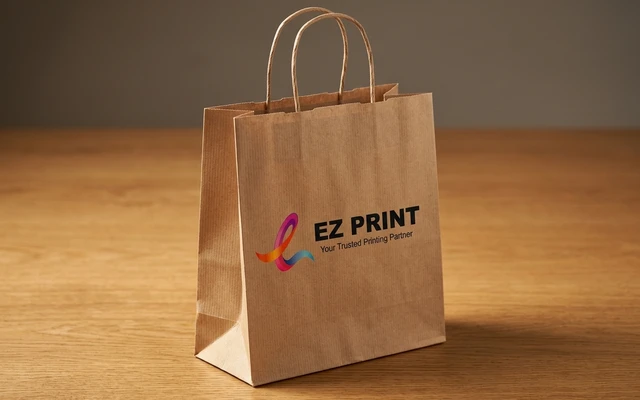
EZ Print prints custom paper bags in Singapore, and has done since 2017. A bag is specified by three dimensions in one order — width × gusset × height — and the gusset is the side fold that gives the bag its capacity. Board runs 157–250 gsm for retail bags and heavier where the contents have weight; kraft board is used unbleached, and coated board where the print has to carry a photograph. Handles are rope, ribbon, twisted paper or die-cut, and each is fitted differently: rope and ribbon are threaded and knotted through eyelets, a die-cut handle is cut from the bag itself. The printed sheet is laminated flat, die-cut to a net, creased, glued and then handled, so a finished bag is five operations after the print. Standard turnaround is 7–14 working days, whatever the handle and whether or not the die exists. Express is quoted per job. EZ Print quotes from the specification and does not publish prices.
Products quoted on this page
Specifications, formats and enquiry details for each product quoted on this service.
Three dimensions, the board, the handle and the finish. The handle is the item most often left out and the one that changes the schedule most, because a threaded handle is fitted by hand on every bag.
A bag is not drawn here at true size. A 250 × 100 × 320 mm retail bag opens out to a flat net roughly 620 mm wide before the glue flap and the top hem, which is wider than the screen this page is read on and wider than the largest sheet the estate draws at 1:1. A drawing reduced to fit and captioned as a trim would state a measurement it was not drawing. The dimensions, the board and the handle are stated as figures instead, and a folded mock-up is the honest way to check a bag before a run — it answers capacity, stiffness and handle position in a way no drawing does.
W × G × H
Width, gusset, height. The gusset is the side fold, and it is what turns a flat envelope into a bag with a capacity.
Sizes
Stated as width × gusset × height in millimetres. Common retail sizes run 200 × 100 × 250 mm to 320 × 120 × 400 mm.
Board
157–250 gsm for retail bags; heavier board where the contents have weight.
Materials
Kraft board unbleached, or coated art board where the print carries a photograph.
Handles
Rope, ribbon, twisted paper or die-cut. Threaded handles are fitted by hand.
Reinforcement
A card strip inside the top hem where a threaded handle is fitted.
Finishing
Matt or gloss lamination, spot UV, hot foil, blind emboss.
Minimum run
100.
Turnaround
Standard is 7–14 working days, whatever the handle. Express is quoted per job.
What to ask for
500 paper bags
250 × 100 × 320 mm, width × gusset × height
210 gsm kraft board
1C printed, white ink
Twisted paper handles, reinforced top hem
Dieline supplied or drawn from the dimensions
Needed by — your date
The material
Boards used for bags, and what each one carries
A bag is a structure that has to survive being carried in one hand while full. The board choice is about stiffness and tear resistance at the handle, and only then about how the print looks.
Kraft board0.40 mm · 300 gsm
Also sold as brown kraft, natural board, unbleached board. Held at 300 and 350 gsm.
Brown through the thickness, strong along the grain, and it takes a fold without cracking.
Under ink
CMYK goes muddy on brown. One or two spot colours, white ink or a foil block are what actually read.
Best for
Food, craft, wellness, and any brand positioned as unbleached.
Avoid for
Photographic artwork and any design relying on white space.
On the schedule
Held. White ink is a separate pass, laid down before the colour.
Matt art card0.32 mm · 310 gsm
Also sold as matt coated board, C2S matt. Held at 310, 350 and 400 gsm.
A coated board for bags that have to look considered. It laminates cleanly, which a bag needs if it is reused.
Under ink
Even solids, no glare, and it is the right ground for spot UV on a logo.
Best for
Retail, fashion, gift bags, anything reused by the customer.
Avoid for
Being left unlaminated on a bag that will be carried in the rain.
On the schedule
Held. Laminated, cut, creased, glued, then handled — five passes.
Gloss art card0.24 mm · 260 gsm
Also sold as gloss coated board, C2S gloss. Held at 260, 310 and 350 gsm.
A reflective face for a bag whose design is a product photograph.
Under ink
High chroma, and images read sharper than they do on matt.
Best for
Promotional and event bags where the artwork is photographic.
Avoid for
Anywhere fingerprints are visible, which on a gloss bag is everywhere.
On the schedule
Held. The reflective board for a photographic bag.
The board has a grain and it runs vertically up a bag for a reason — it is what stops the bag sagging when it is full. It is decided in the imposition rather than in the file, but it is why a bag cannot simply be scaled to a different shape.The materials library →
A threaded handle needs a reinforcing card strip inside the top hem. Without it the knot pulls through the board the first time the bag is full.
Cutting, gluing and the handle
A bag is five operations after the print: laminate, die-cut, crease, glue, then fit the handle. The handle is the slowest, because a rope or a ribbon is threaded and knotted through each bag by hand.
Paper bag finishing: what each operation needs, and whether its die is kept for the reorder
Finish
Tooling
What the reorder pays for
Matt or gloss laminationSingle pass, both sides
None
Nothing to make, so nothing to remake.
Creasing and foldingA creasing line is scored above 170 gsm, so a coated sheet does not crack at the fold
None
Nothing to make, so nothing to remake.
Soft-touch laminationThe film settles before the sheet is guillotined
None
Nothing to make, so nothing to remake.
Spot UVNeeds a screen; reads best over matt film
Made once
Kept on file with your approved artwork. The reorder runs from it.
Die-cuttingA forme is cut once, then kept for the reorder
Made once
Kept on file with your approved artwork. The reorder runs from it.
Hot foil stampingFirst run carries the block; reorders do not
Made once
Kept on file with your approved artwork. The reorder runs from it.
Blind embossingMale and female dies, kept
Made once
Kept on file with your approved artwork. The reorder runs from it.
Creasing and gluingThe gusset and base folds, and the side glue seam
None
Nothing to make, so nothing to remake.
Handle fittingRope or ribbon threaded and knotted by hand through each bag
None
Nothing to make, so nothing to remake.
Top hem reinforcementA card strip inside the hem so the handle does not tear through
None
Nothing to make, so nothing to remake.
Scroll the table sideways to see every column.
Every operation here is quoted inside the standard window. What changes between a first order and a second is the tooling: a die, a block or a screen is made once and then kept on file with your approved artwork, which is why the reorder of a job carrying one is a different job from the first.
A bag fails at the handle or it does not fail at all. Everything else about it is print.
Pairings that work
+300 gsm kraft board, one colour, twisted paper handles. Sturdy, unbleached and it costs nothing in tooling once the die exists.
+Matt-laminated coated board with rope handles and a reinforced hem. The bag people keep, which is the only bag worth printing.
+A die-cut handle punched from the bag itself. No threading pass at all, and the top hem still needs reinforcing.
+A foil block on kraft. Foil is the only finish that reads cleanly on brown board and it needs no white underprint.
Combinations that fail
×A threaded handle with no reinforcing strip. The knot pulls through the board the first time the bag is carried full.
×CMYK photography on kraft board. Brown under four-colour ink gives a muddy image, and no amount of ink corrects it.
×A bag specified with two dimensions. Without the gusset there is no capacity, and the bag that arrives is not the bag that was imagined.
×An unlaminated coated bag used in the rain. The coating darkens, the board softens and the handle tears out at the hem.
Sizes and handles
A bag is sized to what goes in it plus enough height for the contents to sit below the handle. Handles are chosen for the weight they carry and for how the bag is meant to feel.
Small retail · about 200 × 100 × 250 mm
Accessories, cosmetics, small gifts. Twisted paper or ribbon handles.
Medium retail · about 250 × 100 × 320 mm
The general-purpose shop bag. The most commonly ordered size.
Large · about 320 × 120 × 400 mm
Apparel and boxed goods. Needs heavier board and a reinforced hem.
Rope handle
Threaded and knotted through eyelets. Carries the most weight and feels the most substantial.
Ribbon handle
Softer and flatter than rope. A gift bag handle rather than a shopping one.
Die-cut handle
Punched from the bag itself by the same die. No threading pass at all.
Design on the net, and remember the gusset folds
Two thirds of the artwork on a bag is on faces nobody sees flat: the gusset panels fold inward and the base folds under. A design that ignores those is a design that gets cut in half by a crease.
The file
Format
PDF/X-4 or Illustrator at the flat net size with a live dieline.
DIELINE layer
Cuts solid, creases dashed, on a named non-printing layer.
Gusset panels
Drawn as part of the net. Artwork that crosses a gusset fold disappears into it when the bag is closed.
Bleed
3 mm outside every cut edge, including the base flaps and the glue seam.
Safe margin
8 mm from any crease and 15 mm from the top hem, where the reinforcement and eyelets sit.
Glue seam
Left unvarnished and unlaminated. Glue does not key to film.
The colour, and the detail
Colour mode
Spot colours on kraft; CMYK plus named Pantone references on coated board.
White ink
On kraft, supplied as a 100% K vector on a layer named WHITE, under any colour that has to stay bright.
Rich black
C60 M40 Y40 K100 on coated board, total ink 300%.
Logo position
Centred on the front face, clear of both gusset creases by at least 8 mm.
Foil layer
100% K vector named FOIL, at least 5 mm clear of every crease — a block will not strike over a fold.
Small text
K100, 7 pt minimum on coated board and 8 pt on kraft.
Send the three dimensions and the handle type and a dieline comes back with the gusset, the base and the hem drawn — printable at full size so it can be folded and checked before anything is cut.
Turnaround
The handle is the slow part
Standard
Standard turnaround is 7–14 working days.
Standard orders. The schedule for specialist finishing is confirmed in your quotation.
Express
Same-day printing available.
Subject to artwork, stock and production capacity confirmation. Timing is agreed for each job.
What sets the date
The handle. A printed sheet is laminated flat, die-cut to a net, creased, glued and then handled — five operations after the print, and the last one is done bag by bag where a rope or ribbon handle is threaded and knotted through eyelets. All of it is quoted inside the standard window.
What a reorder skips
The die, kept on file with the approved artwork, so the same bag in a different colourway starts from a proved net. Handle fitting is the one operation that does not get lighter on a repeat, because it is done bag by bag every time.
If the date is tight
Send the three dimensions, the board, the handle type and whether a die already exists, and ask for an express quotation. We confirm the specification, production schedule and next steps in the quotation.
The die is kept on file with the approved artwork, so a repeat order of the same bag in a different colourway starts from a proved net rather than a new one. Handle fitting is the one operation that does not get lighter on a reorder, because it is done bag by bag every time.
Every answer here is in the page source at full opacity, open or closed. An answer engine has to be able to read it without executing anything.
Questions asked about paper bags
How do I specify a paper bag size?
As width × gusset × height in millimetres, in that order. The gusset is the side fold, and it is what gives the bag its capacity — a bag described with only two dimensions is a bag whose depth nobody has decided.
What board is used for paper bags?
157–250 gsm for most retail bags, heavier where the contents have weight. Kraft board where the look should be unbleached, coated art board where the print carries a photograph. The board grain runs vertically up the bag, which is what stops it sagging when full.
What handle options are there?
Rope, ribbon, twisted paper and die-cut. Rope carries the most weight and feels the most substantial; ribbon reads as a gift bag; twisted paper is the everyday retail handle; die-cut is punched from the bag itself and needs no threading pass at all.
Why does a bag handle tear out?
Almost always because the top hem was not reinforced. A threaded rope or ribbon handle concentrates the whole load onto two knots, and without a card strip inside the hem the knot pulls through the board the first time the bag is full.
Can you print photographs on a kraft paper bag?
Not well. Kraft board is brown all the way through, so four-colour images go muddy. One or two spot colours, a white underprint or a foil block are the finishes that actually read on brown, and all three look deliberate rather than compromised.
How long do custom paper bags take?
Standard turnaround is 7–14 working days, on a die already held or a die cut for the first time, and with any of the four handle types. The handle is the slowest operation inside that window, because a threaded rope or ribbon handle is fitted bag by bag. Where the date is tighter, ask for an express quotation with the three dimensions, the board and the handle on it.
What is the minimum order for printed paper bags?
A hundred. Below that the die and the setup dominate the job, so if a smaller quantity is needed it is worth asking whether an existing die and a printed sticker or sleeve would do the same work.
Trading since 2017 — EZ PRINT PRIVATE LIMITED, UEN 201706183R.
Standard turnaround is 7–14 working days. For urgent orders or express schedules, please check with EZ Print.
Artwork is checked before production.
Island-wide courier delivery within Singapore.
Collection can be arranged on request.
Ask for a quote on these bags
Every job is quoted from its specification — stock, quantity, sides, finish, size and deadline.
Quantity
Stock — or the feel you want, if you do not know the stock