
Corporate event organisers, roadshow crews, F&B groups, and university clubs in Singapore regularly order custom T-shirt printing, custom-printed event T-shirts, apparel, and garments from our 242-model apparel catalogue. Choosing between Direct-to-Film (DTF) transfer, spot-colour silkscreen, and full dye sublimation depends on three technical factors: garment fibre composition, graphic size and colour count, and your production deadline.
How do DTF heat transfer, silkscreen printing, and dye sublimation compare for custom T-shirts?
Silkscreen pushes spot-colour ink through mesh stencils directly into fabric for high-volume bulk runs of 1 to 4 solid colours; Direct-to-Film (DTF) heat-presses full-colour digital transfers onto cotton or polyester with zero screen setup for urgent or multi-colour logos; and dye sublimation dyes edge-to-edge graphics directly into light polyester yarn.
Matching the decoration method to both your shirt fabric and your artwork prevents stiff chest patches, cracked ink, and missed event deadlines:
| Garment Decoration Method | Compatible Shirt Fabrics | Colour & Graphic Capability | Typical Production Speed & Best Use Case |
|---|---|---|---|
| Spot-Colour Silkscreen | Combed cotton, CVC blends, and quick-dry polyester | 1 to 4 solid Pantone spot colours (no photographic gradients) | Bulk orders (50 to 5,000+ pcs) with simple 1–2 colour chest and back logos |
| Direct-to-Film (DTF) Transfer | All fabrics: dark or light cotton, microfibre quick-dry, nylon jackets, canvas totes | Full CMYK + white underbase; photographic gradients, fine text, and oversized >A3 back prints | Zero screen setup on small-to-medium runs (10 to 300 pcs) and multi-colour artwork |
| Full Dye Sublimation | White or light-coloured 100% polyester / microfibre only (cannot dye dark cotton) | Unlimited full-bleed all-over panel printing or zero-hand chest prints | Cut-and-sew custom sports jerseys and marathon singlets (requires full production lead time) |
| Machine Embroidery | Heavyweight polo shirts (200gsm–230gsm CVC/cotton), work jackets, caps, aprons | Up to 9–12 stitched Madeira/rayon thread colours per crest | Executive corporate polo uniforms and hospitality staff shirts (avoid on thin singlets) |
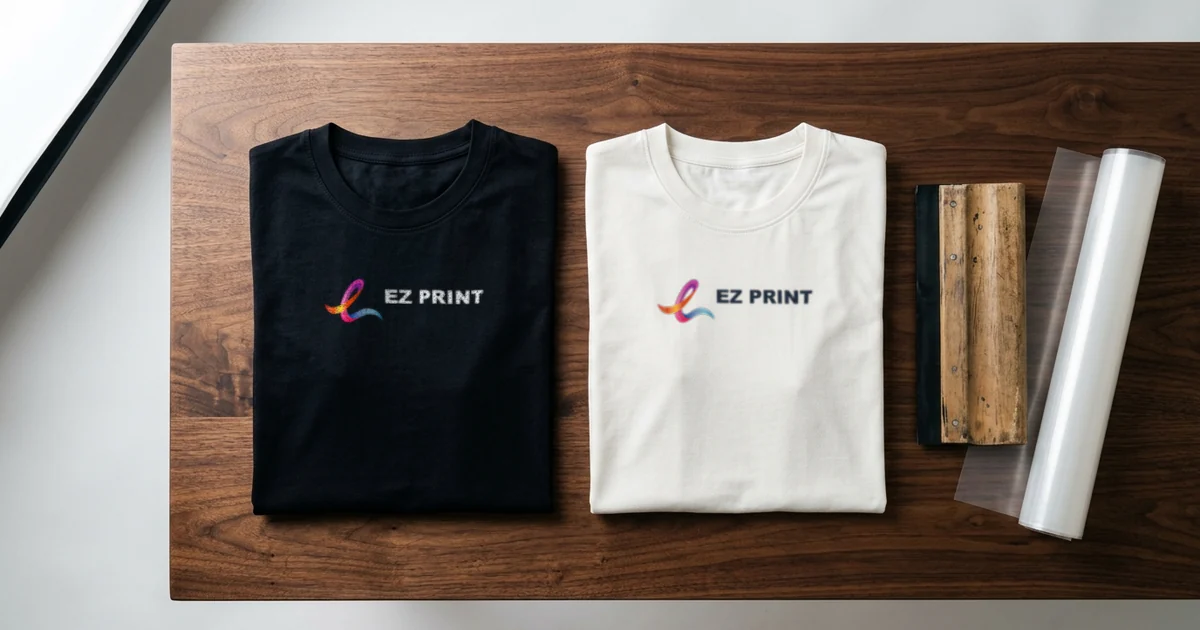
Which printing method works best for urgent small-run black or dark cotton T-shirts?
For urgent short runs—such as 10 to 100 black cotton crew-neck tees or quick-dry shirts needed for an upcoming roadshow or exhibition—Direct-to-Film (DTF) transfer onto stocked blank garments is the fastest and cleanest production route because it requires no individual colour screens and lays a crisp white underbase beneath full-colour logos.
Whereas traditional silkscreen requires exposing a separate mesh screen for every ink colour plus a flash-cured white underbase screen on dark garments, DTF prints the CMYK artwork and white backing simultaneously onto a release film, coats the wet ink with hot-melt polyurethane powder, cures it in an oven, and heat-presses the graphic directly into the garment fibres at 150°C to 160°C.
Why do oversized back prints (>A3) and all-over jerseys require special specification?
Standard silkscreen platens on ready-made T-shirts typically cover up to A4 (210 × 297 mm) or A3 (297 × 420 mm). When a design requires an extra-large back graphic wider than A3 or seam-to-seam coverage across the shoulders, you must specify either an oversized wide-platen DTF transfer on stocked tees or cut-and-sew dye sublimation.
Keep in mind that cut-and-sew full sublimation prints onto flat rolls of white microfibre fabric before the front, back, and sleeve panels are laser-cut and stitched together into a finished shirt. Because the garment is manufactured from scratch after printing, full cut-and-sew sublimation requires a longer production schedule than decorating ready-stocked combed-cotton (EZ-RN, EZ-OT) or quick-dry (EZ-QD) shirts from our Singapore catalogue.
How should artwork files and garment size breakdowns be prepared for custom T-shirt orders?
Supply logos as vector PDF, AI, or EPS files with outlined fonts—or 300 DPI transparent-background PNGs at exact print width in centimetres—and provide a consolidated size matrix (2XS to 5XL) alongside your preferred garment style code and placement zones (left chest, centre chest, full back, or sleeve).
For left-chest logos on polo shirts and crew-neck tees, a width of 80 mm to 100 mm sits cleanly above the pocket line; for full-back event graphics, 260 mm to 300 mm width reads boldly across adult sizes from S to 3XL. Standard production turnaround is 7–14 working days, and Same-day and urgent printing available. Subject to artwork approval, payment, print type and production availability. Timing confirmed per job. Select your garment model and submit your size breakdown on our request a quote page for a digital placement proof and quotation.
Frequently asked questions
Can dye sublimation be printed onto a 100% black cotton T-shirt?
No. Sublimation inks are transparent disperse dyes that only bond chemically to polyester polymers and cannot show up on dark fabrics without a white base. For black cotton or dark quick-dry shirts, specify DTF heat transfer or spot-colour silkscreen instead.
How do we keep DTF and silkscreen prints from cracking or peeling in the wash?
Turn printed T-shirts inside-out before machine washing in cold or lukewarm water (30°C maximum), avoid bleach and fabric softeners, and hang-dry in the shade rather than tumble-drying on high heat or ironing directly over the print face.
Can we mix men’s, women’s, and kids’ sizes under the same artwork setup?
Yes. As long as the printed logo stays at the same physical millimetre dimensions across the batch, you can freely combine adult unisex sizes (2XS–5XL), ladies’ fitted cuts, and kids’ sizes within one order.
What is the best placement size for a sleeve logo on a corporate polo or T-shirt?
Keep sleeve emblems between 60 mm and 85 mm wide so the graphic wraps cleanly across the outer deltoid curve of the short sleeve without folding into the underarm seam.
Same-day and urgent printing available. Subject to artwork approval, payment, print type and production availability. Timing confirmed per job.