
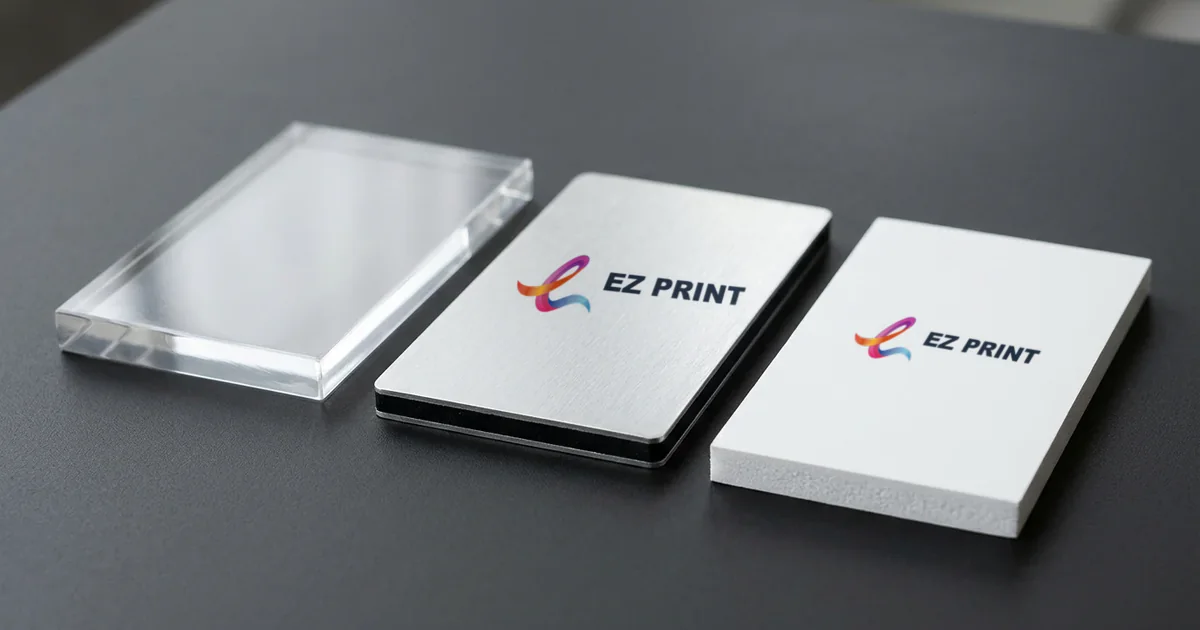
Choose a signboard material by where the sign goes and how long it has to last, not by how it looks on screen. Aluminium composite panel (ACP) is the board for exterior signs that must stay flat, acrylic is for reception and directory signs read up close, foam PVC is the everyday interior panel, and foam board is for short-term indoor display. Fluted polypropylene (corflute) is for temporary outdoor signs, and honeycomb board is an all-paper display board for indoor events.
Which signboard material suits which job?
Panel choice is a question about location and lifespan before it is a question about appearance. An interior sign that will be replaced within the year and an exterior sign expected to last are different materials, and the difference is structural. The six boards below are the common choices, and each one has a job it does well and a job it fails at.
| Board | Also sold as | What it is | Where it belongs | Where it fails |
|---|---|---|---|---|
| Aluminium composite panel | ACP, aluminium sandwich panel, composite sign board | Two thin aluminium skins bonded to a plastic core | Exterior signage, wayfinding, hoarding panels, anything expected to last | Complex internal shapes and temporary campaigns |
| Cast acrylic panel | Acrylic sheet, perspex, PMMA panel | A rigid clear or coloured sheet, cut, drilled and polished at the edge | Reception signs, directories, room signs, anything at close viewing distance | Large unsupported spans, because acrylic flexes |
| Foam PVC panel | Foamex, PVC foam board, expanded PVC | A lightweight rigid foamed plastic sheet | Interior signage, exhibition panels, price and information boards | Long-term exterior use and wide spans |
| Foam board | Foamcore, display board, presentation board | A paper-faced foam core | Short-term indoor display, event signage, presentation boards | Anything handled, anything outdoors, anything kept past the event |
| Fluted polypropylene panel | Corflute, correx, twin-wall polypropylene | A hollow twin-wall plastic sheet with internal flutes | Site signage, temporary directional signs, event boards | Fine detail and signs read up close |
| Honeycomb board | — | A paper honeycomb core between two paper liners | Exhibition and retail displays carried in by hand, temporary plinths, event signage | Outdoor use in any form, and edges that get knocked |
Read the last column first. Most sign failures are a good board used in the wrong place: foam board left outdoors, foam PVC fixed rigidly across a wide exterior wall, corflute used for a reception sign. The panel choices, fixings and margins are all set out on the signage printing page, which lists every board above except honeycomb board.
Why is aluminium composite panel (ACP) used for outdoor signs?
ACP is two thin aluminium skins bonded either side of a polyethylene core. That composite structure resists the oil-canning a single metal sheet develops, and the panel takes up no water, so it does not swell or bow the way a board eventually will. It stays flat outdoors, which is why it is specified for building, unit and wayfinding signs that have to survive weather.
The face is printed directly, or a printed film is applied to it under a UV laminate. A matt laminate over the graphic reduces glare on an exterior panel and slows fading. The face itself can be had as mill finish, white or brushed metal, and a brushed face used deliberately as part of the design is why the panel turns up in considered exterior work rather than only in utility signage.
ACP has two limits worth knowing before the design is finished. Shaping it means routing rather than cutting with a knife, and the composite construction limits how tight a contour can be. It also does not suit a curved surface unless it is routed and folded to that curve.
The most common mistake is committing to the panel before deciding how it is fixed. Standoff bolts, a hidden rail, a tray fold, adhesive onto a flat wall and a post-mounted frame each need something different from the panel, such as holes at set centres or a folded return, and not one of them can be added after the panel has been cut and printed. For a temporary campaign, ACP is a panel built to outlast the message.
When is acrylic the right board for a sign?
Acrylic is the board for a sign read at close range: reception walls, directories, room and meeting-room plates. The graphic is usually printed on the reverse face of a clear panel and read through it, so the acrylic protects the print and it cannot be scratched. The polished edge is part of the finish, and it is the reason acrylic is chosen at all.
A reverse-printed panel needs two things in the file. The artwork has to be mirrored, because it is read through the panel, and a white layer is normally printed behind the colour so that it reads as itself rather than as a tint of whatever the wall behind is painted. Reverse-printed artwork supplied unmirrored, with no white layer specified, reads backwards or shows through to the wall.
The limit is span. Acrylic flexes, and a wide panel on two fixings bows visibly from an angle even when the sign is perfectly made. Acrylic also suits a fixed message: the panel is drilled to a layout, and a change means a new panel and new holes in the wall. Front or reverse print, sheet type and edge finishes are covered in the acrylic office sign guide, so they are not repeated here.
Is foam PVC or foam board better for an indoor sign?
Foam PVC, for anything that has to stay up beyond an event. It is a rigid closed-cell foamed PVC board that cuts cleanly, prints directly with good colour, and takes a screw without a wall plug, so it is the default panel for interior signage and exhibition graphics. Foam board is lighter and paper-faced, and it is the right choice only for short-term indoor display.
Foam PVC is light enough to hang on a plasterboard wall with very little behind it. Its surface is slightly soft, so it scuffs at handling height, and it moves with heat: a long panel fixed rigidly at both ends will bow and stay bowed. Because the cells are closed it takes up no water, so it will hold on a protected elevation outdoors for a season, but it is not the board for a long-term exterior sign.
Foam board is a paper-faced foam core, the lightest rigid panel in the range and the least durable, because it dents under a fingernail. It is not printed directly: a printed paper is mounted to the board and the board is cut to size, so the paper face carries the image. Foam board anywhere outdoors or anywhere handled fails, because the paper face dents and the core absorbs water.
The practical rule is simple. If the sign is for an event, a seminar or a presentation and will be thrown away afterwards, foam board does the job. If it is a room sign, a wall panel or anything going onto a shell-scheme wall for more than an event, specify foam PVC. Foam board standees and easel signs are a separate product, set out on the standees page.
When should a sign be corflute or honeycomb board?
Both are temporary boards, built for opposite conditions. Corflute (fluted polypropylene) is waterproof and light, made for outdoor signs whose job ends when the campaign does, such as site notices and directional arrows. Honeycomb board is paper throughout, stiff for its weight, and made for indoor displays carried in by hand; rain ends it, so it never goes outside.
Corflute has one specification that nobody asks for and everybody needs: the direction of the flutes. The board is far stiffer along the flutes than across them, so a wide sign cut with the flutes running vertically sags in the middle, and a cable tie punched across the flutes tears out where one punched along them holds. State the flute direction with the size. The flutes also show faintly through large flat solids, and UV embrittles the board over a long installation, which is why it suits a short outdoor run rather than a permanent one.
Honeycomb board is a hexagonal paper core with a smooth liner on each face, printed direct or faced with a mounted print. The honeycomb resists bending in every direction at once, so a very light board behaves like a much heavier one, and it can be scored and folded into freestanding display furniture. Where a facility accepts it, the board can go with paper rather than being separated first, which is a property of the material rather than a claim about any collection route; a board laminated with plastic film or faced with vinyl is no longer a single-material product.
The mistake with honeycomb board is asking for the fixings a plastic board would take. A screw pulls straight through a honeycomb cell, so anything hung, bracketed or bolted needs the fixing designed into the panel: a solid insert, a folded return, or a slot-together joint. Decide how it stands up before deciding what it looks like.
How big can a sign panel be, and how is it fixed?
A single panel runs to about 1200 × 2400 mm, which is the usual sheet size. Larger signs are made from joined panels, and the joint line is a design decision, better placed deliberately than left to fall wherever the sheet ends. The fixing is specified with the panel rather than after it, because it changes how the panel is cut and drilled.
| Fixing | How it works | Suits |
|---|---|---|
| Standoff barrels | Holes drilled through the panel; the barrels hold it off the wall | Acrylic and ACP at reception, lobby and directory walls |
| Direct screw fixing | Screwed through the face into the wall | The flattest fixing; the screw head is visible unless it is capped |
| Cable suspension | A top-edge fixing hung from cables | Hanging panels and directories; needs a stated ceiling height |
| Battens | Panel fixed to battens on the wall | Specified against the wall type |
| A-frame | Freestanding, double-sided frame | A pavement or a foyer; the graphic is a panel in a frame |
The fixing also depends on the wall. A sign fixed to plasterboard and the same sign fixed to masonry take different fixings, and the fixing has to be decided before the panel is drilled, because a drilled hole is permanent. Send the wall type with the sign: plasterboard, masonry, glass or timber. Drill margins, frame sizing and how mounting is quoted are covered in the rigid board sign mounting brief.
Type size follows viewing distance rather than the panel. As a guide, about 25 mm cap height reads at two metres and 60 mm at five metres; a directory read at arm’s length can be much smaller. Wayfinding needs value contrast rather than colour contrast, because it is read at speed and often at an angle.
Worked example: choosing boards for a new office and its opening event
Hypothetical planning example. Actual production timing, paper availability, and logistics are confirmed individually upon artwork and specification review. An organisation is moving into a new unit. It needs a sign at the building entrance, a sign at the reception wall, room signs inside, and directional signs on the approach for an opening event that runs for one weekend.
- Entrance sign: aluminium composite panel with a printed film under a matt laminate. The fixing is decided before the artwork: standoffs, so the drill positions go on a separate layer in the file.
- Reception sign: clear acrylic, reverse printed with a white layer behind the colour, polished edges, on standoffs. The artwork is supplied mirrored.
- Room signs: foam PVC, printed directly and screwed to the wall, because they will be replaced when the teams move.
- Event directional signs: fluted polypropylene, printed directly, with the flute direction stated and the cable ties punched along the flutes.
- Seminar boards inside: foam board with a mounted print, on easels, discarded after the event.
- Artwork: PDF/X-4 at final size, with DRILL and CUT positions on separate non-printing layers.
- Wall type: stated for each fixed sign, plasterboard or masonry.
Every one of those boards is quoted inside the same standard window of 7–14 working days. Installation is arranged and scheduled separately against site access, so the access window goes in the enquiry with the sizes.
Frequently asked questions
Which signboard material lasts outdoors?
Aluminium composite panel, for a sign expected to last. Two aluminium skins on a plastic core stay flat and survive weather in a way foam PVC and foam board do not. A matt laminate over the graphic reduces glare and slows fading. For a short outdoor campaign, fluted polypropylene is the temporary alternative.
What material should an indoor sign be?
Foam PVC for most interior signage, because it is light, rigid, takes a screw without a wall plug and is stable indoors. Acrylic where the sign is read at close distance and the finish matters. Foam board only where the sign is short-term, because it dents easily.
Can foam board be used outdoors?
No. Foam board is a paper-faced foam core, so the face dents under a fingernail and the core absorbs water. Outdoors, use fluted polypropylene for a temporary sign or aluminium composite for one that has to last.
Why does the flute direction matter on corflute?
The board is far stiffer along the flutes than across them. A wide sign cut with the flutes running vertically sags in the middle, and a cable tie punched across the flutes tears out. State the flute direction with the size, and fix cable ties along the flutes.
Can honeycomb board be screwed to a wall?
Not directly. A screw pulls straight through a honeycomb cell, so anything hung or bracketed needs the fixing designed into the panel, such as a solid insert, a folded return or a slot-together joint. Decide how the board stands up before deciding what it looks like.
How do you order a signboard from EZ Print?
EZ Print produces printed signage in Singapore and has been trading since 2017. Every sign is quoted from its specification: the panel material, the finished size, the fixing method and the wall type. Artwork is checked before production, and installation is scheduled separately against site access. Standard turnaround is 7–14 working days; express is quoted per job.
The boards, fixings and artwork layers are set out on the signage printing page. Send where the sign goes, how long it has to last and what it is fixed to, and request a quote.
Same-day and urgent printing available. Subject to artwork approval, payment, print type and production availability. Timing confirmed per job.