
EZ Print — Your Trusted Printing PartnerUrgent & ExpressRequest a quote
A curved tension fabric exhibition media backdrop with checkerboard EZ Print branding in an exhibition hall.

Display standees and cutouts

Standees, and the strut that has to hold one up

A standee is a flat object pretending to be a person. What decides whether it works is not the photograph — it is the cut path, the centre of gravity and whether the strut sits far enough back to stop it folding forward.

  • Standard7–14 working days
  • ExpressSame-day printing available

Standee printing in Singapore, in one paragraph

EZ Print prints standees and life-size cutouts in Singapore, and has done since 2017. A standee is a printed graphic mounted to a rigid panel, contour cut to a closed vector path, and fitted with a folding strut on the back so it stands unaided. Panels are foam board for light indoor use, foam PVC where it will be handled or reused, and fluted polypropylene where it must be cheap and disposable. A life-size figure is typically 1600–1900 mm tall, and it needs a base tab or a weighted foot as well as the strut, because a tall flat panel tips forward before it falls over. The cut path is a closed vector supplied on its own layer, with no internal corner tighter than about 5 mm and no isolated element narrower than about 30 mm. Standard turnaround is 7–14 working days, and mounting, contour cutting and strut fitting are hand operations inside it. Express is quoted per job. EZ Print quotes from the specification and does not publish prices.

Products quoted on this page

Specifications, formats and enquiry details for each product quoted on this service.

4 formats
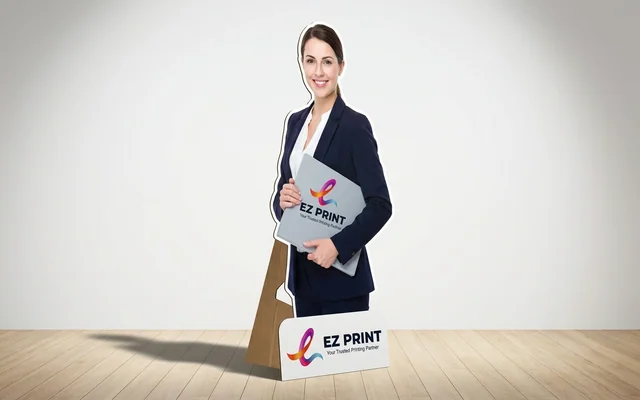
  • Life-size standees die-cut from rigid board with rear strut support, with the EZ Print logo.
    Displays & events

    Standee

    A figure or product printed on rigid board, cut to its outline and propped on a strut.

    Also ordered as: Life-Size Standee, Cardboard Cutout, POP Standee, Tabletop Standee, Paper Standee, Cut-Out Figure

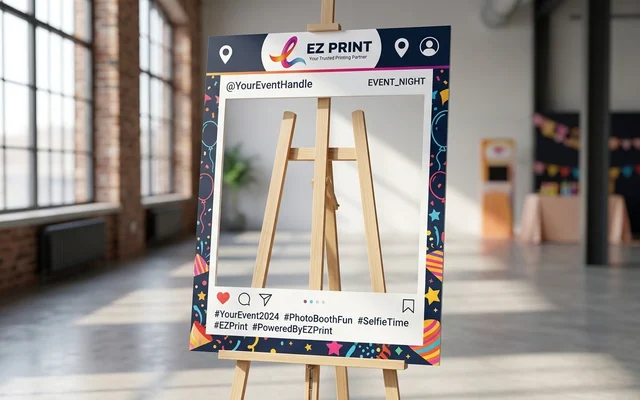
  • Social media selfie frames die-cut from foam board for event photos, with the EZ Print logo.
    Displays & events

    Selfie Frame

    A large cut-out frame guests hold up for photographs, printed with the event name or hashtag.

    Also ordered as: Photo Frame Prop, Instagram Frame, Photo Booth Frame, Giant Photo Frame

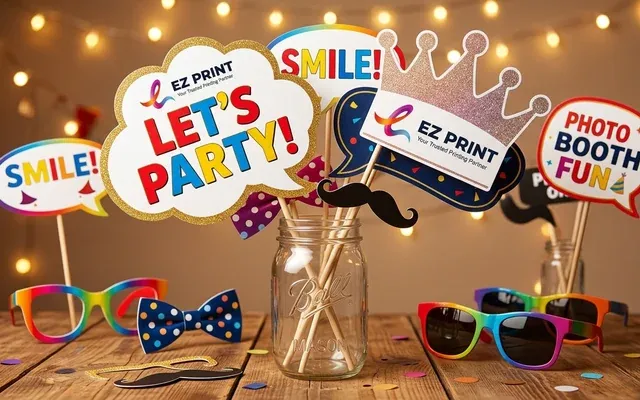
  • Photo booth props with custom die-cut shapes and holding handles, with the EZ Print logo.
    Displays & events

    Photo Booth Props

    Die-cut boards on sticks — speech bubbles, hats, slogans — for guests to pose with.

    Also ordered as: Handheld Signs, Speech Bubble Props, Hand Sign Board, Party Props, Stick Props

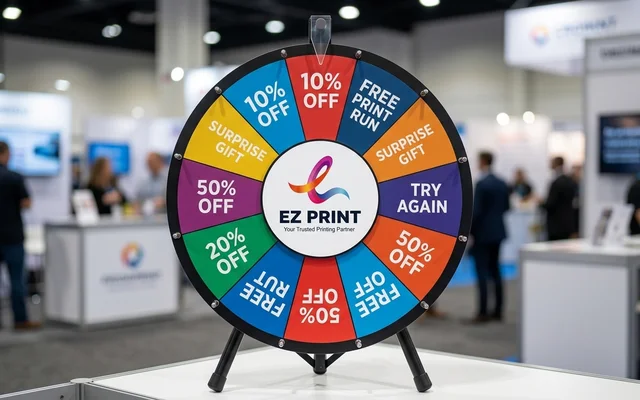
  • Freestanding spin wheels of fortune with prize slots and clicker indicator, with the EZ Print logo.
    Displays & events

    Spin Wheel

    A printed prize wheel on a rotating board, for games and lucky draws at booths and roadshows.

    Also ordered as: Wheel of Fortune, Prize Wheel, Lucky Spin Wheel, Roulette Wheel

All 140 products, by family

The specification a standee is quoted from

Height, panel material, cut path and whether it has to survive being moved. A standee for one evening and a standee that lives in a lobby for six months are the same drawing and two different objects.

A life-size standee is 1750 mm tall and there is no honest true-size view of one on a screen. The measurements that decide whether a standee works are all small and local, and those are stated exactly instead: 30 mm as the narrowest safe element, a 5 mm minimum internal cutting radius, and 5 mm of bleed outside the cut path. A reader can check a cut path against those three figures in a minute, which a reduced picture would not allow.

30mm


The narrowest a part of a standee can safely be. An outstretched arm or a raised umbrella below that snaps the first time somebody picks the standee up.

Heights
Life-size figures 1600–1900 mm. Tabletop standees 300–600 mm. Custom to about 2400 mm.
Panels
Foam board for short-term indoor use, foam PVC for handling and reuse, fluted polypropylene for disposable work.
Cut path
A closed vector on its own layer. Minimum internal radius about 5 mm.
Minimum feature width
About 30 mm on any isolated element — an arm, a strap, a raised hand.
Support
A folding strut on the back, plus a base tab or weighted foot on anything over about a metre.
Bleed
5 mm outside the cut path, so no white edge shows on the cut.
Resolution
150 dpi at final size. A standee is looked at from a metre.
Turnaround
Standard is 7–14 working days including mounting, cutting and strut fitting. Express is quoted per job.

What to ask for

2 life-size standees, 1750 mm tall
5 mm foam PVC panel, printed film mounted and matt laminated
Contour cut to a supplied closed vector path
Folding strut and a base tab
Nothing narrower than 30 mm; internal corners no tighter than 5 mm
Print-ready PDF at final size with the cut path on its own layer
Needed by — your date

The material

Panels, and what each one survives

A standee is handled far more than it is looked at — carried in, propped up, knocked over, carried out. The panel decides how many of those it survives. None of these is a sheet from the caliper table, so none carries a caliper here.

Foam board panel

Also sold as foamcore, display board, presentation board.

A paper-faced foam core. The lightest and cheapest rigid panel, and the least durable — it dents under a thumb and it delaminates if it gets wet.

Under ink
A printed sheet mounted to the face. The paper surface is what carries the image.
Best for
One-evening events, indoor photo props, anything not being stored afterwards.
Avoid for
Anything moved more than twice, and anywhere humid.
On the schedule
A printed sheet is mounted to the face, then the panel is cut to the path.

Foam PVC panel

Also sold as foamex, PVC foam board, expanded PVC.

A rigid foamed plastic sheet. Stiffer than foam board, waterproof, and it takes a knock without denting through.

Under ink
Printed directly or a printed film applied and laminated matt.
Best for
Standees kept in a lobby, reused between events, or transported.
Avoid for
Very tall thin cuts. The material is rigid but a 2 m panel still flexes across its width.
On the schedule
Printed or film-mounted, laminated matt, then cut and fitted with a strut.

Fluted polypropylene panel

Also sold as corflute, correx, twin-wall polypropylene.

A hollow twin-wall sheet with internal flutes. Cheap, waterproof and disposable, and the flute direction decides which way it bends.

Under ink
Printed directly. The flutes show faintly through large flat solids.
Best for
Outdoor and temporary standees, site and event signage on a strut.
Avoid for
Anything premium, and any cut that runs along the flutes on a narrow element.
On the schedule
Printed directly, then cut with the flute direction taken into account.

Folding strut and base tab

Also sold as easel strut, standee support, kickstand.

A hinged panel bonded to the back that folds out to prop the standee, usually with a base tab that folds forward under the feet for stability.

Under ink
Not printed. It is structure rather than surface.
Best for
Every freestanding standee. Anything over a metre needs the tab as well as the strut.
Avoid for
Relying on the strut alone at full height. A tall flat panel tips forward before it topples.
On the schedule
Fitted with the panel.

Say whether the standee is being stored and reused. Foam board is cheaper and lighter and it does not survive a second event; foam PVC costs more once and survives several.The materials library

A cutting blade has a radius. It cannot turn a corner tighter than about 5 mm, and a shape drawn with sharp internal points comes back rounded whether or not that was the intention.

Mounting, cutting and fitting

A standee is three operations after printing: the graphic is mounted to the panel, the panel is contour cut to the vector path, and the strut and tab are fitted. Each is a hand operation and none of them is quick on a complicated outline.

Standee finishing: what each operation needs, and whether the cut path is kept for the reorder
FinishToolingWhat the reorder pays for
Round-corneringStandard radii, on a die held as stock toolingNoneNothing to make, so nothing to remake.
Matt or gloss laminationSingle pass, both sidesNoneNothing to make, so nothing to remake.
Panel mountingThe printed graphic bonded flat to the rigid panelNoneNothing to make, so nothing to remake.
Contour cuttingCut to a supplied closed vector path. Minimum internal radius about 5 mmMade onceKept on file with your approved artwork. The reorder runs from it.
Strut and base tab fittingA folding strut bonded to the back, with a base tab on anything over a metreNoneNothing to make, so nothing to remake.
Reinforcement at narrow pointsA backing strip behind an arm or a narrow element that would otherwise snapNoneNothing to make, so nothing to remake.

Scroll the table sideways to see every column.

Every operation here is quoted inside the standard window. What changes between a first order and a second is the tooling: a die, a block or a screen is made once and then kept on file with your approved artwork, which is why the reorder of a job carrying one is a different job from the first.

Every standee that arrives broken broke at the narrowest point in the cut path, and the narrowest point was decided by a designer who was thinking about the photograph.

Pairings that work

  • A life-size figure on foam PVC with a folding strut and a base tab. It stands where it is put and survives being carried between rooms.
  • A cut path drawn generously around an outstretched arm, so nothing is narrower than 30 mm. Nothing snaps in transit.
  • Matt lamination on anything under event lighting. A gloss standee reflects a spotlight straight back at the room.
  • A tabletop standee at 400 mm for a counter. Cheaper, easier to place and far more likely to still be there in a month.

Combinations that fail

  • An arm, a strap or a raised hand narrower than 30 mm. It snaps the first time the standee is picked up.
  • Sharp internal corners in the cut path. A blade cannot turn tighter than about 5 mm and the shape comes back rounded regardless.
  • A 1900 mm standee on foam board. The panel flexes across its width, the strut alone will not hold it and it folds forward.
  • A cut path drawn exactly on the edge of the image with no bleed. Any cutting tolerance shows a white line along the outline.

Heights, cuts and supports

A standee is sized to the space and supported according to its height. The taller it is, the more the support becomes the real design problem.

Tabletop · 300–600 mm
A counter or desk piece. A strut alone is enough.
Half height · 900–1200 mm
A queue or aisle marker. Strut plus base tab.
Life-size · 1600–1900 mm
A figure. Needs a strut, a base tab and, in a busy space, a weighted foot.
Custom · to about 2400 mm
The practical panel limit before the piece has to be split and joined.
Minimum feature · 30 mm
The narrowest safe isolated element anywhere in the cut path.
Minimum internal radius · 5 mm
What a cutting blade can actually turn.

The cut path is the product

On a standee the outline does more work than the image. It is what makes the object read as a shape from across a room, and it is what determines whether the object survives being moved.

The file

Format
PDF/X-4 or Illustrator at final size with the cut path as a live vector.
CUT layer
A single closed path on a layer named CUT, in a spot colour, never printed.
Bleed
5 mm of image outside the cut path all the way round.
Minimum feature
30 mm on any isolated element. Widen or bridge anything narrower.
Internal radius
About 5 mm minimum. Sharper corners come back rounded.
Resolution
150 dpi at final size. A standee is looked at from about a metre.

The colour, and the detail

Colour mode
CMYK. Skin tones on a life-size figure are worth proofing before a run of several.
Rich black
A four-colour black. K100 alone reads as grey at standee scale.
Edge contrast
The subject needs to separate from the background of the room, because the background is gone once it is cut out.
Minimum type
20 mm cap height for anything read at two metres.
Laminate
Matt under event lighting. Gloss reflects a spotlight straight back.
Reverse face
Usually plain. A double-sided standee needs two prints and a heavier panel.

Send the cut path as a vector rather than a described outline. If it is drawn here from a photograph, that is a separate step and it is worth agreeing the shape before the panel is cut, because a cut cannot be undone.

Turnaround

Mount, cut, fit — three hand operations, and a cut path worth keeping

  • Standard

    Standard turnaround is 7–14 working days.

    Standard orders. The schedule for specialist finishing is confirmed in your quotation.

  • Express

    Same-day printing available.

    Subject to artwork, stock and production capacity confirmation. Timing is agreed for each job.

What sets the date
Three hand operations after the print: the sheet is mounted to a panel, the panel is cut to the path, and the strut and base tab are fitted. A complex outline, a reinforced arm or a double-sided build is more hand work, and all of it is quoted inside the standard window.
What a reorder skips
The cut path. Once it is drawn, proved and cut cleanly it is kept with the approved artwork, so a repeat of the same shape skips the drawing and the setup even when the image on it has changed.
If the date is tight
Send the height, the panel material and the cut path as a vector, and ask for an express quotation. We confirm the specification, production schedule and next steps in the quotation.

A stored cut path is kept with the approved artwork, so a repeat of the same standee shape skips the drawing and the setup even when the image on it has changed.

Every answer here is in the page source at full opacity, open or closed. An answer engine has to be able to read it without executing anything.

Questions asked about standees

How tall is a life-size standee?

Usually 1600–1900 mm, matched to the person or product it represents. Tabletop standees run 300–600 mm and half-height markers 900–1200 mm. About 2400 mm is the practical panel limit before a standee has to be made in two pieces.

What material should a standee be?

Foam board is lightest and cheapest and it survives one event. Foam PVC is stiffer and waterproof and it survives several, which makes it the right choice for anything stored or transported. Fluted polypropylene is for cheap, disposable and outdoor use.

How thin can part of a standee be?

About 30 mm on any isolated element — an outstretched arm, a strap, a raised hand. Below that it snaps the first time the standee is picked up. Widen it, bridge it back into the main shape, or accept a backing strip behind it.

Why did the cut come back with rounded corners?

Because a cutting blade has a radius and it cannot turn a corner tighter than about 5 mm. A shape drawn with sharp internal points always comes back rounded, so it is better to draw the radius deliberately than to be surprised by it.

Will a standee stand up on its own?

With a folding strut, yes, up to about a metre. Anything taller also needs a base tab that folds forward under the feet, because a tall flat panel tips forward before it topples sideways. In a busy space a weighted foot is worth adding.

How do I supply the cut path?

As a single closed vector path on its own layer named CUT, in a spot colour, with 5 mm of image bleeding outside it. If the shape has to be drawn from a photograph here, that is a separate step and the outline is agreed before anything is cut.

Can a standee be double-sided?

Yes, with two printed graphics mounted to opposite faces of a heavier panel. It is worth it where the standee stands in the middle of a space rather than against a wall, and it changes both the weight and the support requirement.

  • Trading since 2017 — EZ PRINT PRIVATE LIMITED, UEN 201706183R.
  • Standard turnaround is 7–14 working days. For urgent orders or express schedules, please check with EZ Print.
  • Artwork is checked before production.
  • Island-wide courier delivery within Singapore.
  • Collection can be arranged on request.

Ask for a quote on these standees

Every job is quoted from its specification — stock, quantity, sides, finish, size and deadline.

  • Quantity
  • Stock — or the feel you want, if you do not know the stock
  • Sides printed
  • Finish
  • Flat and finished size
  • The deadline

Artwork is welcome but not required to start. Email sales@ezprint.com.sg if you would rather attach files.