

In Singapore’s prime commercial districts—spanning Raffles Place, Marina Bay Financial Centre, and Tanjong Pagar—the physical presentation folder and bound pitch deck remain indispensable instruments of corporate deal-making. During confidential mergers and acquisitions briefings, private equity pitches, or client investment presentations, delivering a substantial, professionally finished document folio establishes corporate pedigree before a single slide is presented.
When executive committees finalize financial figures, valuation models, or legal term sheets late in the evening, marketing and corporate communications teams face acute production timelines. Procuring corporate presentation collateral on tight CBD schedules requires an understanding of paper weights, folding mechanics, and finishing constraints. This guide provides an operational briefing on printing urgent presentation folders and executive pitch decks in Singapore.
How Are Presentation Folders Manufactured on Tight Schedules?
Urgent presentation folder manufacturing in Singapore relies on pre-engineered standard house die-lines rather than bespoke steel-rule tooling dies. Custom tooling dies require chemical etching and laser machining taking multiple working days, whereas pre-existing house dies for interlocking single-pocket or glued double-pocket folders can be die-cut immediately following high-speed digital press sheet imaging.
Print buyers often assume that custom folder geometries—such as asymmetrical angled pockets, custom document gussets, or curved promotional flaps—can be manufactured instantly. In physical manufacturing, shaping heavy paperboard requires a physical steel-rule die (a laser-cut hardwood block embedded with sharp cutting knives and rounded creasing matrix rules).
To keep an urgent folder job moving, corporate teams must align with standardized production workflows:
Standard Folder Templates vs Bespoke Dies
- Standard Folder Templates: Ask whether a standard folder template can be used for your size; a custom die takes longer. When standard house templates are used for A4 single-pocket or double-pocket folders with integrated corporate business card slits, digital sheets can be fed directly into cutting and creasing units without tooling delays.
- Bespoke Tooling Dies: Creating a brand-new folder profile requires computer-aided design (CAD) drafting, automated steel-rule bending, and laser block machining. This process requires standard production schedules. Standard turnaround is 7–14 working days for custom tooling dies and non-standard packaging forms.
Interlocking Tabs vs Glued Pockets
- Interlocking Tab Pockets: Pockets feature precision tabs that fold and lock securely into corresponding die-cut slots without requiring wet liquid adhesive. Interlocking folders can be packed flat, transported compactly, and assembled on-site in seconds.
- Glued Pockets: Pockets are permanently fused using automated cold or hot-melt adhesive lines. While delivering structural rigidity, adhesive curing adds finishing steps before stacking and trimming.
What Substrates and Lamination Prevent Spine Cracking?
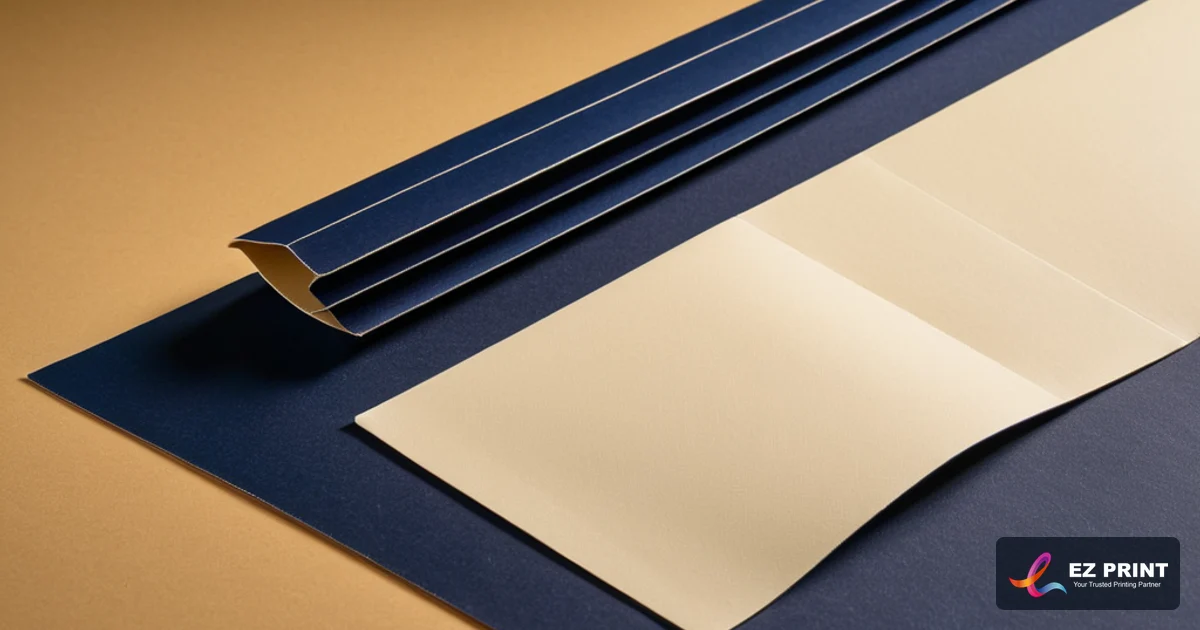
Presentation folders require premium 300gsm or 350gsm two-sided coated art cardstock protected by thermal matte BOPP lamination. Heavy paper cardboards naturally crack along fold lines when creased against paper fiber grain direction; applying thermal film lamination reinforces paper fibers, prevents white toner cracking along spine creases, and repels Singapore tropical office humidity.
A corporate presentation folder that arrives with fractured, flaking paper fibers along its spine or pocket creases undermines brand presentation. In Singapore’s tropical environment, unlaminated heavy paperboard also absorbs atmospheric moisture, softening edges and causing pocket flaps to bow.
Essential Specifications for Executive Folders
- 350gsm Art Cardstock: Provides substantial heft, upright pocket rigidity, and tactile stiffness that easily supports a 30-page inserted report deck without sagging.
- Thermal Matte Lamination: Biaxially Oriented Polypropylene (BOPP) thermal film is heat-bonded to both outer and inner sheet surfaces under heavy silicone rollers. The elastic film bonds over fused digital toner, ensuring creased spines remain pristine without visible fiber tearing.
- Internal Stationery Cohesion: When assembling complete corporate stationery suites, ensure that folder cover hues align with executive letterheads and envelopes. For cross-collateral color management, review our guide to corporate stationery and folder compatibility.
How Are Executive Pitch Decks Bound for Meeting Inserts?
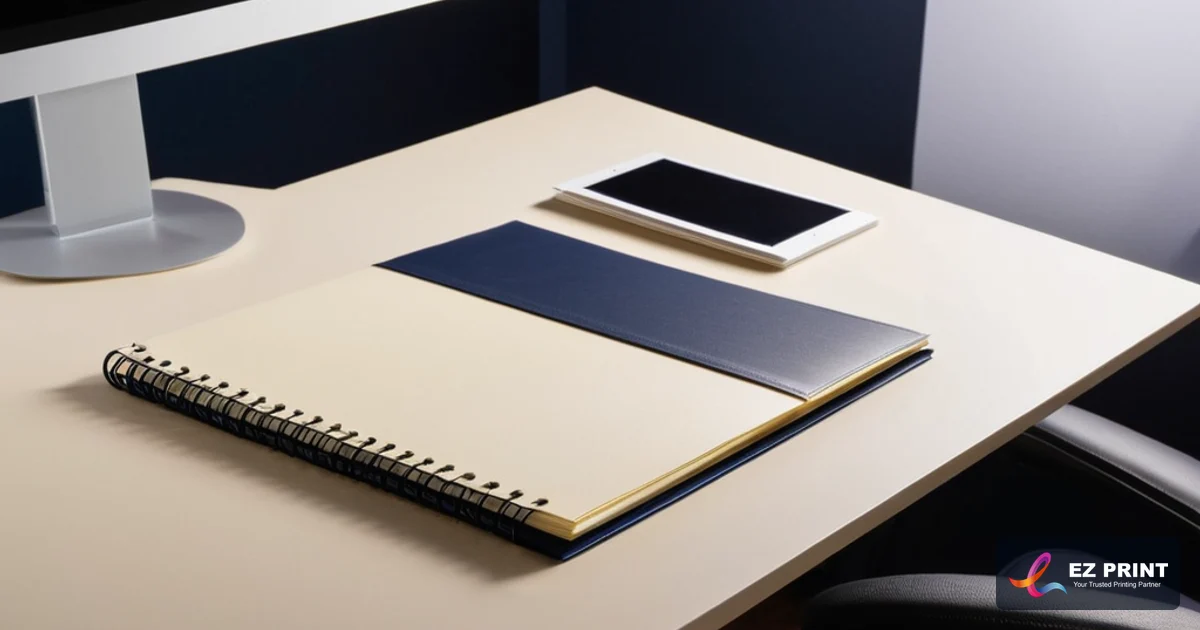
Pitch deck document inserts are bound using twin-loop Wire-O metal mechanical binding or saddle-stitched staples depending on total page count. Wire-O binding accommodates multi-page board presentations from 20 to 120 pages, allowing sheets to rotate 360 degrees and lay completely flat on boardroom tables, protected by frosted translucent polypropylene covers.
An executive folder is only as impactful as the proposal documents housed within its pocket. Depending on content volume, corporate teams utilize two primary binding systems:
1. Wire-O Twin-Loop Metal Binding
For detailed investment proposals, financial models, and strategic pitch decks:
- Mechanical Integrity: Square holes are punched at a 3:1 pitch along document margins, through which double-loop steel wire is hydraulically crimped.
- Flat 360-Degree Opening: Board members can lay the document flat on conference desks or fold pages backwards for notes without spine resistance.
- Protective Polypropylene Covers: A 0.5mm frosted translucent front cover shields printed slide titles, while a solid 350gsm black or navy card back provides structural backing. For multi-volume booklets, consult our technical commercial booklet printing services.
2. Saddle-Stitched Digital Booklets
For concise company overviews, executive executive summaries, and pitch decks under 32 pages:
- Slimline Insertion: Saddle-stitching inserts smoothly into standard 5mm folder pocket gussets without adding bulky wire thickness.
- Dual Galvanized Staples: Precision wire staples inserted along the spine provide clean, magazine-style presentation.
| Feature / Criteria | Wire-O Bound Pitch Deck | Saddle-Stitched Booklet | Loose Leaf Folio Pack |
|---|---|---|---|
| Page Capacity | 20 to 120 pages | 8 to 32 pages | 2 to 16 loose sheets |
| Lay-Flat Usability | 360° completely flat | 180° semi-flat | Loose individual sheets |
| Typical Substrate | 100gsm Woodfree Inner | 157gsm Art Paper Inner | 120gsm Executive Bond |
| Cover Protection | Frosted Polypropylene | 260gsm Art Card Cover | Unbound in folder pocket |
| Best Application | M&A due diligence, boards | Company overviews, pitches | Quotations, single sheets |
How Should Die-Line Artwork Be Prepared for Print?
Presentation folder artwork must be prepared on a dedicated two-layer vector layout separating printable artwork from mechanical die-lines. The die-line layer must feature custom spot color vector paths set to Overprint Stroke, using solid magenta lines for cut paths and dashed cyan lines for score lines, with 3mm bleed wrapping around pocket flaps.
Prepress errors on presentation folders occur when designers flatten mechanical die-cut guides directly into printable CMYK raster backgrounds:
- Dedicated Vector Die-Line Layer: Keep artwork graphics on an “Artwork” layer, and position mechanical cutting paths on an upper layer titled “DieLine”.
- Spot Color and Overprint Stroke: Create a distinct Spot Color named
Die_Cut(100% Magenta) and set attributes to Overprint Stroke. This instructs automated RIP software to read the vector coordinates for CNC cutting beds without printing visible pink lines onto the paper. - Card Slit Orientation: Business card slits are standardly cut as two horizontal half-moon curves spaced 90mm apart to fit standard Singapore executive cards. Keep text and design elements at least 8mm away from card slits to prevent interference during card insertion.
- Bleed Beyond Flap Perimeters: Ensure graphic backgrounds extend 3mm beyond all outer flap edges, fold notches, and interlocking tabs. To explore technical die-cutting specifications, review our complete catalogue of custom presentation folders.
Worked Example: Assembling Urgent Pitch Decks for an MBFC Acquisition Meeting
Hypothetical illustration. Figures are assumptions for explanation, not a real transaction or advice. Consider a corporate advisory firm in Marina Bay Financial Centre requiring 25 executive presentation folders and bound financial annexes ahead of an unscheduled board meeting. This scenario demonstrates how standard folder templates, digital toner printing, and wire-o binding achieve prompt delivery when timing is agreed upon confirmation.
A corporate advisory firm preparing for an unscheduled board meeting with prospective institutional investors at Marina Bay Financial Centre requires 25 personalized presentation folder suites containing confidential pitch decks. This scenario illustrates the sequential decisions and checks made to produce the materials.
Step 1: Template Selection and Specification
The deal coordinator specifies the document suite using standard production parameters:
- Folder: Single-Pocket A4 Folder using a standard template profile (interlocking pocket with card slits). Ask whether a standard template fits your document thickness.
- Folder Stock: 350gsm Two-Sided Art Card with thermal matte lamination on outer and inner surfaces.
- Pitch Deck: 24-page landscape slide deck, Wire-O bound with black twin-loop metal spine, frosted clear front cover, and 300gsm black board back.
- Quantity: 25 matching presentation sets.
Step 2: Preflight and Artwork Verification
The client’s designer places presentation graphics onto the pre-formatted vector template, exports a high-resolution PDF/X-1a file, and sends it by email with an enquiry drafted in the quote builder. Vector cut lines are kept on a separate layer.
Step 3: Production Capacity & Schedule Confirmation
The production team checks press capacity and paper stock availability. Timing is agreed when the job is confirmed. High-speed digital presses image the SRA3 sheets with optical registration marks.
Step 4: Mechanical Finishing and Assembly
The folder sheets pass through thermal lamination, then move to platen cutting for scoring and pocket creasing. Concurrently, booklet units punch margin holes and mechanically crimp the black Wire-O spines.
Step 5: Packaging & Delivery
The 25 Wire-O pitch decks are inserted into their corresponding folder pockets, paired with executive business cards, packed into rigid cartons, and dispatched via courier. Confirm the delivery point and contact with the venue or building security.
Frequently Asked Questions
Is same-day printing available for presentation folders with card slits?
Same-day printing available. Subject to artwork, stock and production capacity confirmation. Timing agreed per job. Standard turnaround is 7–14 working days. Express feasibility requires using standard house die-lines and digital toner printing without custom tooling dies.
What is the advantage of using interlocking pockets over glued pockets?
Interlocking folders rely on precision die-cut tabs that lock mechanically into slots without wet glue. This eliminates adhesive curing time, allows folders to be transported flat without bulk, and avoids adhesive residue under humid Singapore storage conditions.
Can presentation folders include metallic foil logos on express turnarounds?
Hot foil stamping requires chemical etching of custom brass or magnesium stamping dies, which takes multiple working days. For same-day express requests, folders are produced using high-resolution digital color printing on 350gsm art card with thermal matte lamination.
What document thickness can a standard presentation folder pocket hold?
A standard flat pocket comfortably holds up to 15 loose sheets of 80gsm paper or a slim Wire-O bound deck up to 4mm thick. If you need to hold 30 to 60 pages, specify a 5mm capacity gusset pocket during file preparation.
How are completed presentation folders delivered or collected?
Orders can be dispatched by direct courier to your corporate office or meeting venue. Confirm the delivery point and contact with the venue or organiser in advance. Alternatively, clients can opt for pickup: Collection by arrangement — tell us when you would like to collect and we will confirm the time.
Summary Checklist for Urgent Presentation Folder Orders
Before submitting urgent presentation folder artwork for commercial production, verify this essential preflight checklist. Confirming standard house templates, 3mm perimeter bleed, thermal matte lamination, and business card slit tolerances ensures clean platen cutting and structural integrity for Singapore corporate executive meetings. Following these systematic steps avoids common prepress delays.
Before sending your executive presentation folder files to press, verify this quality assurance list:
- Artwork positioned on approved vector template using standard house die-lines.
- Die-line paths saved on a separate vector layer with overprint spot color stroke.
- 3mm bleed provided beyond all pocket perimeters and interlocking tabs.
- Stock specified as 350gsm art card with thermal matte lamination to protect spine creases.
- Business card slit coordinates checked for 90 × 54 mm card insertion.
- Pitch deck page count and wire-o binding specifications confirmed.
To request an urgent quotation for corporate presentation folders, visit our request a quote page or review our same-day printing guidelines.
Same-day printing available. Subject to artwork, stock and production capacity confirmation. Timing is agreed for each job.