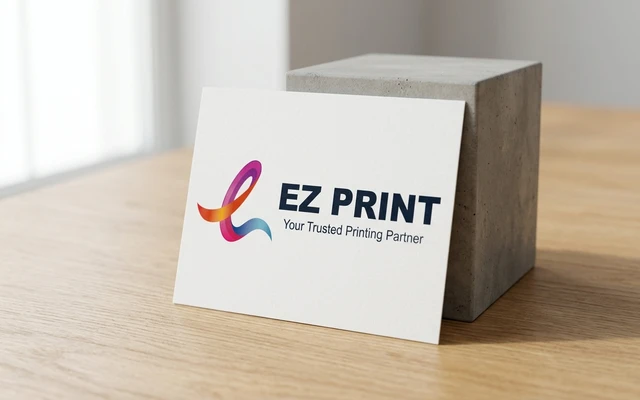
A postcard is two designs with different jobs. The front is read at arm’s length and thrown away or kept; the back has to carry an address, a message and enough clear space that a pen works on it.
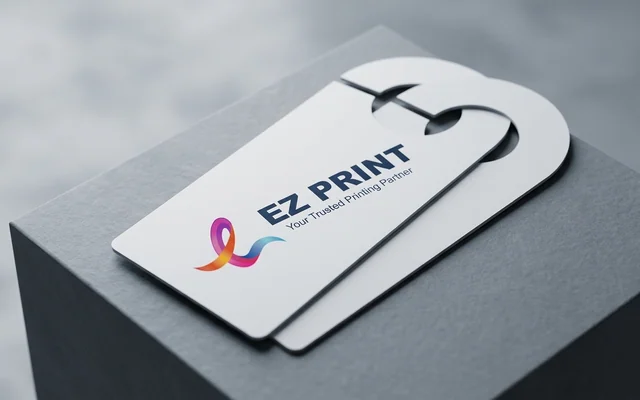
EZ Print prints postcards, direct-mail cards, greeting cards and door hangers in Singapore, and has done since 2017. One press run, three finishing routes: a postcard is trimmed flat, a greeting card is creased and folded, and a door hanger is die-cut with a hole and a slot that clears a handle. A6 105 × 148 mm is the standard, with DL 99 × 210 mm and square 148 × 148 mm cut from the same sheets. Stocks run 260 to 400 gsm: gloss art card where the image carries the piece, matt art card for a considered look, uncoated woodfree where the back is written on. Printing is 4C/4C or 4C/1C, with 3 mm bleed and a 4 mm safe margin. Finishing includes creasing, die-cutting, lamination, spot UV, round-cornering and numbering. Standard turnaround is 7–14 working days, laminated or bare. Express is quoted per job. EZ Print quotes from the specification and does not publish prices.
Products quoted on this page
Specifications, formats and enquiry details for each product quoted on this service.
Size, stock, sides and finish. The one thing worth deciding before any of them is whether it will be written on, because that single answer eliminates half the stock list. The A6 card below is drawn at true physical size.
Postcard · A6 105 × 148 mm
Bleed line (+3 mm)Actual trim size (105 × 148 mm)Safe zone (4 mm inside trim)
Bleed line (+3 mm)Actual trim size · 105 × 148 mmSafe zone (4 mm)
Save the date
The reverse takes a pen
sales@ezprint.com.sg · +65 8208 7778
Drawn at true size — trim 105 × 148 mm, 3 mm bleed dashed outside the trim, 4 mm safety margin dashed inside it.
105 × 148mm
A6 — exactly a quarter of an A4 sheet. It fits every rack and every envelope sold here, and it is the size a postcard is assumed to be.
Sizes
A6 105 × 148 mm, DL 99 × 210 mm, A5 148 × 210 mm, square 148 × 148 mm. Custom sizes on request.
Bleed and safe area
3 mm bleed all round, 4 mm safe margin in from the trim.
Stocks
260–350 gsm gloss or matt art card; 300–400 gsm uncoated woodfree where the card is written on.
Sides and colour
4C/4C or 4C/1C, built in CMYK.
Minimum run
50.
Greeting cards
Creased and folded rather than trimmed flat. A crease is scored before folding so the coating does not crack along the spine.
Door hangers
Die-cut with a hole and an open slot, on 260–350 gsm card, usually matt-laminated so it survives a wet handle.
Finishing
Creasing and folding, die-cutting, matt or gloss lamination, spot UV, round-cornering, sequential numbering.
Turnaround
Standard is 7–14 working days, laminated or bare. Express is quoted per job.
Delivery
Island-wide courier delivery. Collection can be arranged on request.
What to ask for
1,000 A6 postcards
350 gsm matt art card
4C/4C
Matt lamination front only, uncoated reverse
105 × 148 mm trim, 3 mm bleed
Print-ready PDF supplied as two single pages
Needed by — your date
The material
Stocks held for postcards
A postcard survives a postbag, a pocket and a fridge door. It needs weight for that, and it needs the right surface on the side someone writes on. The edges below are drawn at the measured caliper of the weight named.
Gloss art card0.32 mm · 350 gsm
Also sold as gloss coated card, C2S gloss. Held at 260, 310 and 350 gsm.
The image side does the work. Reflective, cool, and photographs gain about a tenth in apparent contrast.
Under ink
High chroma. The coating keeps large solids even across a long run.
Best for
Property, travel, F&B, anything where a photograph is the message.
Avoid for
The address side. A ballpoint skids on gloss and a franking mark smears.
On the schedule
Held as a standing stock, and it prints without a lamination pass.
Matt art card0.32 mm · 310 gsm
Also sold as matt coated card, C2S matt. Held at 310, 350 and 400 gsm.
The considered default. No glare, warm to the eye, and it takes spot UV better than any other sheet held.
Under ink
Flat, even solids. A rich-black build reads deeper than it does on gloss.
Best for
Invitations, save-the-dates, gallery and studio mailers.
Avoid for
Heavy handwriting — the coating still resists a wet pen.
On the schedule
Held as a standing stock. Lamination is a separate pass over every sheet.
Uncoated woodfree0.49 mm · 350 gsm
Also sold as uncoated natural, offset card, natural card. Held at 300, 350 and 400 gsm.
Completely matt, slightly toothy, and the only sheet here a fountain pen behaves on.
Under ink
Chroma drops roughly 15%, which suits a muted palette and fights a photographic one.
Best for
Anything posted, anything handwritten, anything with a reply section.
Avoid for
Full-bleed photography, which goes soft.
On the schedule
Held as a standing stock.
The practical answer for a mailer is a split specification: coated on the image side, uncoated or unlaminated on the address side. It costs nothing extra and it is the difference between a card that can be written on and one that cannot.The materials library →
Laminate one side, not both, on anything that will be written on or posted. Film on both faces makes a card that no pen and no franking machine can mark.
Finishing a postcard, and what each pass adds
A postcard is small enough that finishing changes how it feels more than how it looks. Film on one side only is the most useful thing on this list and the one most often left out of a brief.
Postcard finishing: what each operation needs, and whether its tooling is kept for the reorder
Finish
Tooling
What the reorder pays for
Round-corneringStandard radii, on a die held as stock tooling
None
Nothing to make, so nothing to remake.
Matt or gloss laminationSingle pass, both sides
None
Nothing to make, so nothing to remake.
Creasing and foldingA creasing line is scored above 170 gsm, so a coated sheet does not crack at the fold
None
Nothing to make, so nothing to remake.
Hole-punchingStandard bits. A shaped or slotted opening is die-cutting, not punching
None
Nothing to make, so nothing to remake.
Soft-touch laminationThe film settles before the sheet is guillotined
None
Nothing to make, so nothing to remake.
Spot UVNeeds a screen; reads best over matt film
Made once
Kept on file with your approved artwork. The reorder runs from it.
Die-cuttingA forme is cut once, then kept for the reorder
Made once
Kept on file with your approved artwork. The reorder runs from it.
Sequential numberingWhere the card doubles as a numbered entry or voucher
None
Nothing to make, so nothing to remake.
Single-sided laminationFilm on the image face only, so the reverse still takes a pen
None
Nothing to make, so nothing to remake.
Scroll the table sideways to see every column.
Every operation here is quoted inside the standard window. What changes between a first order and a second is the tooling: a die, a block or a screen is made once and then kept on file with your approved artwork, which is why the reorder of a job carrying one is a different job from the first.
A postcard laminated on both sides is a beautiful object that cannot be posted, because nothing will write on it and the franking mark will not dry.
Pairings that work
+350 gsm matt art card, 4C/4C, gloss spot UV on the front image only. Premium in the hand, and the back still takes a pen.
+Gloss art card front, uncoated reverse. A split specification costs nothing in time and solves the whole write-on problem.
+400 gsm uncoated with 3 mm rounded corners. Survives a postbag, feels expensive, and a fountain pen behaves on it.
+A6 with a perforated reply stub. One card does the offer and the response, and there is no second piece to lose.
Combinations that fail
×Lamination on both faces of anything posted. Neither a pen nor a franking mark will take, and the card is unusable for its actual purpose.
×A dark full-bleed solid on the address side. Handwriting disappears into it, and so does the postal barcode.
×Type inside 4 mm of the trim. Guillotine tolerance across a lift of a thousand cards is about half a millimetre and the uneven margin is obvious when they are stacked.
×A 260 gsm card sent through the post unlaminated. It arrives bent, and the bend is across the image rather than the message.
Sizes, and what each one is used for here
Every size below cuts from the same parent sheets as the flyers and the name cards, so the choice is about the envelope, the rack and the postal rate rather than about the paper.
A6 · 105 × 148 mm
The standard postcard. A quarter of A4, fits every rack and envelope sold here.
DL · 99 × 210 mm
A long card for a DL envelope. More room for a message, less for an image.
A5 · 148 × 210 mm
A mailer rather than a postcard. Reads as a small poster in the hand.
148 × 148 mm square
Distinctive, and it needs a square envelope, which is worth confirming before printing.
Round corners
3 mm or 6 mm radius, cut on a die already held — no new tooling to make.
Custom sizes
Anything that trims from the parent sheet. Say the finished size and the envelope it must fit.
Two pages, two different jobs
Supply a postcard as two single pages rather than as a spread, and design the reverse for the pen and the postal mark rather than as somewhere to put the logo again.
The file
Format
PDF/X-4 preferred. Illustrator and packaged InDesign accepted.
Artboard
Trim plus 3 mm bleed — an A6 card is drawn at 111 × 154 mm.
Safe margin
4 mm in from the trim on both faces.
Two pages
Front first, reverse second, as single pages. Not a spread.
Address area
Where the card is posted, keep the right-hand half of the reverse clear and light.
Placed images
300 dpi at final size.
The colour, and the detail
Colour mode
CMYK. RGB converts, and bright blues are where the conversion shows.
Rich black
C60 M40 Y40 K100 for large solids, total ink 240%.
Reverse side tint
Keep any tint under 20% where handwriting has to be legible over it.
Small text
K100, 7 pt minimum on coated stock.
Spot UV layer
100% K vector on its own layer named SPOTUV, in register with the front artwork.
Rounded corners
Keep artwork 6 mm clear of a corner that is being rounded, not 3 mm.
If the card is being posted, send the envelope size or the postal format with the specification and the trim is checked against it before anything is printed.
Turnaround
What the film pass costs, and what a reorder skips
Standard
Standard turnaround is 7–14 working days.
Standard orders. The schedule for specialist finishing is confirmed in your quotation.
Express
Same-day printing available.
Subject to artwork, stock and production capacity confirmation. Timing is agreed for each job.
What sets the date
Passes over every card. Lamination is one, including single-sided lamination on a card that has to be written on. Spot UV is another, sequential numbering another, a die-cut shape another. All of them are quoted inside the standard window.
What a reorder skips
The spot UV screen and the cutting die are made once and kept with the approved file, so a repeat of the same card does not wait for tooling a second time.
If the date is tight
Send the size, the stock, the sides and whether it is being posted, and ask for an express quotation. We confirm the specification, production schedule and next steps in the quotation.
No cutoff is published and no express time is either. A reorder of a card whose spot UV screen or cutting die already exists skips the part of the first run that took the longest, which is usually the honest way to make a date rather than to buy speed.
Every answer here is in the page source at full opacity, open or closed. An answer engine has to be able to read it without executing anything.
Questions asked about postcards
What size is a standard postcard in Singapore?
A6 at 105 × 148 mm — exactly a quarter of an A4 sheet. DL at 99 × 210 mm is used where there is more to say than to show, and 148 × 148 mm square is used where the card should stand out, though it needs a square envelope.
What gsm should a postcard be?
300–350 gsm is the working range. Below 260 gsm the card bends in a postbag; above 400 gsm it stops fitting comfortably into a standard envelope. If it is being handwritten, uncoated stock matters more than the extra weight.
Can I write on a laminated postcard?
Not reliably. Film resists a ballpoint and a franking mark will not dry on it. Laminate the image face only and leave the reverse bare — it is the same single pass over the sheet, and it keeps the card usable.
How long does postcard printing take in Singapore?
Standard turnaround is 7–14 working days, and it is the same window laminated or bare, round-cornered or square, numbered or plain. Where the date is tighter, ask for an express quotation with the size, the stock and whether the card is being posted; we confirm the specification and production schedule in the quotation.
How much bleed does a postcard need?
3 mm on all four sides, with a 4 mm safe margin inside the trim. Where the corners are being rounded, keep artwork 6 mm clear of the corner instead of 4 mm, because the radius eats into the area a straight cut would have kept.
Do you print postcards for direct mail?
The cards are printed to the specification; the mailing is arranged separately. Send the envelope or postal format with the enquiry and the trim, the address area and the stock are checked against it before printing.
Can a postcard have a tear-off section?
Yes — a perforation across the card gives a reply stub or a voucher that detaches cleanly. It is a separate pass, and the perforation line needs 6 mm of clear space on both sides so no type is cut through.
What is the minimum order for postcards?
Fifty. Short runs go on a digital press and the specification is unchanged; above a few thousand, offset becomes the sensible route and Pantone matching becomes straightforward.
Trading since 2017 — EZ PRINT PRIVATE LIMITED, UEN 201706183R.
Standard turnaround is 7–14 working days. For urgent orders or express schedules, please check with EZ Print.
Artwork is checked before production.
Island-wide courier delivery within Singapore.
Collection can be arranged on request.
Ask for a quote on this postcard
Every job is quoted from its specification — stock, quantity, sides, finish, size and deadline.
Quantity
Stock — or the feel you want, if you do not know the stock