A ticket without a unique number is a piece of card. The number is what makes it countable, reconcilable and hard to duplicate — and it is a separate printing pass, which is why it belongs on the specification rather than in the design.
Ticket and voucher printing in Singapore, in one paragraph
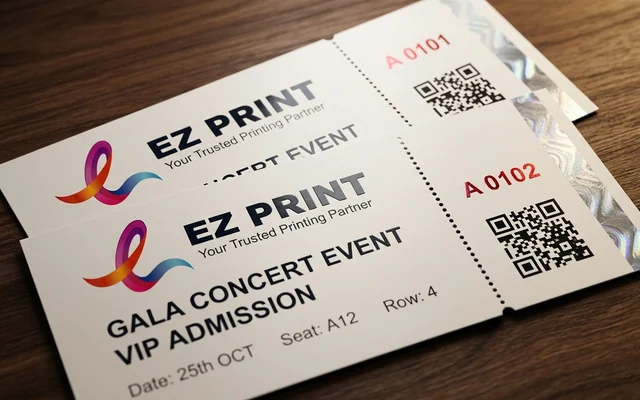
EZ Print prints event tickets, gift vouchers and numbered coupons in Singapore, and has done since 2017. Common sizes are 210 × 74 mm, 180 × 70 mm and DL 99 × 210 mm, usually with a perforated stub between 45 mm and 60 mm wide. Sequential numbering is printed in a separate pass with a stated start value and prefix, and the same number can be repeated on the stub so a torn ticket still reconciles. Stocks are 260–350 gsm art card, uncoated woodfree where the ticket is written on, and 200 micron synthetic stock where it must survive weather or handling. Security features available without special substrates are sequential numbers, a spot UV mark, a foil block and a die-cut shape. Standard turnaround is 7–14 working days, and the numbering and the perforation are separate passes inside it. Express is quoted per job. EZ Print quotes from the specification and does not publish prices.
Products quoted on this page
Specifications, formats and enquiry details for each product quoted on this service.
Size, stub position, numbering scheme and stock. The numbering scheme is the one people leave out and the one that causes reprints — a start value, a prefix and whether the number repeats on the stub. The ticket below is drawn at true physical size.
Wallet voucher · 85 × 55 mm
Bleed line (+3 mm)Actual trim size (85 × 55 mm)Safe zone (6 mm inside trim)
Bleed line (+3 mm)Actual trim size · 85 × 55 mmSafe zone (6 mm)
Admit one
No stub at this size
No. 00001 · sales@ezprint.com.sg
Drawn at true size — trim 85 × 55 mm, 3 mm bleed dashed outside the trim, 6 mm safety margin dashed inside it.
00001
The start value, the prefix and whether the number repeats on the stub. Three decisions, and all three have to be made before the run rather than after it.
Sizes
210 × 74 mm (a third of A4), 180 × 70 mm, DL 99 × 210 mm, and custom sizes cut to order.
Stub
A perforated stub 45–60 mm wide, carrying a repeat of the number.
Bleed and safe area
3 mm bleed all round, 5 mm safe margin, 6 mm clear of the perforation on both sides.
Stocks
260–350 gsm gloss or matt art card, 300 gsm uncoated woodfree, 200 micron synthetic stock.
Numbering
Sequential, with a stated start value, prefix and digit count. Repeated on the stub where required.
Standard is 7–14 working days including numbering and perforation. Express is quoted per job.
What to ask for
2,000 event tickets at 210 × 74 mm
350 gsm matt art card
4C/1C
Perforated stub 50 mm wide
Sequential numbering from 00001, repeated on the stub
Print-ready PDF with the perforation marked on a separate layer
Needed by — your date
The material
Stocks held for tickets and vouchers
A ticket lives in a pocket for a week and is then torn in half by someone who is not looking at it. It has to be stiff enough to tear cleanly along the perforation rather than tearing anywhere. The edges below are drawn at the measured caliper of the weight named.
Matt art card0.36 mm · 350 gsm
Also sold as matt coated card, C2S matt. Held at 310, 350 and 400 gsm.
Stiff, matt and it tears cleanly along a perforation rather than fraying across it.
Under ink
Even solids and no glare, so a printed number stays legible under a torch at a door.
Best for
Event tickets, gift vouchers, anything checked at an entrance.
Avoid for
Anything that will be rained on.
On the schedule
Held. Numbering and perforation are each a separate pass over it.
Gloss art card0.28 mm · 310 gsm
Also sold as gloss coated card, C2S gloss. Held at 260, 310 and 350 gsm.
A reflective face that makes an image-led voucher look like a product rather than a document.
Under ink
High chroma, and a foil block sits well against a gloss ground.
Best for
Gift vouchers, retail promotions, anything sold rather than issued.
Avoid for
A ticket that has to be written on at the door.
On the schedule
Held. Numbering and perforation are each a separate pass over it.
Uncoated woodfree0.42 mm · 300 gsm
Also sold as uncoated natural, offset card. Held at 300, 350 and 400 gsm.
Matt and toothy. Takes a ballpoint or a marker at the door without smudging.
Under ink
Chroma drops roughly 15%, evenly. A one-colour ticket looks deliberate on this sheet.
Best for
Raffle tickets, cloakroom tickets, anything annotated by hand.
Avoid for
Full-bleed photographic vouchers.
On the schedule
Held. Numbering and perforation are each a separate pass over it.
0.20 mmCoating at 8×
Synthetic stock0.20 mm · 200 micron
Also sold as synthetic paper, tear-resistant stock, PP sheet.
Not paper. It does not absorb water and it does not tear along a fold, which is both its advantage and its one complication.
Under ink
Ink sits on the surface and needs a moment longer before the sheet can be handled.
Best for
Outdoor events, wristband tags, anything handled in the rain.
Avoid for
A tear-off stub — the material resists a perforation by design.
On the schedule
Held. Ink sits on the surface, so it needs a moment before handling.
Synthetic stock and a tear-off stub are close to incompatible: the material exists to resist tearing. If a ticket must survive weather and still tear, the honest answer is a card ticket in a sleeve.The materials library →
A number is the cheapest security feature that exists. It makes duplicates visible on reconciliation rather than at the door, and it costs one pass.
Numbering, perforation and the security question
Numbering is a separate pass and so is perforation, so a numbered, perforated ticket goes through the press three times rather than once. Neither can be compressed, and neither should be discovered after the layout is approved.
Ticket finishing: what each operation needs, and whether its tooling is kept for the reorder
Finish
Tooling
What the reorder pays for
Round-corneringStandard radii, on a die held as stock tooling
None
Nothing to make, so nothing to remake.
Matt or gloss laminationSingle pass, both sides
None
Nothing to make, so nothing to remake.
Hole-punchingStandard bits. A shaped or slotted opening is die-cutting, not punching
None
Nothing to make, so nothing to remake.
Spot UVNeeds a screen; reads best over matt film
Made once
Kept on file with your approved artwork. The reorder runs from it.
Die-cuttingA forme is cut once, then kept for the reorder
Made once
Kept on file with your approved artwork. The reorder runs from it.
Hot foil stampingFirst run carries the block; reorders do not
Made once
Kept on file with your approved artwork. The reorder runs from it.
Sequential numberingStated start value, prefix and digit count. Repeated on the stub where required
None
Nothing to make, so nothing to remake.
PerforationA tear line for the stub. Needs 6 mm clear on both sides
None
Nothing to make, so nothing to remake.
Booklet paddingTickets glued into books of 50 or 100 with a card back
None
Nothing to make, so nothing to remake.
Scroll the table sideways to see every column.
Every operation here is quoted inside the standard window. What changes between a first order and a second is the tooling: a die, a block or a screen is made once and then kept on file with your approved artwork, which is why the reorder of a job carrying one is a different job from the first.
Every ticket problem at a door is a numbering problem: two tickets with the same number, or a stub that tore through the number instead of beside it.
Pairings that work
+350 gsm matt art card, 4C/1C, 50 mm perforated stub, sequential numbering repeated on both halves. The standard event ticket.
+Gloss art card with a foil block on the value and a spot UV mark. A voucher that is hard to photocopy convincingly and looks like it is worth something.
+Uncoated 300 gsm padded into books of 100 with a card back. Raffle and cloakroom tickets, and they tear straight every time.
+A number printed in a contrasting colour rather than in black. It reads instantly under bad light at a door.
Combinations that fail
×A perforation running through the number or through any type. Keep 6 mm clear of the tear line on both sides — the perforation wanders by a millimetre or so.
×A ticket numbered in the design file. Every ticket would be a separate page and a separate plate; numbering is a distinct pass over the printed sheet.
×A tear-off stub on synthetic stock. The material is made not to tear, so the stub either will not part or takes the ticket with it.
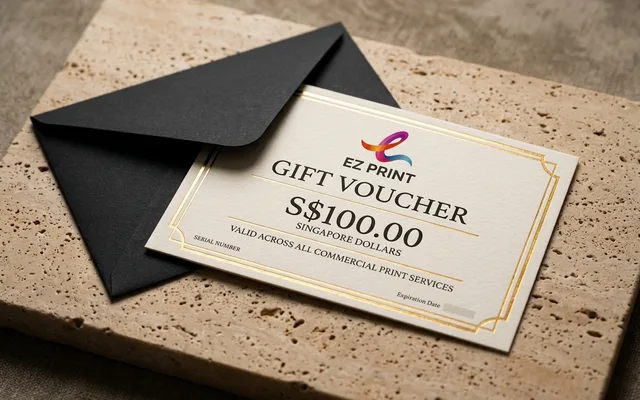
×A voucher with no expiry field and no number. Neither can be added later, and both are what makes a voucher reconcilable.
Sizes and stub arrangements
A ticket is sized by what it has to fit into — a pocket, a wallet, an envelope — and by whether it is torn. Every size below cuts from a standard sheet, so the choice costs nothing but should still be deliberate.
210 × 74 mm
A third of an A4 sheet. The classic event ticket, with room for a stub and an image.
180 × 70 mm
Slightly shorter, fits a jacket pocket and a standard envelope without folding.
DL · 99 × 210 mm
A voucher rather than a ticket. Room for terms on the reverse.
85 × 55 mm
Card-sized vouchers that live in a wallet. No stub at this size.
Stub 45–60 mm
Wide enough to carry a repeated number and a short line of text.
Booked in 50s or 100s
Padded and glued with a card back. Numbers run through the book in order.
Leave the number out of the artwork, and mark the tear line
Two things belong on a separate layer rather than in the design: the perforation, because it is a physical operation, and the number, because it is printed in a pass of its own. Everything else is ordinary card artwork.
The file
Format
PDF/X-4 as one page per side, at the full ticket size including the stub.
Artboard
Trim plus 3 mm bleed on all four sides.
Perforation layer
A dashed line on a layer named PERF, never printed, with the stub width labelled.
Number position
Marked as an empty box, with the typeface, size, colour and alignment stated.
Safe margin
5 mm from the trim and 6 mm from the perforation on both sides.
Numbering scheme
Start value, prefix and digit count supplied with the file, not inside it.
The colour, and the detail
Colour mode
CMYK. A brand colour on a voucher is worth naming as a Pantone reference.
Number colour
A contrasting solid rather than black on a dark ground. It is read under bad light in a hurry.
Rich black
C60 M40 Y40 K100 for large solids, total ink 240%.
Terms text
K100, 6 pt minimum on coated stock. Legible matters more than small here.
Spot UV mark
100% K vector on a layer named SPOTUV. It is invisible on a photocopy, which is the point.
Foil layer
100% K vector named FOIL. Solid shapes only, nothing finer than 0.7 pt.
Send the numbering scheme as a sentence — start value, prefix, digit count, and whether it repeats on the stub — and it is set up and proofed before the run rather than corrected after it.
Turnaround
Two passes after the print, and neither is optional
Standard
Standard turnaround is 7–14 working days.
Standard orders. The schedule for specialist finishing is confirmed in your quotation.
Express
Same-day printing available.
Subject to artwork, stock and production capacity confirmation. Timing is agreed for each job.
What sets the date
Two passes after the print, and neither is optional on a real ticket: the number is printed separately, and the perforation is cut separately. A foil block, a spot UV security mark or a padded book adds another. All of it is quoted inside the standard window.
What a reorder skips
The numbering scheme and the tooling. Say the last number issued and the run picks up from it rather than starting again, and the foil block or die from the first run is already on file.
If the date is tight
Send the size, the stub position, the numbering scheme and the stock, and ask for an express quotation. We confirm the specification, production schedule and next steps in the quotation.
A reorder that continues the numbering from where the last run finished is straightforward — say the last number issued and the run picks up from it rather than starting again.
Every answer here is in the page source at full opacity, open or closed. An answer engine has to be able to read it without executing anything.
Questions asked about tickets and vouchers
Can you print numbered tickets?
Yes. Sequential numbering is a separate printing pass with a stated start value, prefix and digit count, and the same number can be repeated on the stub so a torn ticket still reconciles. It should be specified as a sentence rather than drawn into the artwork.
What size is a standard event ticket?
210 × 74 mm — a third of an A4 sheet — is the most common, with a perforated stub between 45 mm and 60 mm. 180 × 70 mm fits a jacket pocket and a standard envelope, and DL at 99 × 210 mm is used where terms have to be printed on the reverse.
How do I stop tickets being copied?
Sequential numbering is the cheapest and most effective feature, because duplicates become visible on reconciliation. Beyond that, a spot UV mark does not photocopy, and a foil block cannot be reproduced on an office printer. All three can be combined on one ticket.
Where should the perforation go?
Wherever the stub is wanted, with 6 mm of clear space on both sides. A perforation wanders by about a millimetre as it is cut, so type or a number sitting closer than that will be torn through rather than beside.
Can vouchers be printed on tear-resistant material?
Yes, on 200 micron synthetic stock — but not with a tear-off stub, because that material exists specifically to resist tearing. If a voucher must survive weather and still detach, the practical answer is a card voucher in a sleeve.
Can tickets be supplied in books?
Yes. Tickets are padded and glued into books of 50 or 100 with a card back, with the numbers running through the book in order. It is a further pass after numbering and perforation, and it is the usual format for raffle and cloakroom tickets.
Can I continue numbering from a previous print run?
Yes. Say the last number issued and the new run starts from the next one. It is worth recording that number somewhere durable, because a repeated number in a voucher programme is discovered at reconciliation rather than at the counter.
Trading since 2017 — EZ PRINT PRIVATE LIMITED, UEN 201706183R.
Standard turnaround is 7–14 working days. For urgent orders or express schedules, please check with EZ Print.
Artwork is checked before production.
Island-wide courier delivery within Singapore.
Collection can be arranged on request.
Ask for a quote on these tickets
Every job is quoted from its specification — stock, quantity, sides, finish, size and deadline.
Quantity
Stock — or the feel you want, if you do not know the stock