
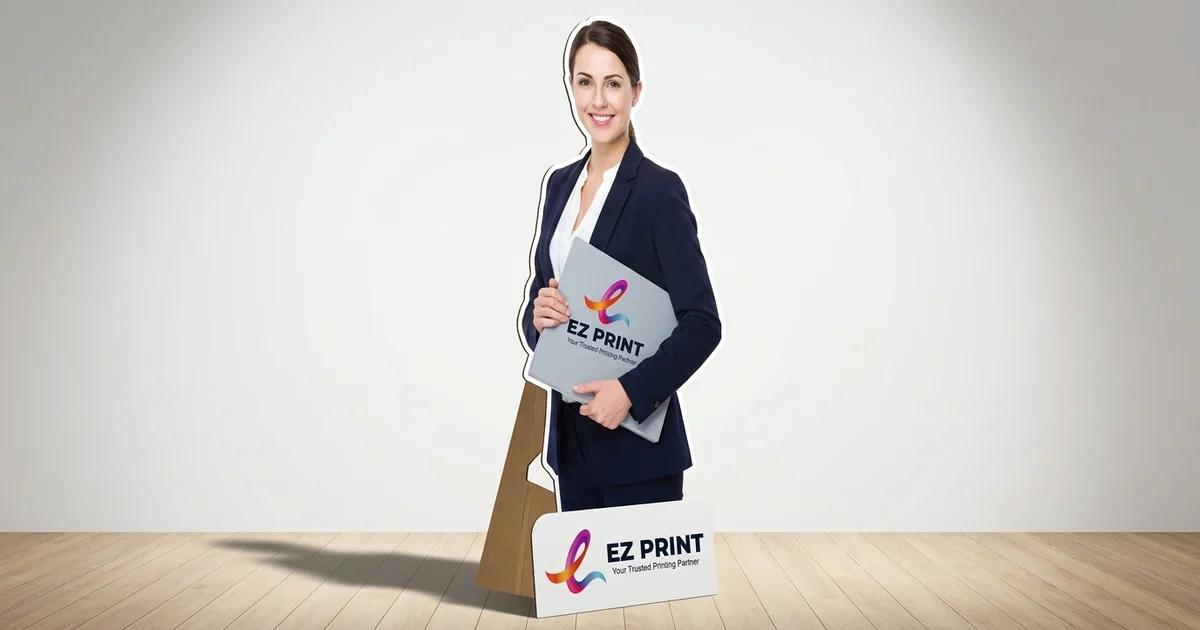
A life-size cutout standee is a printed figure mounted to a rigid panel, cut to its own outline and held up by a folding strut on the back. Most figures are 1600–1900 mm tall, and anything over about a metre needs a base tab as well as the strut. Whether it survives is decided by the cut path: no isolated part narrower than about 30 mm.
This guide is about planning the figure itself: its height, its panel, its outline and how it stands. For rectangular foam boards and standees needed on a tight date, see our urgent foam board and standee guide.
What is a life-size cutout standee?
A life-size standee is a flat object pretending to be a person, a mascot or a product at full size. It has four parts: a printed graphic, a rigid panel, a contour cut to a closed vector path, and a folding strut with a base tab. It takes almost no floor space, and visitors queue to be photographed next to it.
The four parts are specified separately:
- The graphic: printed and laminated, then mounted to the panel, or printed straight onto the board.
- The panel: foam board, foam PVC or fluted polypropylene, chosen by how much handling it must survive.
- The cut path: a closed outline around the figure, supplied as a vector. On a cutout, the outline does more work than the image.
- The support: a hinged strut bonded to the back, usually with a base tab that folds forward under the feet.
Standees suit product launches, cinema and retail foyers, exhibition photo moments and showflats: anywhere a face or a product is worth standing beside. They do not suit an outdoor position, a corridor, or anywhere they can be knocked into a walkway. A standee that has to be weighted, taped and stood back up every morning is a standee in the wrong place.
How tall should a cutout standee be?
Match the height to the person or product it represents and to the space it stands in. Life-size figures are usually 1600–1900 mm, half-height markers 900–1200 mm, and tabletop standees 300–600 mm. About 2400 mm is the practical panel limit before a standee has to be split and joined. The taller it is, the more support it needs.
| Type | Height | Support it needs | Typical use |
|---|---|---|---|
| Tabletop | 300–600 mm | A strut alone is enough | A counter or desk piece |
| Half height | 900–1200 mm | Strut plus base tab | A queue or aisle marker |
| Life-size | 1600–1900 mm | Strut, base tab and, in a busy space, a weighted foot | A figure people stand beside |
| Custom | To about 2400 mm | Confirmed in the quotation | The panel limit before splitting and joining |
| Lead time | All heights | Standard 7–14 working days | Mounting, cutting and strut fitting included |
A tall figure is not always the best answer. A tabletop standee at 400 mm on a counter is easier to place and far more likely to still be there in a month than a full figure in a busy foyer.
Which panel should a cutout standee be made from?
Choose the panel by handling and lifespan, not appearance. Foam board is the lightest panel and suits a standee used once indoors. Foam PVC is stiffer and waterproof, and survives being stored, moved and reused. Fluted polypropylene is for disposable and outdoor work. Say whether the standee will be stored and reused, because that decides it.
| Panel | What it is | Best for | Avoid |
|---|---|---|---|
| Foam board | A paper-faced foam core | One-evening events, indoor photo props | Anything moved more than twice, and anywhere humid |
| Foam PVC | A rigid foamed plastic sheet | Standees kept in a lobby, reused or transported | Very tall thin cuts, which still flex across their width |
| Fluted polypropylene | A hollow twin-wall sheet | Outdoor and temporary standees | Anything premium, and narrow cuts along the flutes |
Foam board dents under a thumb and delaminates if it gets wet, so it is the right panel for a single event and the wrong one for a standee that will be stored. Foam PVC takes a knock without denting through, which makes it the usual choice for a figure that travels between events. On fluted polypropylene, the flutes show faintly through large flat solids and their direction decides which way the panel bends, so the cut has to take the flute direction into account.
Height and panel interact. A 1900 mm figure on foam board flexes across its width, and the strut alone will not hold it, so it folds forward. A full-height figure that will be handled is a foam PVC job.
How do you design a cutout shape that will not snap?
Keep every isolated part of the outline at least about 30 mm wide, and draw no internal corner tighter than about 5 mm, because a cutting blade cannot turn a sharper corner. An outstretched arm, a strap or a raised umbrella below 30 mm snaps the first time somebody picks the standee up.
Every standee that arrives broken broke at the narrowest point of its outline, and that point is usually set by a designer thinking about the photograph. The working rules:
- Minimum feature width: about 30 mm on any isolated element. Widen it, bridge it back into the main shape, or add a backing strip behind it.
- Internal corners: about 5 mm minimum radius. A shape drawn with sharp internal points comes back rounded whether or not that was intended, so draw the radius deliberately.
- The base: keep the foot of the shape wide enough to carry the strut.
- The strut: check that it hides behind the widest part of the shape rather than sticking out beside it.
Reinforcement at narrow points is a finishing operation in its own right: a backing strip behind an arm or another narrow element that would otherwise snap. It is better to plan it than to discover the need when the first standee is lifted.
Can a cutout standee be made from a photograph?
Yes. A photograph of a person or product can be cut to its outline, but the subject must separate clearly from its background, because the background disappears once the figure is cut out. Supply the image at 150 dpi at final size, since a standee is looked at from about a metre, and send the cut path as a vector.
Three things decide whether a photographic cutout looks right:
- The mask. A soft mask around hair or a shoulder reads as a halo at a metre. Give the cutter a clear margin outside the figure rather than drawing the contour hard against it.
- The bleed. Run 5 mm of image outside the cut path all the way round, so a cutting tolerance never shows a white edge.
- The colour. Build in CMYK, and proof skin tones on a life-size figure before a run of several.
If the outline has to be drawn here from the photograph rather than supplied, that is a separate step, and the shape is agreed before the panel is cut, because a cut cannot be undone. Once a cut path is drawn, proved and cut cleanly, it is kept with the approved artwork, so a repeat of the same shape skips the drawing and setup even when the image on it changes.
For the file itself: PDF/X-4 or Illustrator at final size, with the cut path as a single closed path on its own layer named CUT, in a spot colour that never prints. Type that must be read at two metres needs about 20 mm of cap height.
How does a standee stay upright?
A folding strut on the back props the panel, and on anything over about a metre a base tab folds forward under the feet as well. A tall flat panel tips forward before it topples sideways, so the strut alone is not enough at full height. In a busy space, add a weighted foot.
A foam board figure is light enough to feel hollow, which is why an unweighted one can walk across a floor under air conditioning. Where people brush past it, the weighted foot is what keeps it where it was put.
A double-sided standee, with a printed graphic on each face of a heavier panel, is worth it where the figure stands in the middle of a space rather than against a wall. It changes both the weight and the support requirement, so say so at the quotation stage. Most standees are single-sided with a plain back.
Matt lamination suits anything under event lighting, because a gloss standee reflects a spotlight straight back at the room.
Worked example: how would two life-size figures be specified?
An organisation wants two life-size figures for a foyer that will be used at several events and stored in between. Because they will be carried, stored and photographed, the specification below uses foam PVC, matt lamination, a supplied cut path checked against the 30 mm and 5 mm limits, and a strut with a base tab.
Hypothetical planning example. Actual production timing, paper availability, and logistics are confirmed individually upon artwork and specification review.
- Quantity and height: 2 life-size standees, 1750 mm tall.
- Panel: foam PVC, printed film mounted and matt laminated.
- Cut: contour cut to a supplied closed vector path on a layer named CUT, with nothing narrower than 30 mm and no internal corner tighter than 5 mm.
- Bleed: 5 mm of image outside the cut path.
- Support: a folding strut and a base tab on each figure, with a weighted foot for the busier position.
- File: print-ready PDF at final size, images at 150 dpi.
- Date: counted back from the first event using the upper end of the standard 7–14 working day window.
One figure has a raised hand narrower than the limit. The designer widens the hand into the shoulder line instead of adding a backing strip, and the cut path is kept on file for the next set.
Frequently asked questions
How tall is a life-size standee?
Usually 1600 to 1900 mm, matched to the person or product it represents. Tabletop standees run 300 to 600 mm and half-height markers 900 to 1200 mm, and about 2400 mm is the practical limit before a panel has to be split.
What material is best for a cutout standee?
Foam board is the lightest and suits a single indoor event. Foam PVC is stiffer and waterproof, so it suits a standee that will be stored, moved or reused. Fluted polypropylene is for disposable and outdoor use.
How thin can part of a standee be?
About 30 mm on any isolated element, such as an arm, a strap or a raised hand. Anything narrower is likely to snap when the standee is picked up, so widen it, bridge it into the main shape or add a backing strip.
Will a life-size standee stand up on its own?
Yes, with a folding strut and a base tab. Anything over about a metre needs the base tab as well as the strut, because a tall flat panel tips forward, and a weighted foot helps in a busy space.
Can a standee be cut out from a photo?
Yes. The subject needs a clear outline against its background, the image should be 150 dpi at final size, and the cut path is supplied as a vector or drawn and agreed before anything is cut.
How do you order a cutout standee from EZ Print?
EZ Print produces standees and life-size cutouts in Singapore, and has traded since 2017. Every job is quoted from its specification: send the height, the panel, the cut path and whether the standee will be stored and reused. Standard turnaround is 7–14 working days, express is quoted per job, and delivery is by island-wide courier.
See the full specification on our standee printing page. For counter and shelf displays, see point of sale printing, and for a backdrop behind the figure, exhibition stand printing. When the specification is ready, request a quote with the date of the event.
Same-day and urgent printing available. Subject to artwork approval, payment, print type and production availability. Timing confirmed per job.