
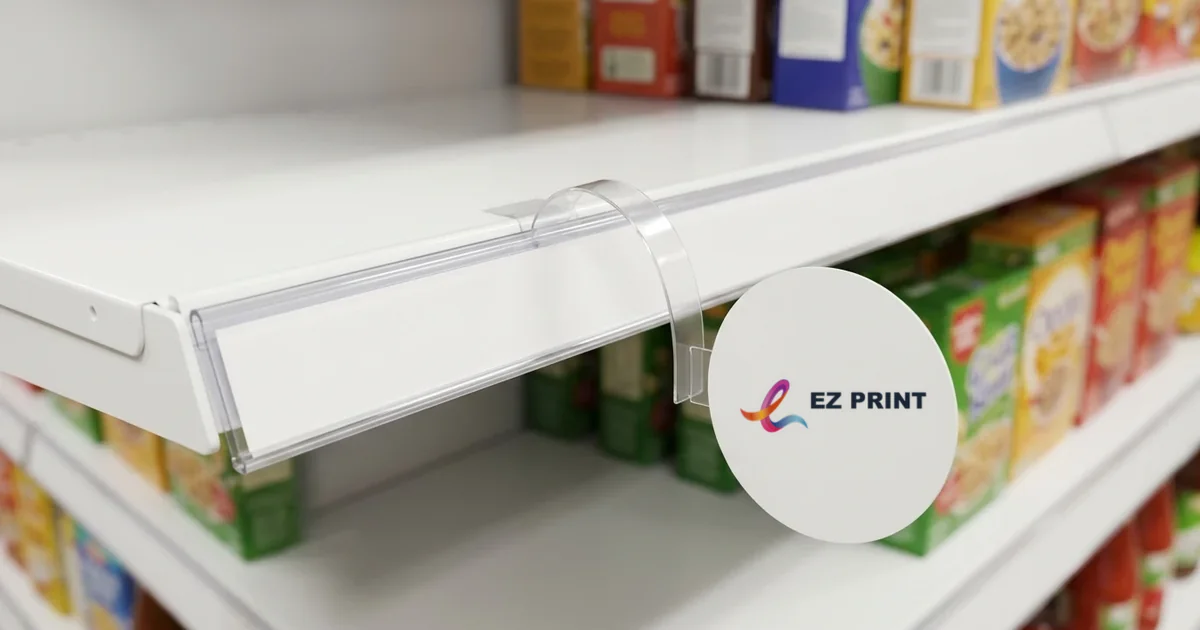
Shelf talkers, shelf strips and wobblers are the printed pieces that work at the shelf edge: a strip runs along the rail, a talker carries a price, an offer or a product claim, and a wobbler is a die-cut shape on a flexible arm that moves as shoppers pass. All three are read at about 600 mm by someone already holding something, so their sizes come from the fixture and their type stays large.
What is the difference between a shelf talker, a shelf strip and a wobbler?
They share a location but do different jobs. A shelf strip is cut to the rail and runs along it. A shelf talker is a printed strip or card on the shelf edge that carries a price, an offer or a product claim. A wobbler is a die-cut shape on a flexible arm, fixed to the shelf edge so that it moves and catches the eye.
| Item | What it is | Working size | What it needs |
|---|---|---|---|
| Shelf strip | A printed strip along the shelf rail | Cut to the rail length; common heights 40–80 mm, printed one side | The rail length and visible height from the retailer |
| Shelf talker | A printed strip or card on a shelf edge carrying a price, an offer or a product claim | Set by the fixture, with dimensions from the retailer | Board stiff enough to stand |
| Wobbler | A die-cut shape on a flexible arm, adhered to a shelf edge | 80–150 mm | A cutting die, and an arm with an adhesive pad |
| Tent card | A creased card that stands on a counter with two or three printed faces | A6 105 × 148 mm or A5 148 × 210 mm folded | 310–400 gsm board, creased before folding |
Buyers use several names for the same pieces. EZ Print’s product list files shelf strip, shelf edge strip, price card, price strip and shelf barker under shelf talker, and shelf wiggler and shelf dangler under wobbler, so any of those names gets the same answer. Table and counter cards are covered in the QR code table tent card guide.
How is a shelf strip sized to the rail?
From the fixture, not from a catalogue. Ask the retailer for the rail length and the visible height, which is usually 40–80 mm, and the strips are cut to that. EZ Print’s point-of-sale page calls a strip that does not match the rail “the single most common retail print failure”, and no proof would show it, because the fault is in the fit rather than the design.
Send the fixture dimensions with the artwork: the rail length for strips, and the bin or gondola size for anything wrapped around a fixture. The point-of-sale page is direct about why: “Retail print fails on fit far more often than it fails on design.”
Strips are printed one side, and the usual sheet for them is gloss art paper, held at 128 and 157 gsm, which the site lists for “Inserts for permanent holders, shelf strips, window bills.” It is light and easy to reprint when a promotion changes, but it will not stand on its own, so a talker that has to stand proud of the shelf edge goes on board instead.
How does a wobbler attach, and why does it need a die?
A wobbler is a printed shape cut by a die, fitted with a flexible arm that has an adhesive pad, and fixed to a shelf edge so that it moves as people pass. The die is what gives every wobbler in the run the same outline. It is made once and kept, so the next promotion using the same shape skips the tooling step entirely.
Two things matter in the shape itself:
- An allowance for the arm. The point-of-sale page lists “A wobbler with no die allowance around the arm” as a failure: the arm pulls through the card and the whole thing ends up on the floor. The shape has to leave room where the arm is fitted.
- One clean outline. The cut is supplied as a closed vector path for the die-cut shape, in a named spot colour, on its own non-printing CUT layer.
The die is also why reusing a shape makes sense. In the site’s words, “Wobbler and shaped-card dies are kept on file, so a second campaign using the same shape with different artwork skips the tooling entirely.” A brand that keeps one wobbler outline and changes only the print inside it gets the reorder benefit every time.
Which stock suits a shelf talker or wobbler?
Retail material is handled by staff, knocked by customers and replaced on a cycle. It needs enough weight to stand and enough surface to survive a wipe, and rarely more than that. EZ Print holds four stocks for point of sale: matt art card, gloss art card, synthetic stock and gloss art paper, each suited to a different position in the shop.
| Stock | Held at | Suits | Avoid |
|---|---|---|---|
| Matt art card | 310, 350 and 400 gsm | “Tent cards, shelf talkers, counter cards, anything on a monthly cycle.” No glare under retail downlights | Anywhere wet |
| Gloss art card | 260, 310 and 350 gsm | Product photography: “Food and drink photography reads noticeably better on gloss.” | Anywhere with a spotlight directly above it. It glares |
| Synthetic stock | Not stated by weight | “Café counters, wash areas, wet markets, anything cleaned daily.” It survives being wiped down, splashed and handled with wet hands | Being recycled with the paper waste |
| Gloss art paper | 128 and 157 gsm | “Inserts for permanent holders, shelf strips, window bills.” | Anything freestanding |
Matt art card is the site’s named “tent card and shelf talker board”, described as “Stiff enough to stand, and it creases cleanly once scored.” Matt or gloss lamination is listed for point of sale, but the glare rule applies to the laminate as well as the sheet: gloss laminate directly under a spotlight makes the card unreadable from the one position customers stand in.
Synthetic stock is not paper, so it does not absorb spills and does not go wavy in humidity. Its ink sits on the surface and wants a moment longer before the pieces can be stacked, which is a handling note rather than a reason to avoid it.
How should shelf talker and wobbler artwork be set up?
Retail print carries one message, set large. EZ Print’s point-of-sale page sets the minimum at 10 mm cap height for anything read at arm’s length, because a shopper reads the piece in about a second and a half, at an angle, under light that is bright, uneven and usually from above. The file then has to say exactly where the piece is cut and where it folds.
- Format: PDF/X-4 at the flat size, with creases and cuts on separate non-printing layers.
- Artboard: the flat sheet plus 3 mm bleed. A folded piece is drawn flat, not as separate panels.
- CUT layer: a closed vector path for any die-cut shape, in a named spot colour.
- CREASE layer: dashed lines with each panel height labelled, on a layer that never prints.
- Safe margin: 8 mm from every trim and 10 mm from any crease.
- Type: 10 mm cap height minimum; body copy at 8 pt on a shelf strip is listed as a failure.
- Contrast: high value contrast, because retail lighting is bright, uneven and usually from above.
- Colour: CMYK, with a Pantone reference for a brand colour that appears across a whole campaign; large black solids as C60 M40 Y40 K100.
- Prices: where prices appear, they are supplied by the retailer and checked against a signed-off list before printing.
- Barcodes: vector, at full size, with quiet zones intact and never across a crease.
For the wider rule that reading distance sets type size, see poster design for real viewing distance.
Should a shelf promotion reprint the piece or refill a holder?
It depends on how often the message changes. Most point-of-sale print is short-life material on a monthly or seasonal cycle, so the specification favours replacement over durability. Where the message changes monthly, the site’s advice is to buy the holder once and print a light insert for it, rather than a standalone piece replaced twelve times a year.
That choice decides the stock. A holder insert can be gloss art paper, because the holder does the standing. A freestanding talker or a wobbler has to stand or hold its shape on its own, so it goes on art card or synthetic stock. Either way, the die for a shaped piece is kept, so a repeat campaign in the same shape skips the tooling step.
Worked example: wobblers and shelf strips for one shelf promotion
Hypothetical planning example. Actual production timing, paper availability, and logistics are confirmed individually upon artwork and specification review. A brand is running a shelf promotion across a set of stores and needs wobblers at the shelf edge and strips along the rail. It plans to reuse the wobbler outline for the following promotion with new artwork, so the die matters as much as the print.
Order specification
- Wobblers: 300 pieces, one die-cut shape within the 80–150 mm working range, on matt art card, with matt lamination, each fitted with a flexible arm and adhesive pad. The shape leaves an allowance where the arm is fitted.
- Shelf strips: 120 strips cut to the rail length the retailer supplies, at a visible height within 40–80 mm, printed one side on 157 gsm gloss art paper.
- Wobbler file: PDF/X-4 at the flat size with 3 mm bleed, the outline as a closed vector path on a CUT layer in a named spot colour, and an 8 mm safe margin.
- Type: headline and offer at 10 mm cap height or larger, one message per piece.
Production sequence
- The artwork, the CUT layer and the retailer’s rail length are checked against the specification before production.
- The wobbler die is made, and kept on file with the approved artwork.
- The strips are cut to the rail length; the wobblers are printed, laminated, die-cut and fitted with arms.
- Standard turnaround is 7–14 working days, with island-wide courier delivery.
- For the next promotion, new artwork goes into the same outline and the run starts from the kept die.
Frequently asked questions
What is a wobbler?
A wobbler is a die-cut printed shape on a flexible arm with an adhesive pad, fixed to a shelf edge so that it moves and catches the eye. It needs a cutting die, which is made once and kept, and the shape needs an allowance around the arm so the arm does not pull through the card.
How tall is a shelf strip?
A shelf strip is cut to the length of the rail in use, and its visible height is usually 40–80 mm. Both dimensions come from the retailer’s fixture rather than from a catalogue, so ask for them before the artwork is set up.
What stock is a shelf talker printed on?
Usually matt art card, held at 310, 350 and 400 gsm, which is stiff enough to stand and has no glare under retail downlights. Gloss art card suits product photography away from direct spotlights, and synthetic stock suits counters and shelves that are wiped down or near water.
How big should text be on shelf print?
Set anything that has to be read at 10 mm cap height or larger. Shelf print is read at about 600 mm, at an angle and under overhead light, by someone who looks at it for about a second and a half, so one large message works better than several small ones.
Is the wobbler die kept for the next promotion?
Yes. Wobbler and shaped-card dies are kept on file, so a later campaign using the same shape with different artwork skips the tooling step entirely and starts from the kept die.
Where can you order shelf talkers and wobblers?
EZ Print prints retail point-of-sale material in Singapore, and has done since 2017: shelf strips and talkers, wobblers, tent cards, counter standees, window graphics and fixture wraps. Every job is quoted from its specification, the dies for wobblers and shaped cards are kept for the next campaign, and artwork is checked before production.
See the point of sale printing page for every item and its working size, and standees for larger freestanding pieces. Send the item, the quantity, the fixture dimensions and the artwork through the quote request page. Standard turnaround is 7–14 working days, express is quoted per job, and delivery is by island-wide courier.
Same-day and urgent printing available. Subject to artwork approval, payment, print type and production availability. Timing confirmed per job.