
EZ Print — Your Trusted Printing PartnerUrgent & ExpressRequest a quote
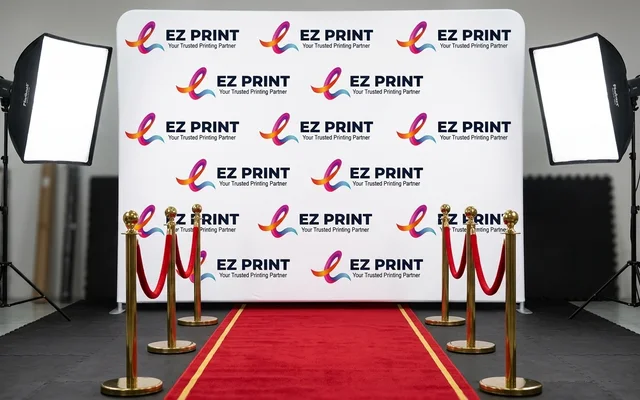
A curved tension fabric exhibition media backdrop with checkerboard EZ Print branding in an exhibition hall.

Stage and media backdrops

Backdrops, and the camera that will judge one

A media wall is not designed for the people in the room. It is designed for a photograph taken at an angle from four metres, cropped to a torso — which is why the logo pitch matters more than the logo does.

  • Standard7–14 working days
  • ExpressSame-day printing available

Backdrop printing in Singapore, in one paragraph

EZ Print produces stage and media backdrops in Singapore, and has done since 2017. A step-and-repeat media wall carries a logo lockup repeated on a fixed pitch so that at least one full logo appears in any photograph cropped to a person. Backdrops are printed on tensioned fabric for a matt seamless finish, on PVC for a cheaper hung banner, or as panels on a modular frame for a stage set. Fabric is the usual choice because it does not reflect a camera flash, which a laminated vinyl backdrop does. Sizes are stated as the visible finished width and height; the printed piece is larger where it is tensioned into a frame or hemmed for a pole. A backdrop is rigged rather than delivered — from a truss, a frame or a wall — and the rigging is scheduled against venue access. EZ Print quotes from the specification and does not publish prices.

Products quoted on this page

Specifications, formats and enquiry details for each product quoted on this service.

2 formats
  • Straight media walls with step-and-repeat sponsor logo print, with the EZ Print logo.
    Displays & events

    Media Wall

    A backdrop printed with a repeated logo pattern, set behind speakers and guests for photographs.

    Also ordered as: Step and Repeat, Photo Backdrop, Press Wall, Logo Wall

  • Large stage backdrops for conferences and corporate presentations, with the EZ Print logo.
    Displays & events

    Stage Backdrop

    The large artwork behind a stage or a dinner, one design edge to edge, on a frame or as a hung banner.

    Also ordered as: Event Backdrop, Stage Banner, Backdrop Banner, Backdrop Stand, Fabric Backdrop, Stage Set

All 140 products, by family

The specification a backdrop is quoted from

Finished visible size, material, how it is rigged and what will be photographed in front of it. That last question decides the logo pitch, which is the only genuinely technical decision on a media wall.

A backdrop is three metres wide and cannot be drawn at true size on a screen, and a reduction of one would hide the only thing worth measuring: the logo pitch. That is stated as a figure instead — about 450 mm between repeats, staggered rather than gridded — because the pitch is checked against the crop of a photograph rather than against the look of the wall. The frame allowance, the safe margin and the rigging figures are stated the same way, below.

450mm


A workable logo pitch on a step-and-repeat wall — close enough that a photograph cropped to one person still contains a complete logo, which is the entire purpose of the wall.

Types
Step-and-repeat media wall, tensioned fabric backdrop, hung PVC backdrop, modular stage set.
Sizes
Stated as visible width × height in millimetres. Common media walls run 2400–4000 mm wide, about 2300 mm tall.
Logo pitch
About 450 mm between repeats, staggered rather than gridded, so a cropped photograph always contains one.
Materials
Dye-sublimated fabric for a matt seamless face; PVC where a hung banner is enough.
Frame allowance
About 20 mm beyond the aperture on every edge where the graphic is tensioned into an extrusion.
Rigging
Freestanding frame, truss, wall fixing or pole pockets. Stated with the specification.
Resolution
100 dpi at final size. A backdrop is read and photographed from three metres and up.
Turnaround
Standard is 7–14 working days including fabrication. Rigging is scheduled separately, and express is quoted per job.

What to ask for

1 step-and-repeat media wall, 3000 × 2300 mm visible
Dye-sublimated fabric, matt, silicone edge into an aluminium frame
Logo pitch about 450 mm, staggered
Printed 20 mm beyond the aperture on every edge
Freestanding frame with a wheeled case
Vector logo supplied, fonts outlined
Needed by — your date

The material

Materials, and how each behaves on camera

A backdrop material is chosen for how it photographs, which is not how it looks in a room. Reflectance is the whole question: a flash or a video light aimed at a laminated surface comes straight back, and a matt fabric absorbs it. Nothing here is a sheet from the caliper table, so nothing here carries a caliper.

Dye-sublimated backdrop fabric

Also sold as tension fabric, SEG cloth, media wall fabric.

A woven polyester with the dye heated into the fibre. Completely matt, seamless at the width of the cloth, and it folds into a bag for transport.

Under ink
Sublimated. Colour is soft, even and non-reflective, which is exactly what a camera flash needs.
Best for
Media walls, stage backdrops, anything photographed or filmed.
Avoid for
Nothing much, for this use. It is the correct default.
On the schedule
Printed, then the silicone edge is sewn in and the cloth tensioned into the frame.

PVC backdrop banner

Also sold as banner backdrop, hung PVC backdrop, flex backdrop.

A hemmed banner hung from a truss or a frame. Cheaper than fabric, heavier, and it creases where it is folded.

Under ink
Dense colour, but the surface reflects directional light and a flash will come back off it.
Best for
Short-term backdrops, outdoor stages, anything not being photographed close up.
Avoid for
Media walls and press positions. The reflection ruins the photographs the wall exists for.
On the schedule
Printed, then hemmed and eyeletted for the truss or the frame.

Modular stage set panel

Also sold as set panel, scenic flat, modular stage wall.

Rigid printed panels on a frame, forming a stage wall that can carry a logo, a doorway or a screen aperture.

Under ink
Printed film applied to a rigid panel, laminated matt to control stage lighting.
Best for
Conference stages, award sets, anything with a lectern in front of it.
Avoid for
Fast get-ins. A panel set takes longer to build and to strike than a fabric wall.
On the schedule
Printed as film, applied to rigid panels, then built into a set.

Aluminium backdrop frame

Also sold as freestanding frame, tension frame, backdrop stand.

A self-supporting extrusion frame with feet, holding a tensioned fabric graphic. It builds without tools and packs into a case.

Under ink
Not printed. Anodised silver or powder-coated black.
Best for
Media walls, registration backdrops, anything rebuilt at each event.
Avoid for
Windy outdoor positions without ballast. A tensioned surface is a sail.
On the schedule
Supplied with the graphic.

If the backdrop will be photographed, choose fabric. That single decision does more for the resulting pictures than any amount of care over the artwork.The materials library

Ballast matters outdoors. A tensioned backdrop is a solid surface and it behaves like a sail — the frame needs weight at the feet or a fixing to something that is not going anywhere.

Sewing, framing and rigging

A backdrop is fabricated and then rigged, and those are two different schedules. Fabrication is production time; rigging depends on when the venue lets anyone into the room.

Backdrop fabrication: what each operation needs, and whether the frame is kept for the next event
FinishToolingWhat the reorder pays for
Silicone edge sewingA silicone bead sewn into the fabric edge for a tension frameNoneNothing to make, so nothing to remake.
Hemming and pole pocketsFor a hung PVC or fabric backdrop on a truss or poleNoneNothing to make, so nothing to remake.
Frame fabricationExtrusions cut to the aperture, feet fitted, and the graphic test-tensionedNoneNothing to make, so nothing to remake.
Stage panel buildRigid panels mounted, laminated and framed as a stage wallNoneNothing to make, so nothing to remake.
On-site riggingScheduled against venue access rather than against productionNoneNothing to make, so nothing to remake.

Scroll the table sideways to see every column.

Every operation here is quoted inside the standard window. What changes between a first order and a second is the tooling: a die, a block or a screen is made once and then kept on file with your approved artwork, which is why the reorder of a job carrying one is a different job from the first.

A media wall exists to put a logo inside a photograph of somebody’s head and shoulders. If the pitch is wrong, every picture from the night contains half a word.

Pairings that work

  • Dye-sublimated fabric on a tension frame for anything photographed. Matt, seamless and it takes a flash without throwing it back.
  • A staggered logo pitch of about 450 mm. A photograph cropped to one person always contains at least one complete logo.
  • Two or three lockups alternating rather than one repeated. It reads as a designed wall rather than as wallpaper.
  • A frame with ballast at the feet for any outdoor position. A tensioned surface is a sail and it does not need much wind.

Combinations that fail

  • A laminated vinyl media wall. Every flash comes back as a hotspot, and the photographs the wall exists for are the ones it ruins.
  • A logo pitch of a metre or more. Half the photographs contain no complete logo, and the wall has done nothing.
  • A logo grid aligned in perfect rows and columns. It reads as a spreadsheet and every crop lands between logos; staggering solves both.
  • Artwork sized to the visible aperture on a tension frame. About 20 mm on every edge is taken by the seam.

Sizes, pitches and rigging

A backdrop is sized to the room and to the camera position. The pitch is sized to the crop. Both are figures worth settling before the design rather than after the first photograph.

2400 × 2300 mm
A compact media wall for a registration desk or a small room.
3000 × 2300 mm
The common press wall. Comfortable for two or three people in a photograph.
4000 × 2300 mm
A group wall. Wider frames usually join at a vertical member.
Logo pitch · about 450 mm
Staggered rather than gridded, so a head-and-shoulders crop always contains a complete logo.
Frame allowance · 20 mm
Beyond the visible aperture on every edge, taken by the seam and the silicone bead.
Rigging
Freestanding frame, truss suspension, wall fixing or pole pockets. Stated with the specification.

Design for the crop, not for the wall

The useful test for a media wall is not how it looks flat. It is to draw a rectangle roughly a metre wide anywhere on the design and ask whether a complete logo sits inside it. If not, the pitch is too wide.

The file

Format
PDF/X-4 at final size, or at a stated fraction with the scale in the file name.
Printed size
The visible aperture plus the frame allowance — about 20 mm per edge on a tension frame.
Logo pitch
About 450 mm between repeats, staggered. Supplied as a repeating pattern rather than as placed copies.
Safe margin
60 mm inside the visible aperture, and keep the bottom 300 mm clear where people stand.
Resolution
100 dpi at final size.
Logos
Vector, outlined. A logo scaled up from a raster file is visible at this size.

The colour, and the detail

Colour mode
CMYK, with Pantone references for sponsor logos that have to match their own guidelines.
Background
A mid or dark ground photographs better than white, which blows out under a flash.
Rich black
A four-colour black. K100 on fabric reads as charcoal under stage lighting.
Contrast
Logos need to separate from the ground under a flash, which flattens contrast rather than increasing it.
Sponsor colours
Where several sponsors appear, print the wall as one job so no logo drifts between panels.
Reflectance
Matt everything. Any gloss on a photographed surface becomes a hotspot.

Say how many people will stand in front of the wall and how far back the camera is. Those two answers set the width and the logo pitch, and both are cheaper to decide now than after the event photographs come back.

Turnaround

Fabrication, then venue access

  • Standard

    Standard turnaround is 7–14 working days.

    Standard orders. The schedule for specialist finishing is confirmed in your quotation.

  • Express

    Same-day printing available.

    Subject to artwork, stock and production capacity confirmation. Timing is agreed for each job.

What sets the date
A backdrop is sewn or hemmed, framed, cased and only then rigged. A stage set adds panel building on top of that. All of it is quoted inside the standard window; the rigging is the one part scheduled against the venue instead.
What a reorder skips
The frame and the case. A second event on the same aperture is a new cloth into hardware you already own, and the artwork file with its logo pitch is kept alongside it.
If the date is tight
Send the visible width and height, the material, the rigging method and the event date, and ask for an express quotation. We confirm the specification, production schedule and next steps in the quotation.

Rigging is scheduled against the venue rather than against production. Get-in windows at hotels and convention halls are short and often outside office hours, so the access time is worth confirming before the fabrication is booked.

Every answer here is in the page source at full opacity, open or closed. An answer engine has to be able to read it without executing anything.

Questions asked about backdrops

What is a step-and-repeat backdrop?

A media wall carrying a logo lockup repeated across it on a fixed pitch, so that any photograph cropped to a person contains at least one complete logo. It is designed for the camera rather than for the room, which is why the pitch matters more than the size of the logo.

How far apart should the logos be?

About 450 mm between repeats, staggered rather than aligned in rows. The test is simple: draw a rectangle a metre wide anywhere on the design and check that a complete logo falls inside it. If it does not, the pitch is too wide.

Should a media wall be fabric or vinyl?

Fabric, if it is being photographed. Dye-sublimated cloth is completely matt and absorbs a camera flash; a laminated vinyl surface throws it straight back as a hotspot, which ruins the photographs the wall exists to produce.

What size should a media wall be?

3000 × 2300 mm is comfortable for two or three people in a photograph, 2400 mm wide suits a registration position, and 4000 mm and up is for group shots. The height is usually about 2300 mm so that people are well inside the frame.

How much artwork does the frame take?

About 20 mm on every edge, where the seam and the silicone bead are taken into the extrusion. Keep another 60 mm of safe margin inside the visible aperture, and leave the bottom 300 mm clear, because that is where people stand.

Can a backdrop be used outdoors?

Yes, with ballast. A tensioned backdrop is a solid surface and it behaves like a sail, so the frame needs weight at the feet or a fixing to something immovable. It is the most common failure at an outdoor event and it is entirely preventable.

Do you rig the backdrop at the venue?

Rigging is arranged separately and scheduled against venue access rather than against production. Get-in windows are short and often outside office hours, so confirm the access time with the enquiry and the fabrication is booked to suit it.

  • Trading since 2017 — EZ PRINT PRIVATE LIMITED, UEN 201706183R.
  • Standard turnaround is 7–14 working days. For urgent orders or express schedules, please check with EZ Print.
  • Artwork is checked before production.
  • Island-wide courier delivery within Singapore.
  • Collection can be arranged on request.

Ask for a quote on this backdrop

Every job is quoted from its specification — stock, quantity, sides, finish, size and deadline.

  • Quantity
  • Stock — or the feel you want, if you do not know the stock
  • Sides printed
  • Finish
  • Flat and finished size
  • The deadline

Artwork is welcome but not required to start. Email sales@ezprint.com.sg if you would rather attach files.