
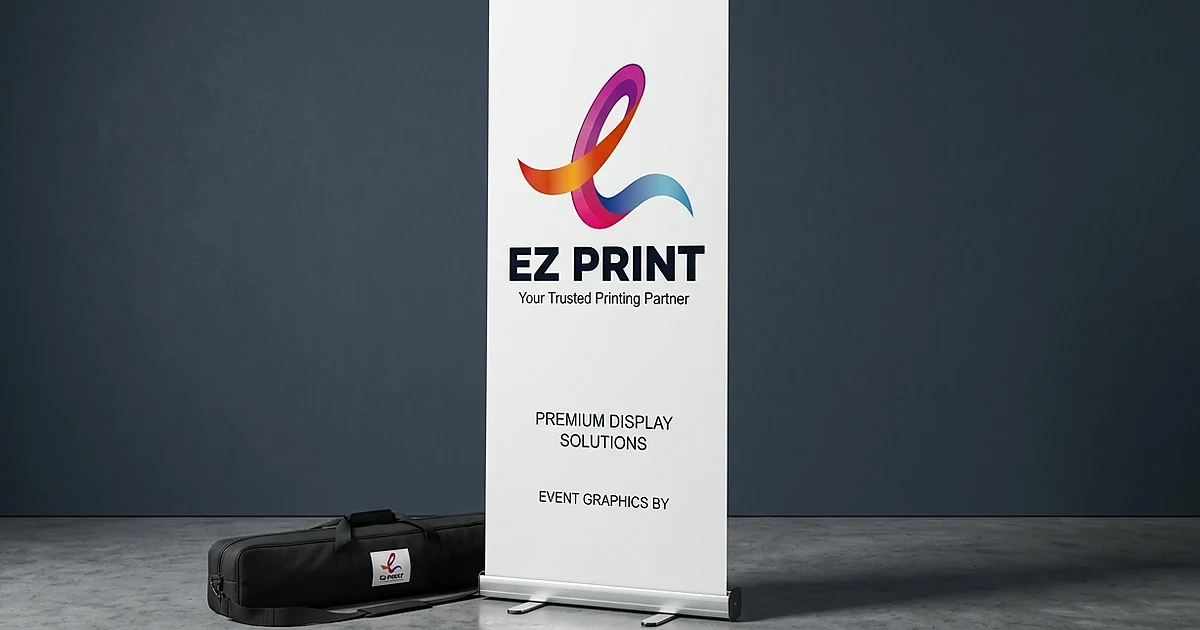
A banner fails far more often from layout hierarchy than from printing: a headline set too small to read across a corridor, a phone number or QR code placed at ankle height where a table or cassette roller hides it, or a border punched through by a metal eyelet. Whether you are ordering retractable pull-up banners, hung outdoor PVC and mesh banners or stage and media backdrops in Singapore, designing for the viewing distance and hardware allowances turns a crowded poster into an effective display.
How do you structure the 3-zone vertical hierarchy on a pull-up banner?
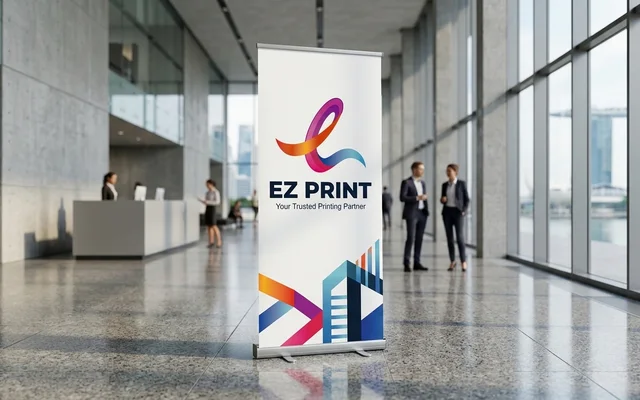
A standard 600 mm, 800 mm, 850 mm or 1200 mm wide by 2000 mm tall pull-up banner is read by people walking past in two to three seconds. Structure the 2000 mm height into three zones — eye-level hook, mid-height proof, and a 150–300 mm bottom buffer kept clear of critical text.
When a visitor walks past an exhibition booth, roadshow table or foyer entrance, their line of sight lands between chest and head height first, while the bottom fifth of the stand sits behind furniture, bags or feet:
- Top Zone (Eye-Level Hook): place the company logo and one primary headline (six to eight words maximum) at the top of the panel where nothing obstructs it.
- Middle Zone (Visual & Core Offer): place the hero product photography, key diagram or three short bullet points at waist-to-chest height, along with any QR code (sized above 25 mm square so a phone camera scans it from two metres away).
- Bottom Zone (150–300 mm Roller & Foot Buffer): extend your background colour or image all the way to the bottom bleed so the cassette wound-in leader never shows white, and keep the bottom 150–300 mm completely free of small text, URLs and QR codes. Compare lightweight stand alternatives on the X-stand banner product page.
What font sizes and resolutions match each banner viewing distance?
Typography on a banner must be sized by physical cap height in millimetres rather than screen point size: allow at least 10 mm cap height at 600 mm reading distance, 20–25 mm at two metres, 40 mm across an exhibition aisle, and 60 mm at five metres.
Use this viewing-distance matrix to set type scale, image resolution and QR code dimensions before laying out your artboard:
| Display Format & Typical Distance | Minimum Type Cap Height | Recommended File Resolution (at 100% Size) | Minimum QR Code & Hardware Allowance |
|---|---|---|---|
Counter display / tabletop standee (600 mm) |
10 mm cap height | 150 to 300 dpi | 20–25 mm QR code; 8 mm safe margin from trim |
Pull-up banner / floor standee (2 m) |
20–25 mm cap height | 150 dpi | 25 mm+ QR code; keep bottom 150–300 mm clear |
Exhibition aisle wall / booth fascia (3–4 m) |
40 mm cap height | 100 to 150 dpi | 60 mm safe margin inside visible frame aperture |
Outdoor PVC / mesh banner (5 m+) |
60 mm cap height | 100 dpi (or 300 dpi at 10% scale) | 30–50 mm hem & eyelet clearance; 10 mm perimeter bleed |
How do hems, eyelets, pole pockets and backdrop frames affect the artboard?
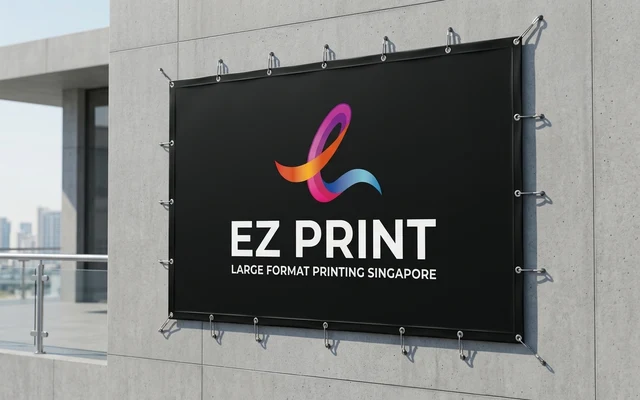
Every hung banner and tensioned backdrop loses part of its outer perimeter to the hardware that holds it flat: allow 30–50 mm of safe margin inside the trim for hems and eyelets on PVC or mesh banners, and allow 20 mm of seam wrap plus a 60 mm inner safe margin on tensioned backdrop frames.
Designing to the visible aperture rather than the raw sheet edge prevents hardware from cutting through logos:
- Outdoor PVC and mesh banners: hems are folded and welded around the perimeter and metal eyelets are punched along the hem. Keep all text, borders and logos 30–50 mm inside the finished trim, and supply 10 mm of perimeter bleed.
- Step-and-repeat media walls (
2400–4000 × 2300 mm): repeat sponsor or brand lockups on a staggered pitch of about 450 mm (never an un-staggered spreadsheet grid) so any photograph cropped to one or two people always frames a complete logo. Keep the bottom 300 mm clear where speakers or guests stand, and choose matt dye-sublimated fabric over laminated vinyl so camera flashes never bounce back as white hotspots. - Colour build for large dark grounds: build large black backgrounds as a four-colour rich black (
C60 M40 Y40 K100, capped at 240% total ink) becauseK100alone prints as dark charcoal under hall and stage lighting. You can check your banner PDF dimensions and DPI before ordering in our interactive artwork preflight checker.
Worked example: designing a matching pull-up banner and media wall set
A conference organiser in Singapore prepares artwork for one 3000 × 2300 mm fabric media wall and four 850 × 2000 mm pull-up banners. Using a 450 mm staggered logo pitch on the wall, 40 mm aisle headlines on the banners and a 300 mm bottom floor buffer keeps every piece legible in person and on camera.
Hypothetical planning example. Actual production timing, paper availability, and logistics are confirmed individually upon artwork and specification review.
The event team checks the files against the specification:
- Media wall (
3000 × 2300 mm): matt dye-sublimated fabric on an aluminium tension frame; artboard includes 20 mm frame allowance on every edge, 60 mm inner safe margin, bottom 300 mm clear, and logos staggered at a 450 mm pitch at 100 dpi in CMYK. - Four directional pull-up banners (
850 × 2000 mm): 40 mm cap-height headlines in the top eye-level zone, session schedule and 25 mm+ QR code in the middle zone, and the bottom 300 mm carrying only the background gradient into the cassette bleed at 150 dpi. - Turnaround: produced within the standard 7–14 working day window with island-wide courier delivery ahead of venue setup.
Frequently asked questions
How should a 2000 mm tall pull-up banner be structured vertically?
Divide a 600–1200 × 2000 mm pull-up banner into three vertical zones: the eye-level hook zone at the top (brand mark and one headline), the core visual and 3-bullet value proposition in the middle, and a bottom buffer where the lowest 150–300 mm is kept clear of small text and QR codes.
What font size should a banner use for different viewing distances?
Match letter cap height to the reading distance: at least 10 mm cap height at 600 mm (counter displays), 20–25 mm cap height at two metres (pull-up banners and standees), 40 mm across an exhibition aisle, and 60 mm at five metres (outdoor PVC banners and wayfinding).
How much margin do eyelets, hems and tension frames take on a banner?
On hung PVC and mesh banners, keep all text and logos 30–50 mm inside the trim so hems and metal eyelets never punch through letterforms, plus a 10 mm perimeter bleed. On tensioned backdrop frames, allow 20 mm beyond the visible aperture for the seam and silicone bead, plus a 60 mm inner safe margin.
How far apart should logos be spaced on a step-and-repeat media wall?
Space repeating logos on a staggered pitch of about 450 mm across a 2400–4000 × 2300 mm media wall so any head-and-shoulders camera crop contains at least one complete logo, and keep the bottom 300 mm clear where people stand.
What resolution and colour mode should large-format banner files use?
Build banner artwork in CMYK colour mode (using a four-colour rich black C60 M40 Y40 K100 for deep dark grounds) at 100 to 150 dpi at 100% scale, or at 300 dpi at 10% scale, exported as a print-ready PDF/X-4.
How do you quote pull-up banners, PVC banners and backdrops with EZ Print?
EZ Print has produced pull-up banners, outdoor PVC and mesh banners, and tensioned fabric backdrops in Singapore since 2017. Send your finished width and height, indoor or outdoor location, hardware or hem/eyelet requirement, quantity and event date. Standard turnaround is generally 7–14 working days with island-wide courier delivery.
When your banner layout is ready, request a quote for a preflight check and written quotation.
Same-day and urgent printing available. Subject to artwork approval, payment, print type and production availability. Timing confirmed per job.