
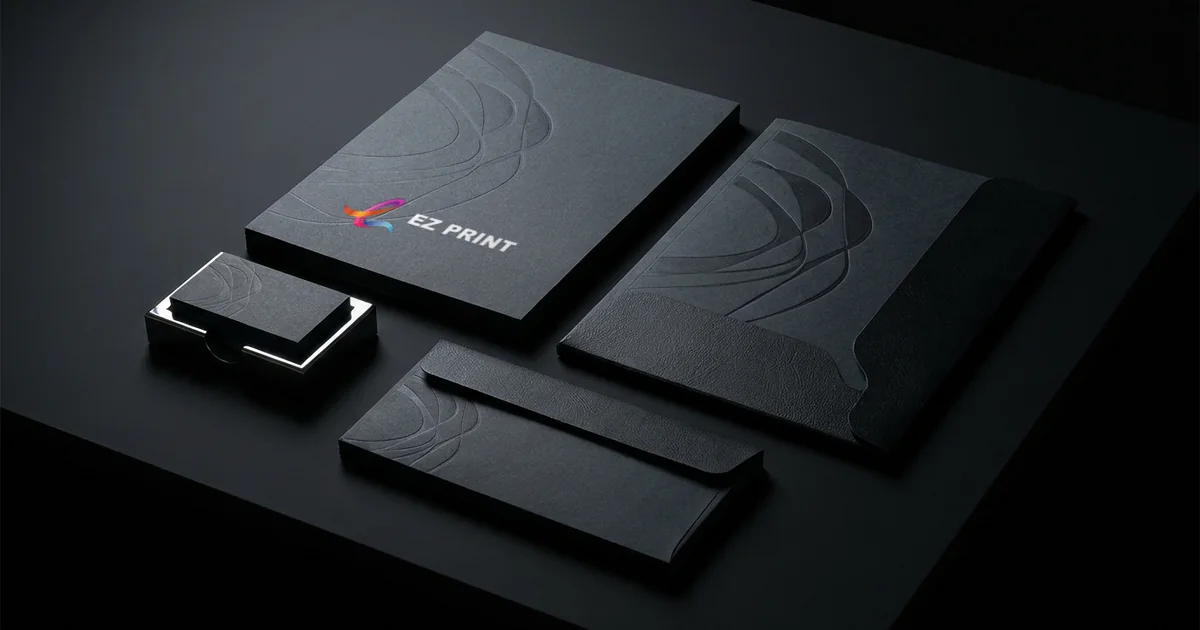
A complete corporate stationery set is usually six pieces: name cards, A4 letterheads, DL compliment slips, DL and C5 envelopes, presentation folders, and NCR bill books for the paperwork that is signed in duplicate. The pieces are a system rather than a list, because each one is sized to the envelope or folder it goes into. Specify them together, on matched stock, and the set reads as one identity.
What belongs in a complete corporate stationery set?
A full set covers the pieces an office hands out, mails and files. Name cards and presentation folders are handed over in person. Letterheads, compliment slips and envelopes carry correspondence. NCR bill books record invoices, delivery orders and job sheets in duplicate. Self-inking rubber stamps complete the set for endorsements and received dates.
Each piece has a different job, and the job sets the specification:
- Name cards. The piece a stranger holds for a few seconds, so weight, edge and surface matter most.
- Letterheads. Designed for a second printer: whatever office printer the letter is eventually typed on.
- Compliment slips. A third of A4, on the same stock as the letterhead so the set matches.
- Envelopes. Bought as made envelopes and printed, rather than cut from a sheet, with the stock matched to the letterhead.
- Presentation folders. A die-cut net that holds A4 documents, often with a slit for a name card.
- NCR bill books. Carbonless sets, numbered and padded into books, where the third copy has to stay legible.
- Rubber stamps. A moulded polymer die in a self-inking housing, made from a supplied vector.
Not every office needs every piece on day one. A new practice may start with name cards, letterheads and envelopes, then add folders and bill books once proposals and invoices are flowing. Ordering the core pieces together still matters, because the stock and colour decisions made on the first order are the ones every later piece has to match.
Which sizes and stocks does each piece use?
Name cards are 90 × 54 mm on 260–600 gsm stock. Letterheads are A4 on 100–120 gsm uncoated woodfree or laid text. Compliment slips are DL 99 × 210 mm. Envelopes are DL 110 × 220 mm and C5 162 × 229 mm. Folders finish around 220 × 307 mm on 300–400 gsm art card, and NCR books are A5 or A4.
| Piece | Size | Stock | Minimum run | Fits with |
|---|---|---|---|---|
| Name card | 90 × 54 mm trim, 96 × 60 mm artboard | 260–600 gsm: matt and gloss art card, uncoated natural, cotton, kraft board, textured papers, bonded duplex | 50 cards | The card slit in the folder pocket |
| Letterhead | A4, 210 × 297 mm | 100–120 gsm uncoated woodfree or laid text | 100 | Folded into a DL or C5 envelope |
| Compliment slip | DL, 99 × 210 mm | The letterhead stock; 300 gsm uncoated where the slip stands alone | Quoted with the set | A DL envelope, flat |
| DL envelope | 110 × 220 mm | Made envelopes, smooth wove or laid to match the letterhead | 100 | An A4 letter folded in three |
| C5 envelope | 162 × 229 mm | Made envelopes, matched to the letterhead | 100 | An A4 letter folded once, or A5 flat |
| Presentation folder | About 220 × 307 mm finished; flat net roughly 460 × 320 mm | 300–400 gsm matt or gloss art card, 350 gsm the usual choice | Quoted from the specification | A4 documents and a name card |
| NCR bill book | A5 148 × 210 mm or A4 210 × 297 mm | Two, three or four plies, each around 50–55 gsm, with a card back | 10 books | 50 sets per book as standard |
| Rubber stamp | Self-inking, up to 60 × 40 mm | Moulded polymer die | 1 | Received-date and endorsement stamps |
The table shows where the pieces depend on each other. The letterhead’s fold is set by the envelope. The compliment slip is set by the DL envelope. The folder’s card slit is set by the name card. That is why the envelope is usually where a stationery set’s decisions start.
How do the pieces have to fit together?
The pieces fit through three links: the letter fold, the envelope window and the folder’s card slit. An A4 letter folds in three for a DL envelope or once for a C5. On a window envelope, the address block on the letterhead has to sit inside the window when folded. A folder pocket can carry a diagonal slit for a name card.
These are the checks that catch a set that does not work as a set:
- Letter to envelope. A DL envelope takes an A4 letter folded in three, or a DL slip flat. A C5 envelope takes an A4 letter folded once, or A5 documents flat.
- Address block to window. The standard DL window is 45 × 90 mm, 20 mm from the left and 15 mm from the bottom. Position the address block on the letterhead against that window with 5 mm of tolerance on every side, because a folded letter shifts slightly inside the envelope. A misaligned block is found when the first letters are folded, and the fix is a reprint of the letter or the envelope.
- Card to folder. A 55 mm diagonal slit in the right-hand pocket, cut by the same die as the folder net, holds a name card. Keep heavy solid artwork clear of the slit, because its cut edges show the white board core.
- Stock to stock. Order the letterhead and envelope together on matched stock. Two batches bought six months apart are two different whites, and the difference shows the moment they sit side by side on a desk.
For a closer look at matching the letter, the envelope and the folder, see the guide to letterhead, envelope and folder compatibility.
What should the letterhead and envelopes specify?
A letterhead is printed twice: once by the printer and again by the office printer it is typed on. That is why it stays on 100–120 gsm uncoated or laid stock, keeps a 10 mm clear margin on all four edges, and is never laminated or coated. Envelopes are printed on the face and optionally the flap, with ink kept clear of the gum line.
The letterhead rules in brief:
- Weight. 100–120 gsm. Heavier sheets jam or curl in most office laser printers.
- Margin. 10 mm of unprinted paper on all four edges, so the office printer can grip and release the sheet.
- Surface. No lamination, coating or varnish, because toner does not bond to a coated surface.
- Colours. One to four colours; spot colours suit a one or two colour identity.
The envelope rules in brief:
- Sizes. DL 110 × 220 mm and C5 162 × 229 mm, window or plain, gummed or self-seal.
- Printing. On the face and, where asked, the flap. Full-bleed envelope printing is avoided because seams and the gum line do not take ink evenly.
The full letterhead specification, including stock choice, margins and file rules, is covered in the guide to corporate letterhead printing and paper. This checklist only needs the letterhead to agree with the rest of the set.
How do name cards, folders and NCR books complete the set?
Name cards carry the identity in the hand, presentation folders carry proposals and tender documents, and NCR bill books carry the day-to-day paperwork. Cards and folders take the heavier stocks and the relief finishes. Bill books are thin carbonless plies, numbered and padded, and judged entirely on whether the last copy is legible.
Name cards. The Singapore standard trim is 90 × 54 mm with 3 mm bleed, on a 96 × 60 mm artboard, with a 4 mm safe margin inside the trim. Stocks run 260 gsm to 600 gsm. The minimum run is 50 cards, though below 100 the setup dominates the job, so 100 is usually the sensible floor. Paper and finish choices for cards are covered on the name card printing page.
Presentation folders. A folder is a flat net cut by a steel rule die, creased and glued. The standard holds A4 documents: about 220 × 307 mm finished, cut from a net of roughly 460 × 320 mm. Pockets are glued or interlocking, around 90 mm deep, and a creased gusset of 5 mm or 10 mm lets the folder hold a thick document and still close flat. The die is made once and kept on file with the approved artwork, so a reorder skips that step. Pocket and gusset choices are explained in the guide to presentation folder pockets.
NCR bill books. A carbonless set is two, three or four plies, each around 50–55 gsm, coated so the pressure of a pen transfers the writing down the set. Books are A5 or A4, padded into 50 sets with a card back and a glued head, and perforated so the top copy detaches. Sequential numbering is printed on every ply of a set, so all copies carry the same reference. Three plies, conventionally white, pink and yellow, is the usual specification. The NCR bill book page sets out ply orders and numbering.
Which finishes belong on which piece?
Finishes follow the job each piece does. Anything fed through an office printer stays unfinished, so letterheads take no lamination, coating or varnish. Relief finishes such as blind embossing, hot foil and letterpress belong on pieces that are never printed on again: name cards, compliment slips and folder covers. Bill books stay plain, with light print over the writing areas.
- Name cards. Lamination, soft-touch, spot UV, hot foil stamping, embossing, letterpress, die cutting and painted edges. The standard turnaround is the same window whether the card is plain or carries foil, embossing, letterpress or a painted edge.
- Letterheads. No lamination, coating or varnish. The relief finishes offered on stationery, namely blind embossing, hot foil stamping and letterpress, belong on the pieces that are never fed through a machine.
- Compliment slips. A blind emboss on the slip and nothing on the letterhead is a reliable pairing: the relief lives on the piece that never meets a second printer.
- Folders. Matt or gloss lamination on the outside face, spot UV, hot foil and blind emboss. Gloss lamination on the inside faces makes documents slide out.
- NCR books. One or two spot colours. Heavy solid ink over a writing area reduces what the lower plies pick up.
Brand colour across different stocks needs one decision up front. Spot colours suit a one or two colour identity on stationery, and name cards are Pantone matched on offset runs and simulated on digital. Uncoated stock shows colour more muted than coated card, so judge the set against the actual stocks rather than a screen.
What should you check before ordering the whole set?
Check the pieces against each other before checking each one alone. Confirm the trim sizes, the envelope that each letter goes into, the window position, the stock shared by the letterhead, slips and envelopes, the finish on each piece, the details printed on every item, and quantities that match how often each piece is used.
- Company details. The registered name, UEN, address, telephone and email are identical on every piece.
- Letterhead stock and margin. 100–120 gsm uncoated or laid, with 10 mm clear on all four edges and no lamination.
- Envelope pairing. DL for an A4 letter folded in three; C5 for a letter folded once or A5 flat.
- Window position. The address block sits inside the 45 × 90 mm DL window with 5 mm of tolerance.
- Matched stock. Letterhead, compliment slips and envelopes ordered as one job so the whites match.
- Name card file. 90 × 54 mm trim on a 96 × 60 mm artboard, with 4 mm kept clear inside the trim.
- Folder net. Artwork drawn at the flat net size, with the dieline on its own unprinted layer and a card slit if needed.
- Bill book scheme. Ply count, ply colours, sets per book and the numbering start value and prefix.
- Stamp artwork. A vector at the finished size, solid black on white, nothing finer than 1 pt.
- Timing. Standard turnaround is 7–14 working days for the whole set. Express is quoted per job.
Worked example: how would a five-piece set be specified for a new office?
Hypothetical planning example. Actual production timing, paper availability, and logistics are confirmed individually upon artwork and specification review. A professional services firm opening a new office needs one consistent set: cards for the team, letter paper and envelopes for correspondence, folders for proposals and bill books for invoices. The firm sends the specification for all five pieces together so the stock and colours are settled once.
The specification is written as follows:
- Letterheads and envelopes: 1,000 A4 letterheads and 1,000 DL envelopes. 100 gsm laid text letterhead and a plain DL window envelope, 2C printed in one Pantone plus black, with a 10 mm clear margin all round on the letterhead and the envelope printed on the face only.
- Name cards: 500 name cards on 350 gsm matt art card, 4C/4C, matt lamination both sides, 90 × 54 mm trim with 3 mm bleed.
- Presentation folders: 500 A4 presentation folders on 350 gsm matt art card, 4C outside and 1C inside, matt lamination on the outside face with gloss spot UV on the logo, and two glued pockets 90 mm deep with a card slit in the right pocket.
- NCR bill books: 50 NCR invoice books, A5 148 × 210 mm, three plies in white, pink and yellow, 50 sets per book with a card back and a glued head, perforated at the head with sequential numbering on every ply.
- Artwork: Each piece as a print-ready PDF; the folder at the flat net size with the dieline on its own layer, and the letterhead address block checked against the envelope window.
- Timing: Standard turnaround is 7–14 working days for the set. A tighter date would be raised as an express quotation, quoted per job.
When the firm reorders, the folder die, the spot UV screen and the checked window position are already on file, and the bill book numbering continues from the last number issued.
Frequently asked questions about corporate stationery printing in Singapore
What is included in a corporate stationery set?
Usually name cards, A4 letterheads, DL compliment slips, DL and C5 envelopes, presentation folders and, for operational paperwork, NCR bill books. Some offices add self-inking rubber stamps. The pieces are specified together so the sizes and the stock match.
What size is a Singapore business card?
The Singapore standard trim is 90 × 54 mm with 3 mm bleed, on a 96 × 60 mm artboard. Name card stocks run from 260 gsm to 600 gsm.
Which envelope fits an A4 letterhead?
A DL envelope, 110 × 220 mm, takes an A4 letter folded in three. A C5 envelope, 162 × 229 mm, takes an A4 letter folded once or A5 documents flat. A DL compliment slip, 99 × 210 mm, fits a DL envelope flat.
Should letterheads and envelopes be ordered together?
Yes, if they are meant to match. Paper whites shift between batches, so pieces bought months apart are visibly different shades on a desk. A matched set is quoted as one job because the stock has to be common to all of it.
How long does a corporate stationery set take to print?
Standard turnaround is 7–14 working days for the whole set, printed envelopes and moulded stamp dies included. Express is quoted per job, so put the required date on the quotation request.
How can EZ Print print the whole stationery set?
EZ Print prints letterheads, envelopes, compliment slips, rubber stamps, name cards, presentation folders and NCR bill books in Singapore, and has done since 2017. A matched set is quoted as one job from its specification, artwork is checked before production, and standard turnaround is 7–14 working days with express quoted per job.
- Business stationery printing: A4 letterheads on uncoated and laid stock, DL and C5 envelopes, compliment slips and self-inking rubber stamps.
- Presentation folder printing: A4 capacity, glued or interlocking pockets, card slits, lamination and spot UV.
- Name cards and NCR bill books, as linked above, complete the set on the same order.
Send the list of pieces, the stock, the number of colours, whether the envelopes have windows and the quantities through the quote request page, and the set is quoted as one job.
Same-day and urgent printing available. Subject to artwork approval, payment, print type and production availability. Timing confirmed per job.