
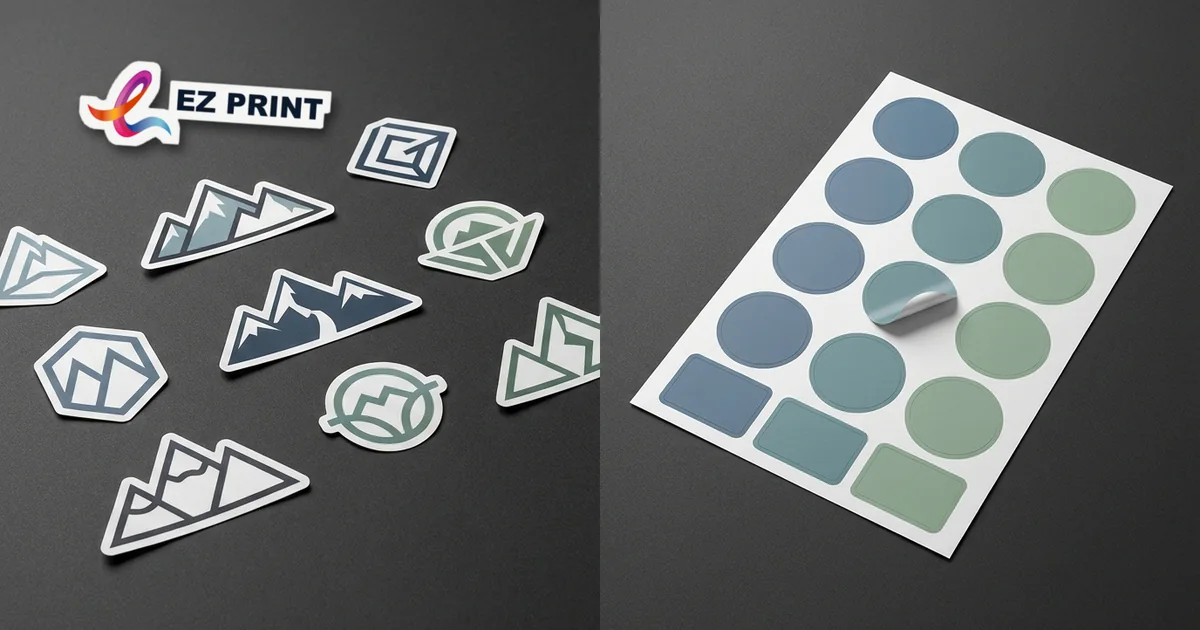
Every printed sheet leaves the press oversized and becomes a finished product only after it is trimmed, stamped, kiss-cut or creased. In Singapore commercial print, understanding how custom die-cut shapes differ from straight guillotine trimming and digital contour cutting prevents cracked folds, torn internal corners and uneven borders.
What are the three methods of paper and board cutting in commercial print?
Commercial print uses three distinct cutting processes: straight-knife guillotine trimming for rectangular sheets and cards, steel-rule die-cutting for custom silhouettes, pocket folders, door hangers and 300–400 gsm folding cartons, and digital blade kiss-cutting or router contour cutting for adhesive labels and 3–10 mm rigid display boards.
Each cutting method is selected according to the substrate thickness, the geometry of the outline and whether the shape will repeat on future orders:
| Cutting Method | What It Cuts | Minimum Corner / Feature Limit | Bleed & Safe Margin | Tooling Kept for Reorders? |
|---|---|---|---|---|
| Guillotine straight trimming | Flyers, booklets, postcards, 90 × 54 mm name cards, A4/A3 placemats | Straight 90° edges only (optional round-cornering pass) | 3 mm bleed; 4–5 mm safe margin (0.5 mm card tolerance) |
No tooling required |
| Steel-rule die-cutting | Custom shapes on 260–600 gsm card, 240 × 89 mm door hangers, 300–400 gsm cartons, 50–297 mm sleeves | 2 mm minimum internal corner radius | 3 mm bleed; 5 mm safe margin from cut or crease | Yes — steel-rule forme kept on file |
| Sticker kiss-cut & die-cut | Paper, vinyl, transparent and foil stickers from 15 × 15 mm up to A3 sheets | 2 mm internal corner radius; 15 × 15 mm minimum piece size | 2 mm bleed outside cut path; 3 mm safe margin inside | Held moulds (54 × 92 mm to 113 × 189 mm) or stored vector path |
| Rigid board contour & V-cut | 3 mm, 5 mm and 10 mm foam board, HIPS and fluted PP standees (80–1180 mm wide) | 5 mm minimum internal radius; 30 mm minimum isolated feature width | 5 mm bleed outside CUT path (1–2 mm tolerance) |
Stored digital CUT vector file |
Why do cutting tolerances make narrow perimeter borders fail?
Mechanical cutting requires a physical running gap and clamp tolerance: roughly 0.5 mm on 90 × 54 mm business cards, 1–2 mm on contour-cut foam boards, and about 3 mm on 50–297 mm packaging sleeves and placemats. A thin border drawn close to the trim turns a tiny shift into a lopsided frame.
When a stack of card or paper moves through a guillotine or die-cutter, the sheet needs a small clearance gap so it does not jam:
- On 90 × 54 mm name cards: registration tolerance is roughly 0.5 mm, so foil, Spot UV or thin frame lines placed within 3 mm of the trim look cut off on some cards and wider on others. Keep a 4 mm safe margin inside the trim.
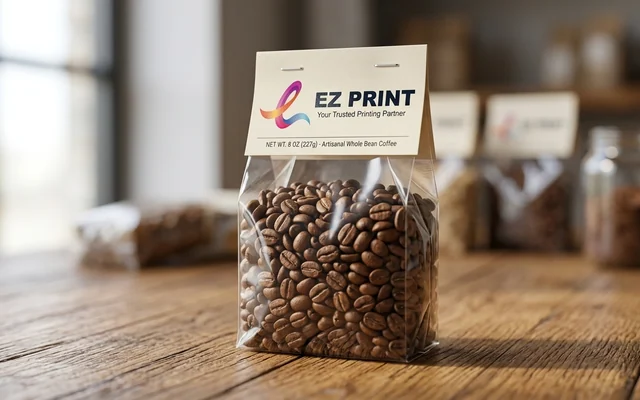
- On 50–297 mm packaging sleeves, bag toppers and A4/A3 placemats: cutting requires up to 3 mm of tolerance. Replace tight perimeter borders with full-bleed background colour extending 3 mm (or 10 mm on large-format sheets) past the cut edge.
How do steel-rule dies, creasing and perforation work together?
A steel-rule die combines sharp cutting blades and rounded creasing rules in one wooden forme, stamping the outer net and pressing fold channels in a single pass. On any coated stock above 170 gsm, creasing before folding is mandatory so the outer coating does not crack along the spine.
When designing custom packaging boxes, presentation folders, tent cards or tear-off vouchers, the die performs three separate mechanical jobs:
- Cutting rules (solid vector line): slice completely through 260–600 gsm card or 300–400 gsm folding boxboard. Because steel strip is bent around a mandrel, draw every internal corner with at least a 2 mm radius so the board does not tear at a sharp vertex.
- Creasing rules (dashed vector line): crush the paper fibre along the fold line without cutting the surface. Above 170 gsm, folding a coated sheet without creasing splits the coating and leaves a rough white crack down the spine.
- Perforation rules: punch a line of micro-slits for tear-off ticket stubs, voucher books and reply slips. See our perforation and scoring specification for tear-line placement rules.
How can you use held die-cut sticker moulds to save tooling time?
For die-cut stickers on Mirrorkote, Simili, Transparent and Metallised Foil stocks, EZ Print offers four held die-cut mould layouts — 1-up (54 × 92 mm), 2-up (113 × 92 mm), 3-up (92 × 172 mm) and 4-up (113 × 189 mm) — allowing custom shapes within those footprints without new die charges.
When ordering die-cut stickers, you can either supply a custom closed vector path on a separate non-printing CUT layer (from 15 × 15 mm up to an A3 sheet) or build your layout inside one of the four held mould footprints (54 × 92 mm, 113 × 92 mm, 92 × 172 mm, 113 × 189 mm), with matt or gloss lamination or sandblast plus Spot UV on metallised foil. You can verify your artboard and bleed dimensions before ordering in our interactive artwork preflight checker.
Worked example: specifying a die-cut promotional card and sticker pack
A retail brand orders 1,000 shaped product hang-cards on 350 gsm matt art card and 2,000 die-cut stickers using the 1-up 54 × 92 mm held mould. Supplying closed vector cut paths on a non-printing CUT layer with 2 mm internal corner radii and 3 mm bleed keeps both runs sharp.
Hypothetical planning example. Actual production timing, paper availability, and logistics are confirmed individually upon artwork and specification review.
The production brief covers both items:
- Shaped hang-cards: 1,000 cards on 350 gsm matt art card, matt laminated both sides, creased and die-cut from a single steel-rule forme with a 2 mm minimum internal corner radius and 5 mm safe margin from every cut and crease.
- Die-cut stickers: 2,000 Mirrorkote stickers with matt lamination in the 1-up 54 × 92 mm held die-cut mould, supplied with 2 mm bleed outside the cut path and 3 mm safe margin inside.
- Turnaround: completed inside the standard 7–14 working day window with the steel-rule die retained on file for repeat campaigns.
Frequently asked questions
What is the difference between guillotine cutting, steel-rule die-cutting and kiss-cutting?
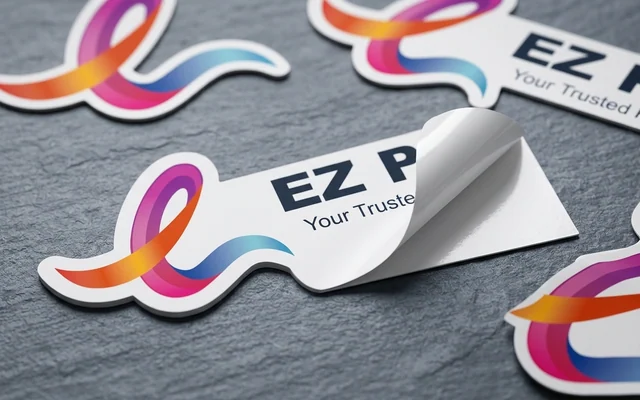
Guillotine cutting trims flat stacks of paper or card along straight 90-degree edges. Steel-rule die-cutting stamps custom outlines, windows, slots and creases through 260–600 gsm card or 300–400 gsm boxboard using a shaped steel blade. Kiss-cutting slices through a sticker face and adhesive without cutting the backing liner.
Why are narrow perimeter borders discouraged on trimmed cards, placemats and sleeves?
Every cutting machine requires a mechanical running tolerance — roughly 0.5 mm on 90 × 54 mm cards, 1–2 mm on mounted foam boards and about 3 mm on 50–297 mm packaging sleeves. A thin border close to the trim makes any sub-millimetre shift visibly uneven.
What is the minimum corner radius and size for a die-cut shape?
On stickers, card windows and packaging nets, internal corners require a minimum 2 mm radius because a blade or steel rule cannot turn a sharp point without tearing the stock, and the smallest die-cut sticker is about 15 × 15 mm. On rigid contour-cut standees, minimum internal radius is 5 mm and minimum isolated feature width is 30 mm.
Are held die-cut moulds available without custom tooling?
Yes. For die-cut stickers on Mirrorkote, Simili, Transparent and Metallised Foil stocks, held mould sizes include 1-up (54 × 92 mm), 2-up (113 × 92 mm), 3-up (92 × 172 mm) and 4-up (113 × 189 mm). Custom steel-rule dies are made once from your vector path and kept on file for reorders.
Why must coated paper above 170 gsm be creased before folding?
Above about 170 gsm, the outer coating on a folded sheet is under enough tension to crack along the spine and show a white split line. Pressing a crease channel into the board before folding crushes the fibre cleanly along the fold.
How do you quote custom paper cutting and die-cut printing with EZ Print?
EZ Print has produced guillotine-trimmed collateral, steel-rule die-cut packaging, shaped cards and kiss-cut labels in Singapore since 2017. Send your flat dimensions, stock weight, vector `CUT` or `DIELINE` file, finishing choice and quantity. Standard turnaround is generally 7–14 working days with island-wide courier delivery.
When your dieline or cut path is ready, request a quote for a pre-press check and written quotation.
Same-day and urgent printing available. Subject to artwork approval, payment, print type and production availability. Timing confirmed per job.