
Every glass graphic in Singapore starts with two questions that come before the artwork: what must the glass do (provide office privacy, display a street-facing promotion while keeping the view out, reduce sun glare, or hold a removable car or door decal), and which side of the glass is it read from? Those answers choose between frosted film, printable solar film, perforated one-way vision and static cling decals. For full specifications and enquiries, see window sticker printing.
Frosted film, solar film, one-way vision or static cling: which glass material fits?
Choose frosted film for office partition privacy with printed or cut logos, one-way vision for street-facing shop windows that must keep the view out, printable solar film for sun-facing glazing, and static cling decals for parking permits or seasonal notices that hold without adhesive and peel off cleanly.
| Glass Material | Width per Panel / Standard Sizes | How It Behaves on Glass | Typical Application |
|---|---|---|---|
| Printed frosted film | 148 to 1220 mm wide (tiled with 25 mm overlap beyond) | Frost reads grey; colour is translucent unless white-backed | Meeting room partitions, clinic doors, privacy bands |
| White-frost film | 148 to 1220 mm wide | Grey or white frost background with optional white backing | Reception glazing and shopfronts needing bright frost |
| Ready-patterned frosted film | 1200 mm wide | Pattern is in the film; no ink printed | Plain privacy runs on office or bathroom glazing |
| Printable solar window film | 148 to 1220 mm wide | Full-surface print, white or frost (no clear areas left) | Sun-facing windows compared on VLT, UVR and IRR percentages |
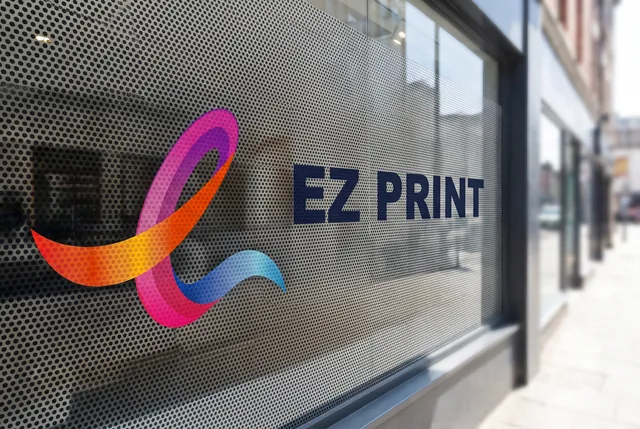
| One-way vision film | 152 to 1320 mm wide, or A4, A3, A2, A1, A0, 2A0 | Perforated film; graphic faces out, view out is kept | Street-facing retail glazing and vehicle windows |
| Static cling decal | 50 to 900 mm wide; car clings 90 × 54, 115 × 120, 130 × 170, 90 × 420 mm | Holds without adhesive; requires 5 mm clear border | Car window decals, parking labels, movable retail notices |
| Cut frosted vinyl | Lettering weeded from 25 mm height and 2 mm stroke | Cut and weeded frosted film with no ink | Etched-look room names, numbers and door logos |

For solid-colour PVC decals and outdoor equipment markings, see vinyl sticker printing and large-format printing.
Face-in, face-out or both-side view: how does the viewing side change the print?
A sticker applied to the outside of a pane and read from outside is printed direct (face out). A sticker applied inside a shopfront or car windscreen and read through the glass from outside is reverse printed (face in) with a white ink base laid behind the colour. Double-sided clings print colour on both faces around a white or blockout layer.
Getting the viewing side right prevents a graphic from reading backwards on installation day:
- Supply artwork right-reading: never mirror your file yourself for an inside-mount reverse print; state the viewing side on your brief and prepress mirrors the print layer.
- White backing on frosted and clear film: on clear clings and printed grey frost, white is not automatic. Draw every area that must read opaque on its own named vector white layer, and leave clear or frosted background areas empty in the file.
- Blockout for double-sided clings: on a standard clear double-sided cling (such as a 90 × 54 mm, 115 × 120 mm, 130 × 170 mm or 90 × 420 mm car cling, or square templates from 80 × 80 to 120 × 120 mm), pale colours look translucent when backlit; specify a blockout static cling when both faces must read completely solid.
For transparent label artwork setup, read our guide to transparent sticker printing with white ink.
What are the artwork and sizing rules for window graphics?
Send vector PDF or Illustrator files with all fonts outlined, white on its own named layer, and a 5 mm clear border inside the cut line on every static cling. For panes wider than 1220 mm on frosted or solar film (or 1320 mm on one-way vision), panels are tiled with a 25 mm overlap at each join.
Check these detail thresholds before exporting your file:
- Static cling type and QR codes: keep type at 8 pt (3 mm) and QR codes over 15 mm square on fine-detail clings, or 14 pt (5 mm) and QR codes over 20 mm square on standard clings.
- Cut frosted lettering: keep letters above 25 mm high with strokes above 2 mm thick so the background weeds cleanly and transfers on application tape.
- One-way vision overlaminate: specify the clear overlaminate on exterior perforated window film so rain and dust do not fill the perforations and blur the view out.
Worked example: how would an office and retail unit specify window stickers?
A clinic opening a ground-floor unit needs street-facing graphics that let staff see outside, frosted privacy bands with a solid logo across internal consulting-room glass, and removable parking clings for staff cars. Specifying laminated one-way vision, white-backed printed frosted film and reverse-printed 90 × 54 mm static clings covers all three panes.
Hypothetical planning example. Actual production timing, paper availability, and logistics are confirmed individually upon artwork and specification review.
The clinic manager prepares the glass schedule pane by pane:
- Street-facing shopfront (two panels, 1320 mm wide each): perforated one-way vision film with clear overlaminate, split into two vertical panels with a 25 mm overlap, applied to the exterior face.
- Internal glass partitions (two panes, 1180 × 600 mm each): printed frosted film in grey with the clinic logo backed in white ink so the mark reads solid at eye level.
- Staff car window clings: 90 × 54 mm reverse-printed static clings (face out through the windscreen) with a white base, a 5 mm clear border inside the cut line, and text above 8 pt (3 mm).
Timing. All three items are produced inside the standard 7–14 working day window; the static clings are applied by hand on arrival, while fitting for the wide partition and shopfront films is scheduled against site access.
Frequently asked questions
What is the difference between printed frosted film and white-frost film?
Standard printed frosted film reads grey on the glass, and colour printed on it stays translucent unless white ink is backed behind it. White-frost film lets you specify a grey or white frosted background with optional white backing so light brand colours read opaque.
When do I need a reverse-printed window sticker?
Specify reverse printing with a white base whenever the sticker is applied to the inside face of a window or glass door and read from the outside through the glass. Supply your artwork reading the right way round; mirroring is done in prepress.
How does one-way vision window film work?
One-way vision is a perforated film (152 to 1320 mm wide, or A4 to 2A0) printed on the outward-facing side so passers-by see the graphic from the street while people inside keep their view out. Adding a clear overlaminate seals the perforations against rain and dust.
Why does a static cling decal need a 5 mm clear border?
Static clings hold to clean glass without adhesive, and the 5 mm unprinted clear border inside the cut line is what grips the glass so the edge does not lift.
How wide can a single panel of window film be?
Printed frosted and solar films run from 148 to 1220 mm wide per panel, ready-patterned frosted film is 1200 mm wide, and one-way vision runs from 152 to 1320 mm wide. Glass wider than one panel is tiled with a 25 mm overlap at each join.
How do you get a quote for glass and window stickers from EZ Print?
EZ Print prints glass and window stickers in Singapore, and has traded since 2017. Send your pane widths and heights, the material (frosted, white-frost, solar, one-way vision or static cling), which side of the glass the sticker goes on and which side it is read from. Standard turnaround is generally 7–14 working days, with island-wide courier delivery.
When your pane measurements are ready, request a quote to confirm your specification and schedule.
Same-day and urgent printing available. Subject to artwork approval, payment, print type and production availability. Timing confirmed per job.